Youth Social Media Bans Are Becoming the New Moral Consensus
As trust in platforms collapses, governments are choosing exclusion over redesign.
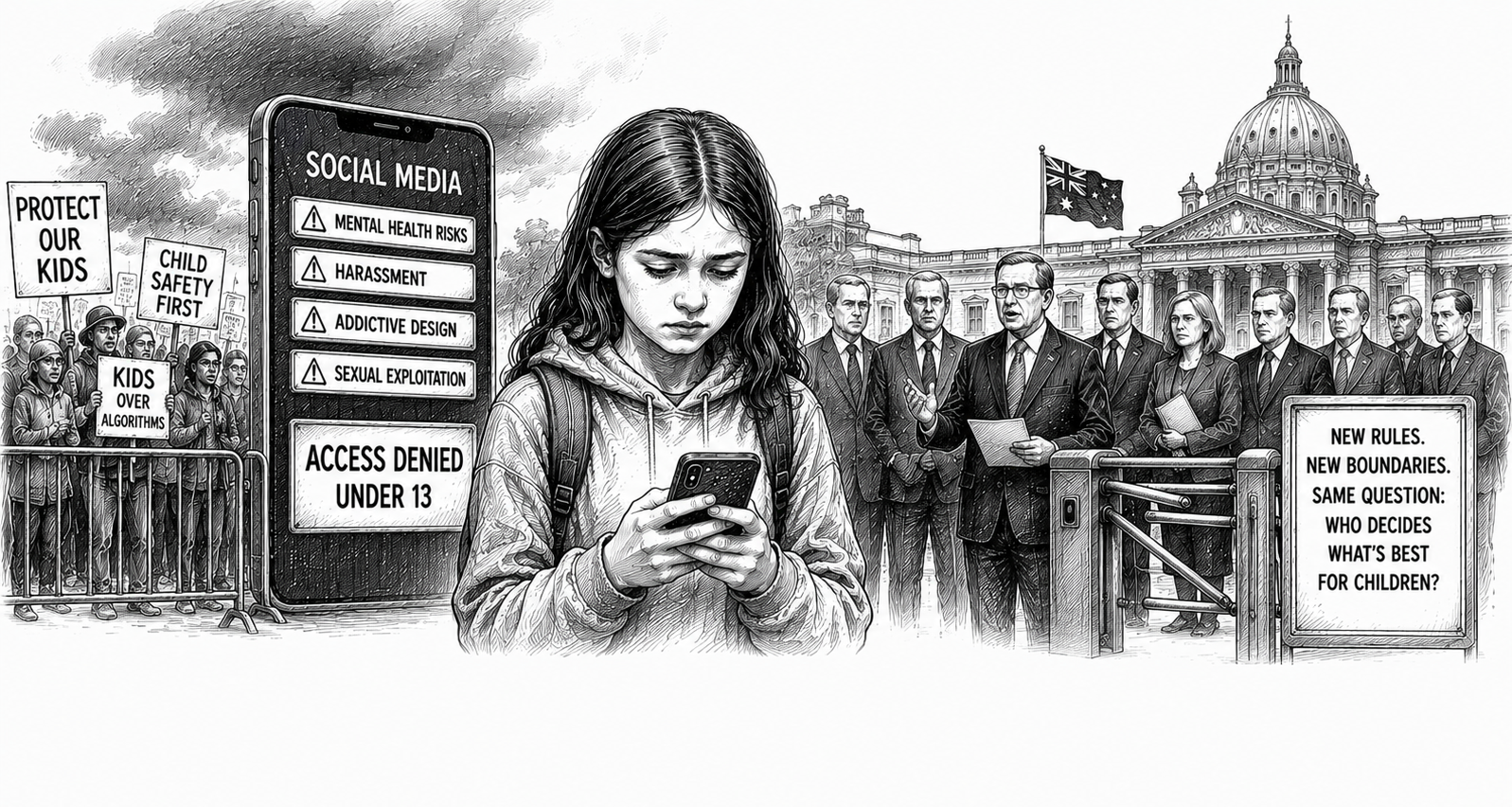
Dan Milmo reported for The Guardian on June 28 that youth social-media bans are approaching a global tipping point, with Australia, Indonesia, Malaysia, Austria, France, Norway, Brazil, and the United Kingdom all moving toward stricter age rules. Days earlier, Reuters reporters Andreas Rinke and Linda Pasquini reported that a German expert panel recommended banning children under 13 from social media and creating stronger protections for older teens.
Age gates are becoming a proxy for platform failure. Governments are no longer treating youth access as a design problem that can be solved through content moderation, parental controls, or industry commitments. They are treating it as a harm category that can be restricted before the platform is repaired. That shift changes the social meaning of being online as a child. Access is being reclassified from participation in public life to exposure to risk.
The mechanism is trust collapse. For years, platforms argued they could manage youth safety through product design, privacy settings, and voluntary codes. Regulators are increasingly responding that those tools have not worked at the scale required. Once that belief hardens inside enough governments simultaneously, the policy move stops being reform and becomes removal. The state is stepping into a space platforms once governed through their own terms of service.
Child safety gives governments a justification that crosses political systems that usually cannot agree. The policy details differ — minimum ages, verification methods, parent-linked accounts, tiered protections for teenagers — but the direction is shared: platforms lose some discretion over who can enter and under what conditions. That is a real redistribution of authority from company product decisions to state regulation.
The enforcement architecture will determine who actually bears the next cost. Strong age verification can create privacy risks and build surveillance infrastructure as a side effect of child protection. Weak verification makes bans symbolic. Parent-linked account systems can help households with resources and attention while leaving more vulnerable children with the same exposure they had before. A policy aimed at protecting children can produce a new gatekeeping layer depending on how identity verification is built.
Governments are accepting those tradeoffs because platform credibility is depleted. The industry’s promise to self-correct has not held up against years of evidence on mental health, harassment, addictive design, and sexual exploitation risks. When the designer loses public trust, the regulator starts designing the boundary.
Bans have found the politically easy sentence: children should be protected online. The harder sentences are about who verifies age, who stores identity, who controls access, and what counts as harm when a teenager wants to see news, connect with friends, or find community. Moral consensus travels fast. Technical and civil-liberties costs arrive later.