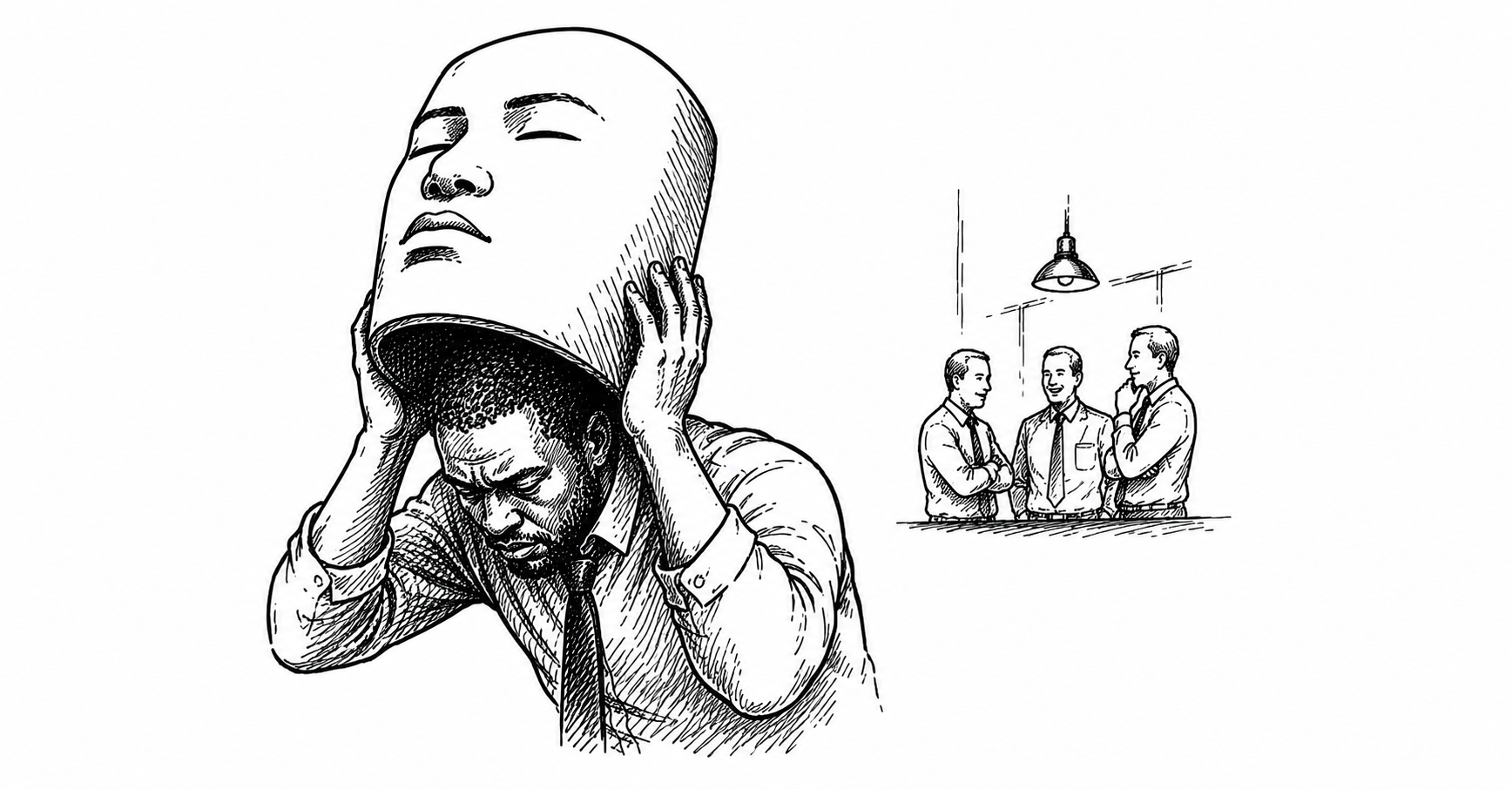
Performing Strength Is Killing Black Men. The Research Knows Why. The Institutions Don’t.
A 2026 study names the specific mechanism: for Black men navigating workplaces shaped by racial stress, the performance of strength is an adaptive strategy — and that strategy makes crisis invisible until it’s too late. Understanding it as an environmental pattern changes what an institutional response would look like.
In American public life, the conversation about mental health has expanded significantly since 2020. Campaigns, workplace initiatives, public figures sharing their experiences — the cultural permission to acknowledge struggle has grown in ways that were not true a decade ago. That expansion has reached Black men at a fraction of the rate it has reached the general population. A 2026 study from Adams et al., published through the Suicide Information and Education Resources database, makes a specific argument about why — and the argument is worth taking seriously.
The research focuses on Black men at risk of suicide and the role that racialized masculinity expectations play in shaping their help-seeking behavior. The finding is not that Black men don’t experience mental health crises. It is that the conditions under which those crises develop include a specific adaptive pressure: the demand to perform strength, stability, and composure in environments that are already racially stressful — and that this performance becomes, for many men, the thing that makes deterioration invisible until the point of crisis.
THE DOUBLE BIND
The research identifies a pattern that operates at two levels simultaneously. In workplace settings, Black men are frequently perceived as hypermasculine — expected to be physically and emotionally durable in ways their non-Black peers are not expected to match. At the same time, expressions of vulnerability, frustration, or distress are disproportionately penalized when they come from Black men. The result is a double bind: perceived as stronger than you are, and punished more severely when you aren’t.
The adaptive response to this environment is performance — learning to present composure regardless of internal state, to manage the perceptions of coworkers and supervisors, to be the version of yourself that the workplace is prepared to accommodate. This is not unique to any individual. It is a documented pattern of identity work that Black men navigate in predominantly White professional environments, and it has a cost that compounds over time.
The cost is clinical. Men who have learned to perform strength in environments that require it do not easily shift into the disclosure mode that mental health intervention requires. Seeking help involves admitting need. Admitting need runs against a performance that has been necessary for professional survival. The therapy intake, the call to a crisis line, the conversation with a manager about struggling — each of these requires a version of vulnerability that the work environment has been systematically teaching against.
WHAT INSTITUTIONS HAVE NOT DONE
The mental health infrastructure in the United States was not built with this dynamic in mind. Therapy models, employee assistance programs, and crisis intervention frameworks were developed primarily from research on majority-White populations and operate on assumptions about disclosure, help-seeking, and access that do not hold evenly across racial and cultural contexts.
Black men are underrepresented in therapy not because they are not struggling but because the therapeutic model asks for something the environment has been training them to withhold. Employee Assistance Programs — the most common institutional mental health benefit — typically require an employee to self-identify as struggling and initiate contact. That design places the entire burden of the first step on the person whose environment has taught them that first step is dangerous.
Institutions have largely not redesigned their mental health offerings to address this. They have added awareness messaging, changed the language of their campaigns, and updated their resource guides. What they have not done is change the condition that makes disclosure feel like a professional risk — or build intervention models that don’t depend on self-disclosure as the entry point.
WHAT UNDERSTANDING THE MECHANISM WOULD CHANGE
The value of the Adams et al. research is that it moves the frame from individual mental health to environmental design. If the performance of strength is an adaptive response to a racially stressful environment, then the intervention point is not only the man in crisis — it is the environment producing the stress that makes performing strength necessary. Workplace cultures that penalize visible vulnerability for Black men while extending latitude for it to others are not neutral contexts. They are producing a specific outcome.
That reframe changes what a meaningful institutional response looks like. It is not a better EAP brochure. It is a reckoning with what the workplace is asking Black men to be — and what that asking is costing them.
— Social Storytellers Collective covers the gap between the data and the life inside it.