Paramount-Warner Cleared One Gate. The Bigger Question Is Who Gets to Own the Culture Stack.
The Justice Department signed off on a $111 billion merger. The harder fight over who actually controls it is just getting started.
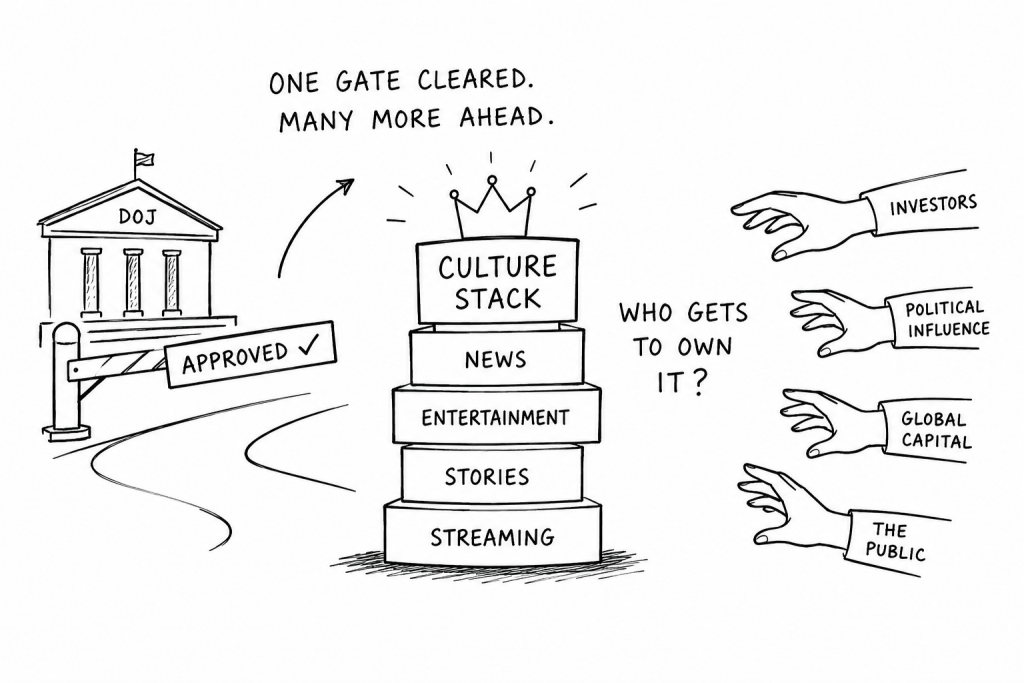
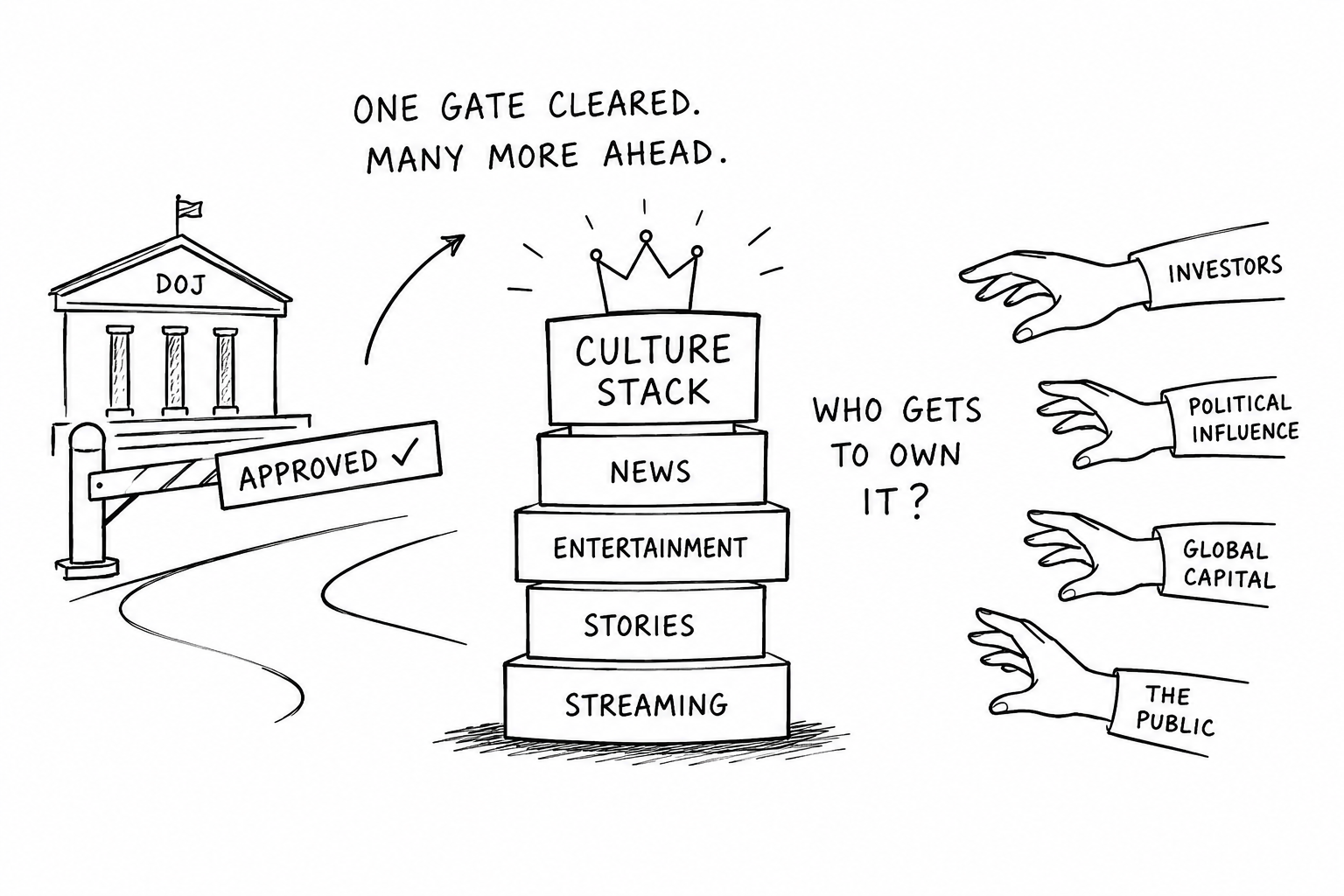
The Justice Department approved Paramount Skydance’s proposed $111 billion acquisition of Warner Bros. Discovery on June 12, concluding its antitrust investigation found the deal “is not likely to result in harm to competition or American consumers.” The merger unites Paramount, owner of CBS, with the considerably larger Warner Bros. Discovery, whose holdings include HBO, CNN, TNT, and the Warner Bros. film studio. Paramount described the deal as “pro-competitive,” positioning the combined company to compete “against dominant technology platforms in an industry increasingly defined by intense competition for audiences, talent, technology, and investment.” The companies plan to merge their streaming services, Paramount+ and HBO Max, into a single platform once the deal closes, which both sides are targeting before the third quarter ends.
The DOJ’s approval is one gate among several, not the finish line. The deal still requires sign-off from European regulators, who set a provisional July 14 deadline to review the transaction under the EU’s Foreign Subsidies Regulation — a review specifically scrutinizing the roughly $24 billion in financing coming from the sovereign wealth funds of Saudi Arabia, Qatar, and the United Arab Emirates. Once the merger closes, those three funds will collectively own 38.5% of Paramount Skydance, though without voting shares attached to that stake. California Attorney General Rob Bonta has said his office’s independent antitrust investigation continues regardless of the federal approval, posting that the merger “is not a done deal.” Senator Elizabeth Warren went further, calling the DOJ’s clearance “terrible news for every American who doesn’t want Trump-aligned billionaires to control what they watch and how much they pay,” and urging state attorneys general to block the deal outright.
Warren’s framing points to the part of this deal that antitrust review doesn’t directly examine: political proximity. Paramount Skydance CEO David Ellison told CNBC he is “incredibly grateful for the relationship” he has with Trump, and the same administration coordinated a separate deal allowing Ellison’s father, Larry Ellison, to acquire a significant ownership stake in TikTok under the foreign-adversary divestment law. Neither fact establishes that the DOJ’s antitrust analysis was compromised — the department’s statement focused narrowly on competition and consumer harm, which is what antitrust law actually governs. But it does mean a transaction reshaping who controls CBS News, CNN, HBO, and the Warner Bros. film catalog is closing at a moment when the company’s leadership has an unusually direct relationship with the administration approving adjacent media transactions, and critics are treating that proximity as relevant context even though it sits outside the DOJ’s legal authority to weigh.
The opposition extends beyond elected officials. Every major Hollywood labor guild has raised concerns about the merger, alongside Cinema United and thousands of industry professionals, with worries centered on job losses, content consolidation, and reduced competition for buying and distributing creative work. WBD shareholders approved the deal in April despite that opposition, also voting to reject a roughly nine-figure golden parachute payout for outgoing CEO David Zaslav — a sign that even shareholders benefiting financially from the sale drew a line at rewarding the executive overseeing it. Paramount has agreed to a $7 billion breakup fee if regulatory approval ultimately fails, on top of a separate $2.8 billion fee already owed to Netflix after WBD walked away from an earlier acquisition agreement with that company in February.
What the DOJ’s approval actually settles is narrow: whether combining two major media companies’ market share crosses a legal threshold for anticompetitive harm. What it doesn’t settle is the broader question critics are actually raising — whether a small number of increasingly interconnected media, technology, and political relationships are consolidating control over what gets produced, distributed, and watched, regardless of whether any single transaction technically violates antitrust law. Power in this deal is moving toward a combined entity backed partly by foreign sovereign capital and led by executives with direct access to the federal government reviewing their transaction, and away from the individual networks, unions, and regulators whose objections didn’t block the deal’s federal approval, even if some of those objections may still shape its final terms in Europe or in state courts.
— SSC Culture Desk | Social Storytellers Collective
Free, daily structural analysis like this lands in your inbox every weekday morning. Subscribe: https://246481934.hs-sites-na2.com/newsletter