
Newark Lost Transit Access Before the Workers Who Needed It Most Could Find New Jobs
NJ Transit service cuts reduced the geographic reach of low-income job seekers in one of the most transit-dense regions in the country. The labor market data doesn’t show it because it isn’t designed to.
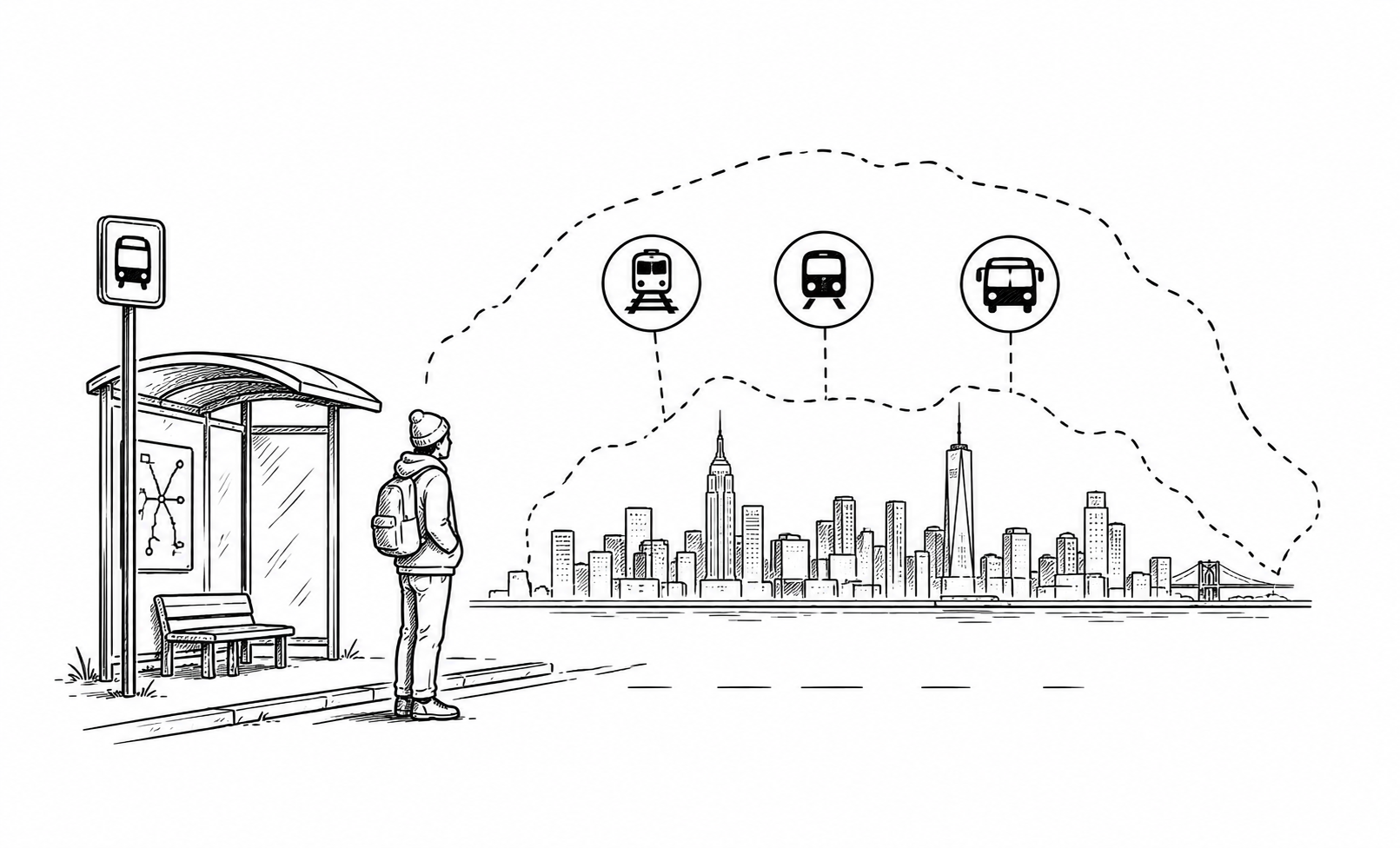
Newark sits inside the most transit-dense corridor in the United States. It has direct rail connections to Manhattan’s Penn Station and lower Manhattan via PATH. Its light rail system runs through downtown and connects to rail hubs. Its bus network historically served neighborhoods throughout Essex County and into the surrounding region. By the geographic logic of transit infrastructure, Newark workers should have access to one of the deepest labor markets in the country.
The service reality has diverged from that infrastructure legacy. NJ Transit service reductions and route degradations over the past two years have eliminated or significantly reduced frequency on dozens of bus routes in the Newark core, according to NJ Transit service reduction data from 2024 and 2025, reported by the SSC News Desk in June 2026. What remains is a network that works reasonably well for commuters whose routes align with surviving high-frequency lines — and works poorly for workers whose jobs are off those corridors, who work shifts that fall outside peak service hours, or who need connections that degraded feeder routes once provided.
The labor market consequence is not visible in unemployment statistics, which measure whether a person has a job, not whether they can reliably get to one. What transit cuts produce is a contraction in the effective job-search geography for workers who depend on public transportation. A worker without a car, living in Newark’s South Ward or the Ironbound, whose viable commute has been reduced by route cuts, is not unemployed. They are constrained. They can reach fewer employers. They have fewer shift options. They face higher risk of late arrival and the termination that follows it. That constraint is a labor market problem that operates invisibly inside the transit infrastructure category.
The population most affected by that constraint is not random. Transit-dependent workers in Newark are disproportionately low-income, Black, Hispanic, and working in service, healthcare support, and logistics roles — jobs that don’t offer the flexibility to absorb unreliable transit. These are also the workers for whom the geographic reach of job access matters most: unable to move to follow employment, unable to afford car ownership in a market where insurance, maintenance, and parking represent significant additional costs on a low wage.
The policy conversation about workforce development in Newark — job training, employer partnerships, career pathways — rarely includes transit infrastructure as a variable. It treats the transit system as background, a fixed condition that workers navigate rather than a design choice that shapes who can participate in the labor market. The NJ Transit route cuts made a design choice. They made the labor market smaller for a specific population without naming it as a labor market decision.
NJ Transit is facing its own fiscal constraints, operating a large multi-modal system in a state where capital investment and operating subsidy have historically been in tension. The service reductions are not arbitrary — they are responses to budget gaps. But the consequence of those reductions is not distributed evenly. It concentrates on the workers least able to absorb it and least likely to be in the political conversation about how NJ Transit’s budget should be resolved.
The labor market Newark workers can access is a function of the transit routes that run. That function got smaller. No jobs report measured it happening.