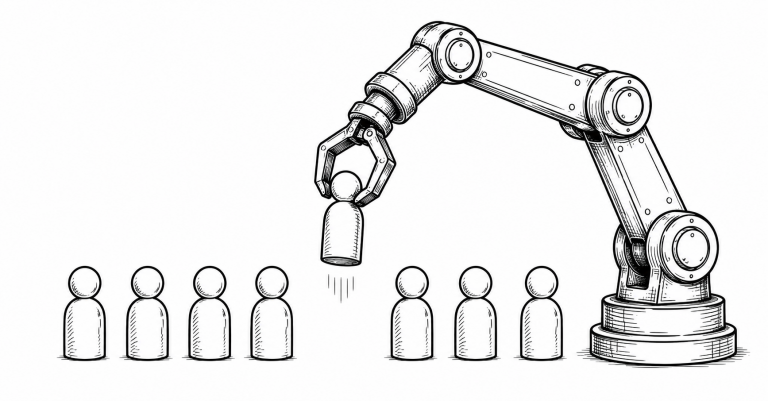

More Than 110,000 California Tech Workers Lost Their Jobs in 2026. More Than Half of Layoff Events Named AI as the Cause.
The companies eliminating jobs are the same companies announcing record AI investment — and the people being let go are not being transitioned into the economy being built.
California has shed more than 110,000 tech jobs in 2026, according to tracking data compiled by Parriva, TechCrunch, and the SkillSyncer workforce tracker. Nationally, 302 tech layoff events have affected 201,754 workers — an average of 1,029 job losses per day. More than 54% of all layoff events explicitly named AI as a contributing factor. Entry-level and mid-tier roles are being eliminated first. The companies executing these layoffs are, in nearly every case, simultaneously announcing expanded AI infrastructure investment — data centers, model development, chip procurement, and platform buildout that runs to billions of dollars per company.
The efficiency argument at the center of these layoffs holds that AI tools allow companies to do more with fewer people, generating productivity gains that justify the headcount reduction. The argument is internally consistent from the company’s perspective. What it does not address is who captures the productivity gain. When a company eliminates 200 software engineers because its AI coding tools can do the equivalent work of 40, the productivity surplus that previously flowed to those 200 workers as wages now flows to the company as margin or gets reinvested in the infrastructure that made the substitution possible. The workers who were replaced do not receive a share of the efficiency dividend their replacement produced. They receive severance packages and a labor market in which the roles most accessible to them are precisely the roles being eliminated most aggressively.
Entry-level tech positions are disappearing faster than senior ones because AI tools currently automate the tasks that entry-level workers perform most. This is the pattern that matters most for workforce equity: the jobs that have historically been the entry point into the tech economy — the roles that allowed workers without established networks or prestige credentials to build skills and accumulate experience — are the ones the current wave of automation is hitting hardest. The career pipeline that once connected technical education to professional advancement is being cut at its base.
The 54% figure — the share of layoff events explicitly citing AI — is likely an undercount. Companies have legal and reputational incentives to frame layoffs as strategic restructuring, workforce optimization, or organizational redesign. The attribution of displacement to AI carries reputational risk in a policy environment where the adequacy of that explanation is increasingly scrutinized. When companies do name AI explicitly, they are communicating something to investors: that the capital allocation from people to machines is intentional, tracked, and expected to produce returns.
California’s 110,000 is a statewide number, but the concentration is geographic: San Francisco, the Peninsula, and the South Bay account for the majority. These are also the regions where housing costs are highest and the support infrastructure for displaced workers is thinnest relative to need. The workers losing jobs are not moving to lower-cost areas where tech roles are more available. They are staying in markets that are expensive because they were built around the compensation levels the jobs that no longer exist used to provide.
The story being told is about disruption — the necessary turbulence that accompanies technological progress. The more accurate frame is capital reallocation: resources that previously compensated workers are being redirected to infrastructure that makes those workers substitutable. That is a choice, not an inevitability, and the workers on the receiving end of it are not the ones who made it.