
The Majors Employers Dismissed Are the Ones That Travel
When hiring slows and roles keep shifting, the degree that crosses industries outperforms the one that only fits one.

Forbes reported LinkedIn data showing that English majors led all college disciplines in career versatility, with 69% of 2022 to 2024 graduates landing jobs outside their field of study. Visual and performing arts followed at 68%, communication and journalism at 67%, business and marketing at 64%, and computer and information sciences at 63%. Social sciences came in at 62%, interdisciplinary studies at 60%, and psychology and physical sciences at 55% each. At the bottom: biological sciences at 43%, engineering at 41%, education at 34%, and health professions at 21%. The analysis arrived against a backdrop of overall hiring down 20% from pre-pandemic levels and 5% from the prior year.
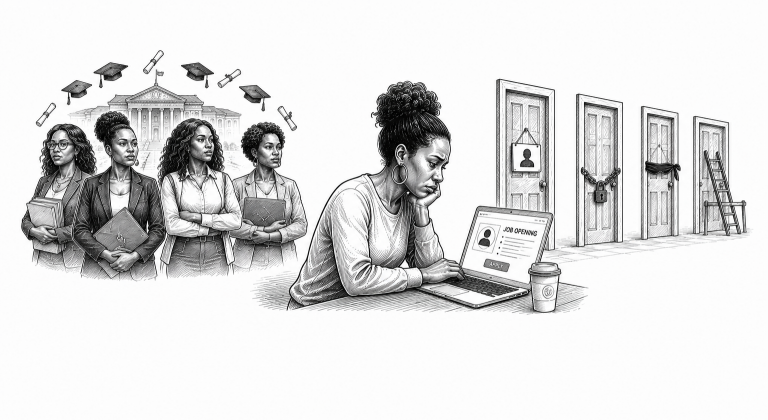
The majors at the top of that list are the ones higher education and corporate hiring culture have spent years treating as the riskier choice. The data does not say English, arts, or journalism graduates automatically out-earn engineers, nurses, or computer scientists. It says they are more likely to move into work outside the narrow lane their major was designed for — and in a labor market where roles keep shifting and entry-level hiring keeps contracting, that lateral range is a form of job security the conventional return-on-investment frame for college majors was never built to measure.
Health professions at 21% and education at 34% are not underperforming majors. They are credentialed, occupationally specific, and structurally in-demand. A nursing degree is built to produce nurses. An education degree is built to produce teachers. Those degrees offer strong occupational alignment and limited lateral flexibility — by design. The problem arrives when the specific occupational track they were built for contracts, reorganizes, or gets restructured around a new technology, and the graduate has no adjacent lane to move into. Engineering at 41% faces a version of the same constraint. The occupational specificity that makes these degrees legible to employers in good hiring conditions is the same feature that narrows options when conditions change.
English, communication, social sciences, interdisciplinary studies, and arts programs are built around skills that cross industries rather than belonging to one: writing, analysis, interpretation, audience understanding, problem framing, and the ability to synthesize complex material for people who did not come from the same professional background. Those capacities do not belong to one sector. They move through media, marketing, policy, nonprofit, corporate communications, technology, consulting, and management — and the LinkedIn data confirms that graduates from these programs are actually using that range, not just theoretically possessing it. In a stable, high-volume hiring market, that breadth can look inefficient. In the current one, it is functioning as insurance.
The caveat the data does not resolve is access. A broad degree provides range only when paired with internships, a portfolio, a professional network, and a coherent way to explain transferable skills to a hiring manager who did not study the same thing. Graduates without that infrastructure remain exposed regardless of their major. What the LinkedIn findings do close is the argument that flexibility is a secondary outcome — something that happens despite a major, not because of it. Power inside the credential economy has been organized around the assumption that the most specific degree produces the most durable outcome. That assumption is being revised by the hiring data in real time, and the universities still advising students to optimize for occupational specificity over range are preparing graduates for a version of the labor market that their own institution’s alumni data no longer supports.