
Enterprise Data Is Becoming the AI Bottleneck
Companies are discovering that artificial intelligence is only as useful as the information architecture underneath it.
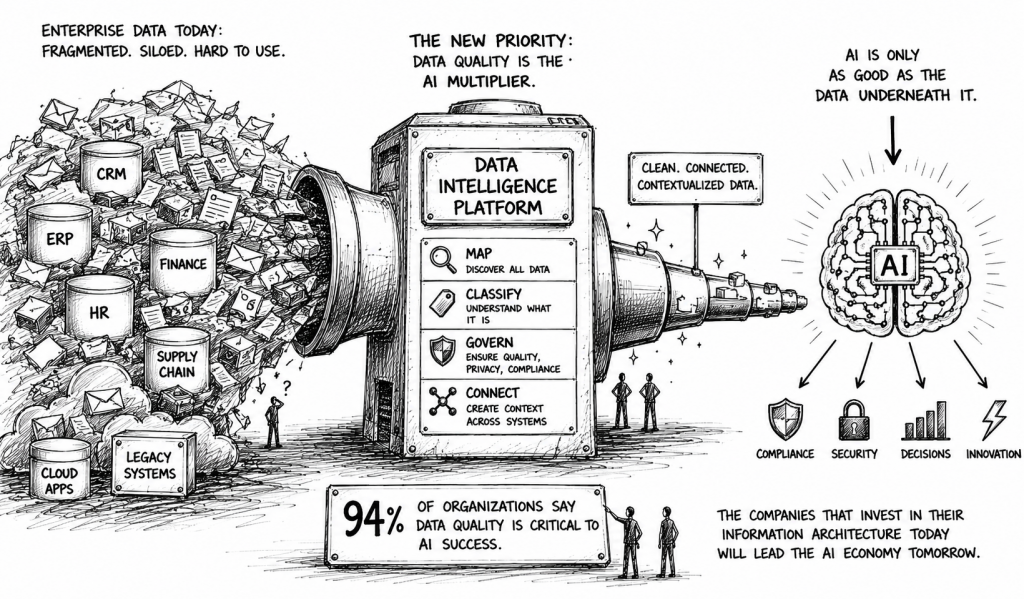
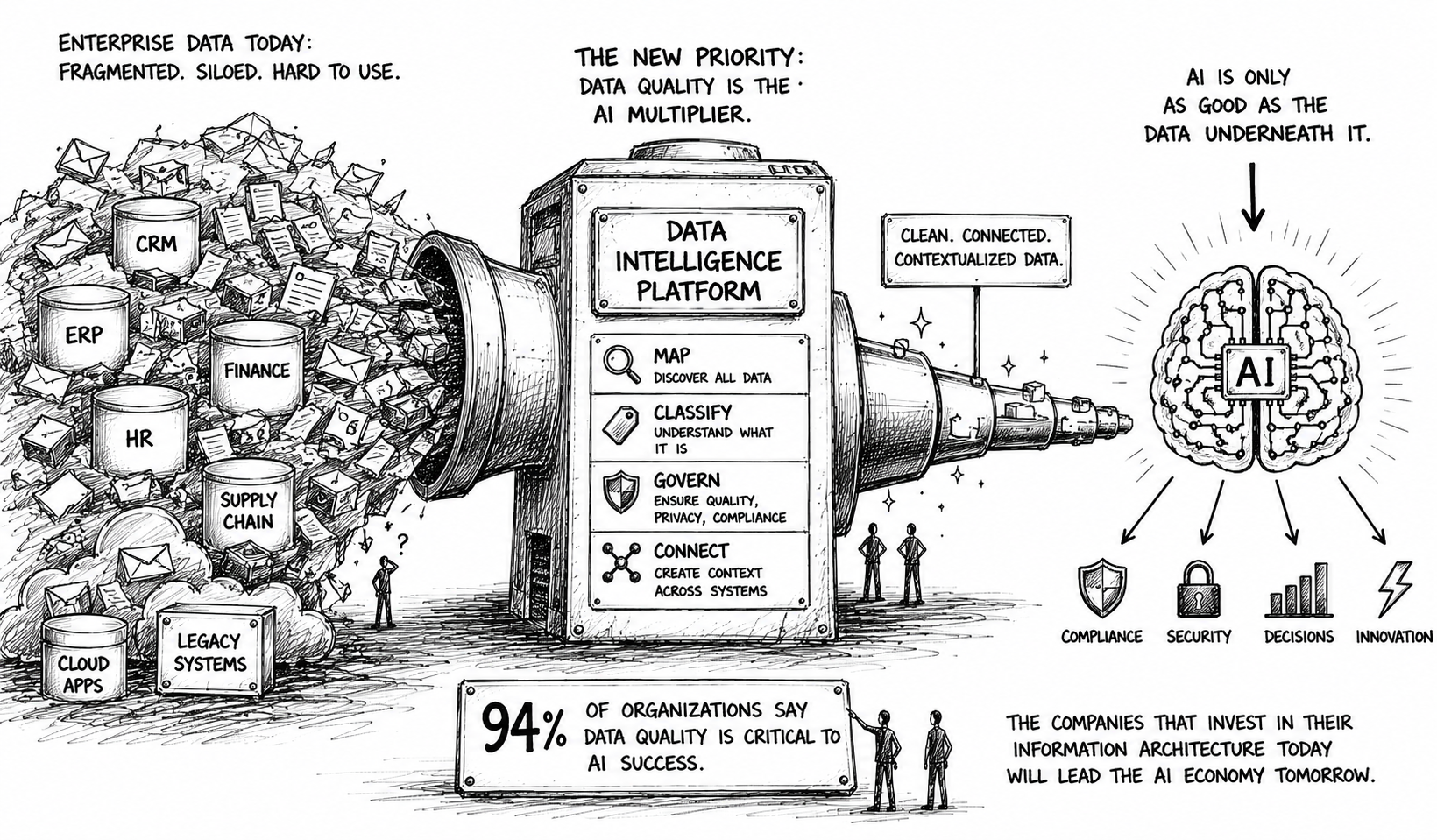
ITPro reported from the Pure Accelerate conference in Las Vegas that Everpure, formerly Pure Storage, launched a new Data Intelligence platform designed to help enterprises map, classify, and govern information spread across cloud systems and applications. The announcement came alongside research showing that 94% of organizations consider data quality important or very important to AI success. The launch highlights a growing realization inside the industry: model quality is no longer the primary constraint. Data quality is.
The first phase of the AI boom focused on models. Companies raced to adopt ChatGPT, deploy copilots, and experiment with agents. The assumption was that smarter models would naturally produce better results. Instead, many organizations discovered that the intelligence layer could not overcome fragmented information. AI systems perform well only when they can access clean, connected, and contextualized data.
That challenge reflects decades of enterprise software design. Businesses organized information around applications. Finance data lived in one system. Customer information sat in another. Human resources maintained its own records. Over time, companies accumulated thousands of disconnected repositories. Those silos made sense when people manually moved information between departments. AI agents change the equation because they depend on access across systems rather than inside them.
The timing matters because many companies are trying to push AI projects beyond pilot programs. Research cited by ITPro found that a large share of agentic AI initiatives remain stuck in proof-of-concept stages. Organizations are discovering that buying AI software is easier than preparing the underlying information required to support it. Cleaning, organizing, and mapping data often becomes more difficult than deploying the model itself.
That shift changes where power sits inside companies. For years, application vendors controlled the conversation. Customer relationship software, enterprise resource planning systems, and cloud providers competed to become the center of enterprise computing. AI introduces a different hierarchy. The firms that control the context layer — the information connecting all those systems together — gain leverage because intelligence depends on understanding relationships between data rather than individual applications.
The consequences extend beyond technology departments. Compliance teams, cybersecurity groups, finance departments, and executives all depend on the same underlying information. Questions about regulatory reporting, cyber resilience, and AI governance increasingly require answers from the same datasets. Data architecture stops being an IT issue and becomes an organizational issue. The quality of information determines the quality of decisions.
The AI race is beginning to resemble earlier infrastructure transitions. The companies that invested in cloud computing before competitors gained an advantage when digital transformation accelerated. AI may reward a different kind of preparation. Organizations that treat data as infrastructure rather than exhaust will be better positioned to move from experimentation to production. In the next phase of the AI economy, the most valuable asset may not be the smartest model. It may be the cleanest map of what a company already knows.