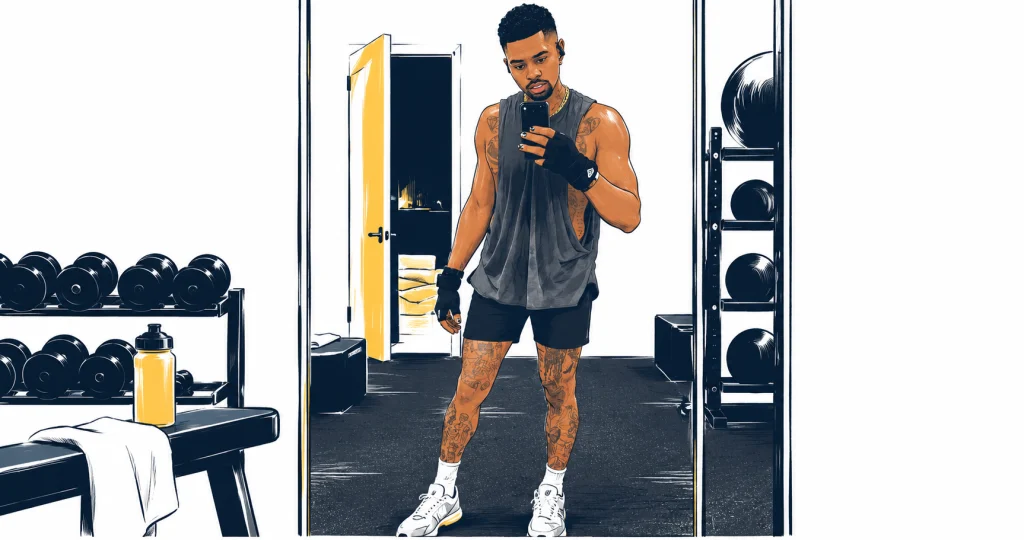
A former NBA player’s gym photo turned into a podcast segment about whether he looked gay. The reaction shows how one ambiguous word lets audiences police masculinity while no one answers for it.
Former NBA player Jeremy Lamb posted a gym mirror selfie to Instagram on October 3, and the photo drew thousands of comments and tens of thousands of shares, most of them about how his legs and hips were positioned. Many commenters called him “zesty,” online shorthand for a man seen as feminine or gay. The conversation reached The Joe Budden Podcast, where Marc Lamont Hill asked Mona how she would react if a man sent her the photo. “This is gay. Ain’t no way in the whole world,” she said. She then added, “I’m not saying he’s gay, but he looks gay and I will be alarmed if he was my man.”
Ambiguity is what makes this kind of policing cheap. “Zesty” can be affectionate, playful or hostile depending on who says it, so the speaker keeps deniability while the audience gets the message. Mona’s qualifier does the same work: she disclaimed any claim about Lamb’s orientation and still attached the label to a photo that said nothing about whom he dates. No reliable method infers sexual orientation from posture, and legs held together or angled hips can reflect comfort, habit, balance or a flattering angle. The meaning comes from the viewer.
Those meanings come from learned rules. Family, entertainment, peer groups and social media teach that a wide stance reads masculine and that closed legs, an arched back or a particular gesture reads feminine. Male professional athletes face the strictest version, because sports built their public identity on strength and conventional masculine ideals. A career in the NBA bought Lamb no exemption; in the comments his stance was treated as evidence.
Hill challenged the premise by separating gender expression from sexual orientation. A man can wear a dress and be straight, paint his nails and be gay, or dress conventionally and be either. SSC made the same cut in May in The Argument Is About Masculinity, Not Sexuality, where a viral clip asked why debates over LGBTQ visibility in Black cultural spaces crowd out questions about who defines Black manhood.
Hip-hop has made the point visible for years, from Young Thug in a dress on the cover of Jeffery to Lil Yachty in nail polish and Pharrell Williams in jewelry, handbags and tailored silhouettes. Their choices drew criticism anyway, which shows that the audience holds the template and the artist does not. Fashion keeps testing it. SSC’s Leena Alridge reported Friday that Drake stepped out in New York in a fringed wrap and leather trousers, in photographs shared by The Shade Room, another sign, she wrote, that men’s fashion no longer follows the old rules.
Enforcement also runs through dating. Mona’s reaction shows how a partner’s preferences can work as a screening test, with a man expected to prove his heterosexuality through how he stands, dresses and poses. Preferring a certain style is personal taste. Turning it into a public ruling on his sexuality sets a standard, and it assumes being read as gay is a defect.
Platforms and the podcast economy complete the circuit. A photo that once drew a joke among friends now travels through Instagram, reaction videos and podcasts, and each stop adds commentary from people who do not know the man. SSC traced the same mechanism in June, when a pink Goyard bag in Stefon Diggs’ Instagram carousel became the occasion for a verdict on his masculinity delivered through jokes, memes and laugh emojis, which spread the enforcement across thousands of participants, none of whom had to own it. It had already seen it with painted nails in The Nails Are Not the Story. The Reaction Is. The object of scrutiny changes each time, and the enforcement does not. Attention is the product, and a stranger’s body is cheap raw material for it. The power to decide what a selfie means moved from the man who took it to the audiences, and the shows that build programming around their reactions.
That trade will keep repeating. As more athletes and entertainers post their gyms and outfits as content, every image becomes available for a public ruling, and vague words like “zesty” will keep supplying verdicts nobody has to defend. Men with large followings will face a choice between posing to the template and accepting the ruling, and the template will tighten for those who have the most to lose from being read wrong.
