
The real problem in the Black community isn’t what y’all think.
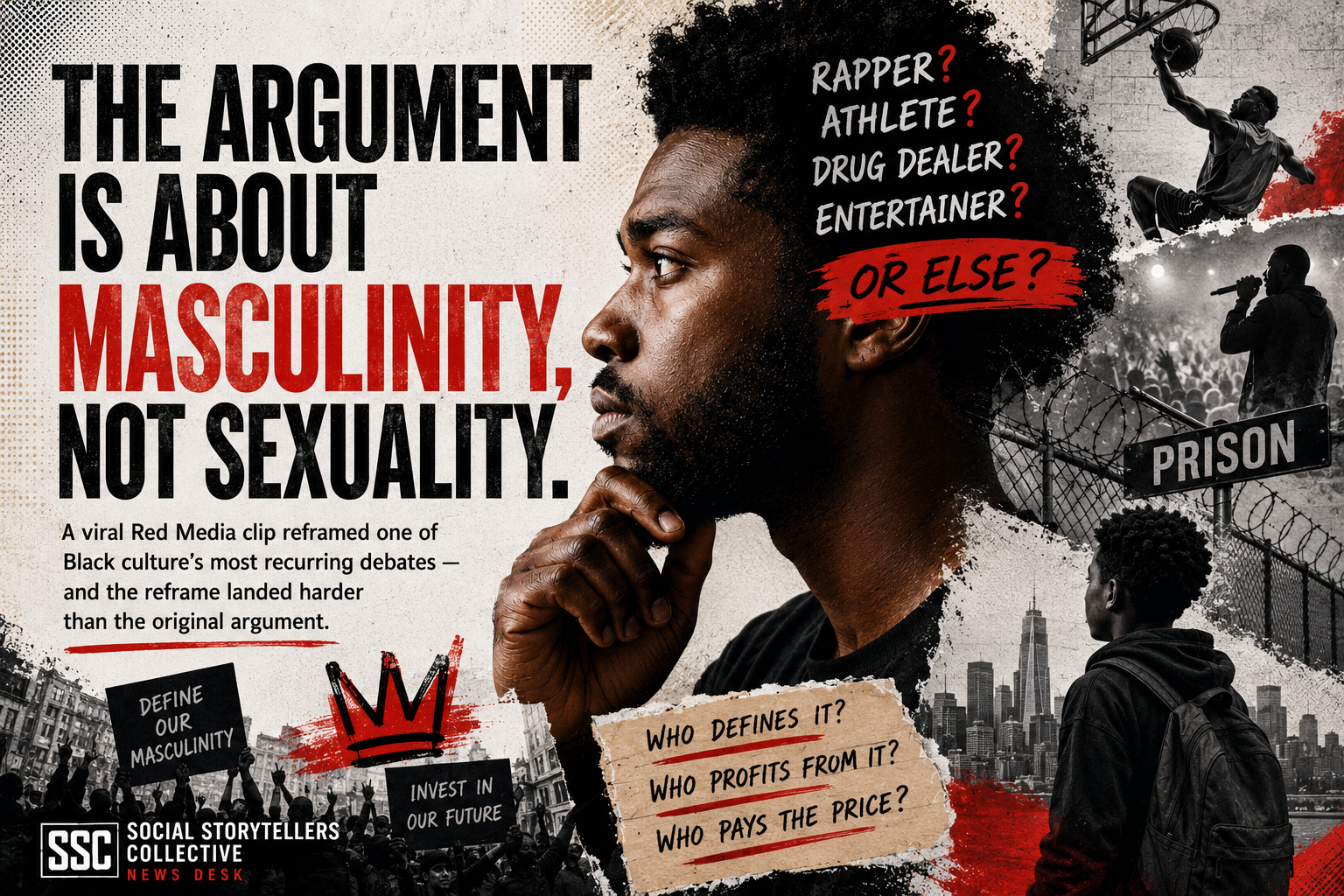
That’s the line from a clip Red Media posted to X Tuesday afternoon that pulled 360 reposts and 2.2K likes within hours. The video’s subject is direct: why does so much cultural energy get spent debating LGBTQ visibility in Black spaces while far less attention goes to the systems that have spent decades narrowing acceptable versions of Black manhood down to rapper, athlete, drug dealer, or entertainer — and funneling the rest toward incarceration?
The clip is not making a new argument. It is making a precise one at a moment when the audience was ready to hear it. And the speed of its spread says something worth examining about where Black cultural discourse actually is right now.
The reframe that landed
The woman in the clip interrupts a familiar hierarchy of concern. Rather than debating whether LGBTQ visibility exists or whether it represents a threat, she asks why certain forms of masculinity get repeatedly normalized while others get treated as existential dangers to the community. That shift in framing is the most important thing about the clip — because it moves the conversation from identity policing toward structural accountability.
Who benefits when Black boys grow up believing their value comes primarily from dominance, entertainment, physicality, or survival performance? What industries profit from promoting those definitions? And why does cultural panic consistently get redirected toward identity expression rather than toward the economic, educational, and institutional conditions producing those outcomes?
Those are harder questions. They also produce less viral content — which is part of why they get asked less often.
The algorithm problem
Social media accelerates this dynamic by rewarding emotional confrontation over structural analysis. Conversations about sexuality travel faster algorithmically because they produce outrage, tribal alignment, and engagement spikes. Structural conversations about education access, incarceration rates, literacy gaps, labor exclusion, economic vulnerability, untreated trauma, or narrow representations of Black men require more nuance and produce less instant virality.
The internet consistently chooses the emotionally combustible argument. That is not an accident of user behavior. It is a design outcome — platforms are built to surface what generates the most engagement fastest, and structural arguments rarely win that race against identity-based conflict.
Red Media amplifying this particular clip is itself part of that dynamic. A 30-second video filmed in a car can become a national debate within hours because platform algorithms elevate emotionally resonant personal testimony faster than institutional analysis. The message is right. The medium is doing what the medium does.
The generational divide underneath it
The clip also reflects a broader generational divide happening across Black media spaces right now. Younger audiences increasingly challenge inherited ideas about masculinity, emotional expression, gender presentation, and identity politics. Older or more conservative audiences often interpret those shifts as instability or cultural erosion. Social platforms compress those disagreements into short-form conflict, making every discussion feel existential even when the underlying concerns are about fear, protection, visibility, and changing social norms.
That compression is consequential. Traditional gatekeepers — churches, radio personalities, civic organizations, Black newspapers, local leaders — no longer control these conversations the way they once did. Now a single clip posted by a media account with a platform can become a national debate before the day is over. The conversation has been democratized. It has not necessarily been deepened.
What connects this to the larger SSC conversation
This clip lands in the middle of a week where SSC has been tracking the same structural argument across multiple industries.
The deja.zhane beauty piece asked why the beauty industry that profits from Black American culture consistently reaches past the community that built it when distributing brand deals and economic returns. The Druski casting piece examined why Hollywood reaches outside the US for Black dramatic talent to tell Black American stories. The Pitchfork piece examined how critical institutions evaluate Black male cultural figures and whose standards they apply.
The clip Red Media amplified today is asking the same structural question from a different angle: who constructs the definition of Black masculinity, who profits from keeping it narrow, and why does the cultural conversation keep getting redirected away from those questions toward identity debates that are easier to monetize and harder to resolve?
The loudest debates in Black cultural spaces are rarely about what they appear to be about on the surface. They are about who gets to define Black identity, Black masculinity, and Black cultural legitimacy in a platform era where everyone can speak at once — and the platforms themselves are deciding what gets amplified.
That is the argument underneath the argument. And increasingly, more people are naming it directly.