Jacki-O Called Herself a Failure. The Internet Turned Her Regret Into Judgment.
The former Miami rapper’s response to JT’s “Satan’s ex-wife” role shows how conversion can change the meaning of a cultural legacy without giving its creator control over what the next generation does with it.
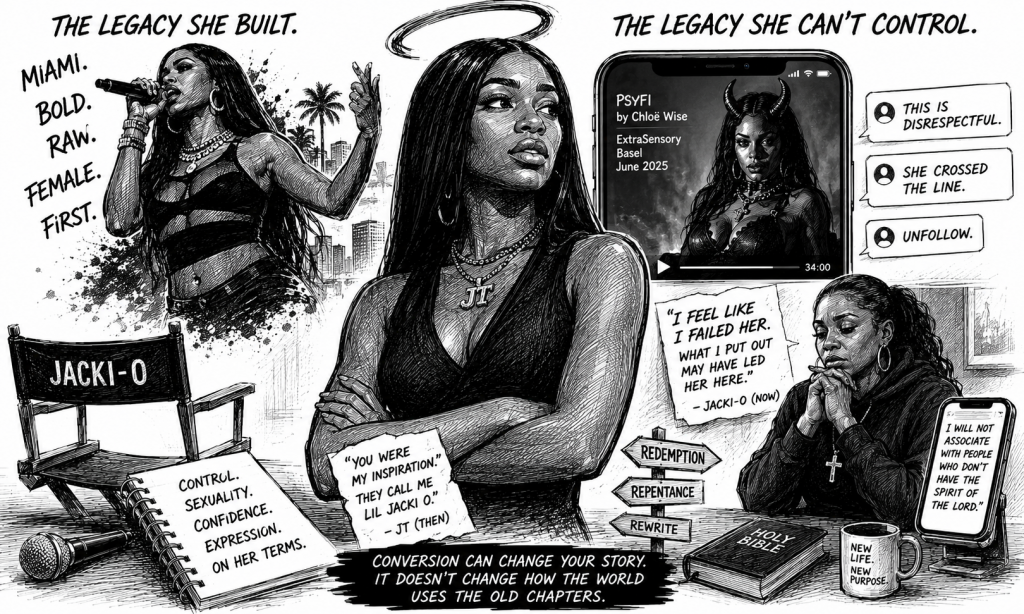
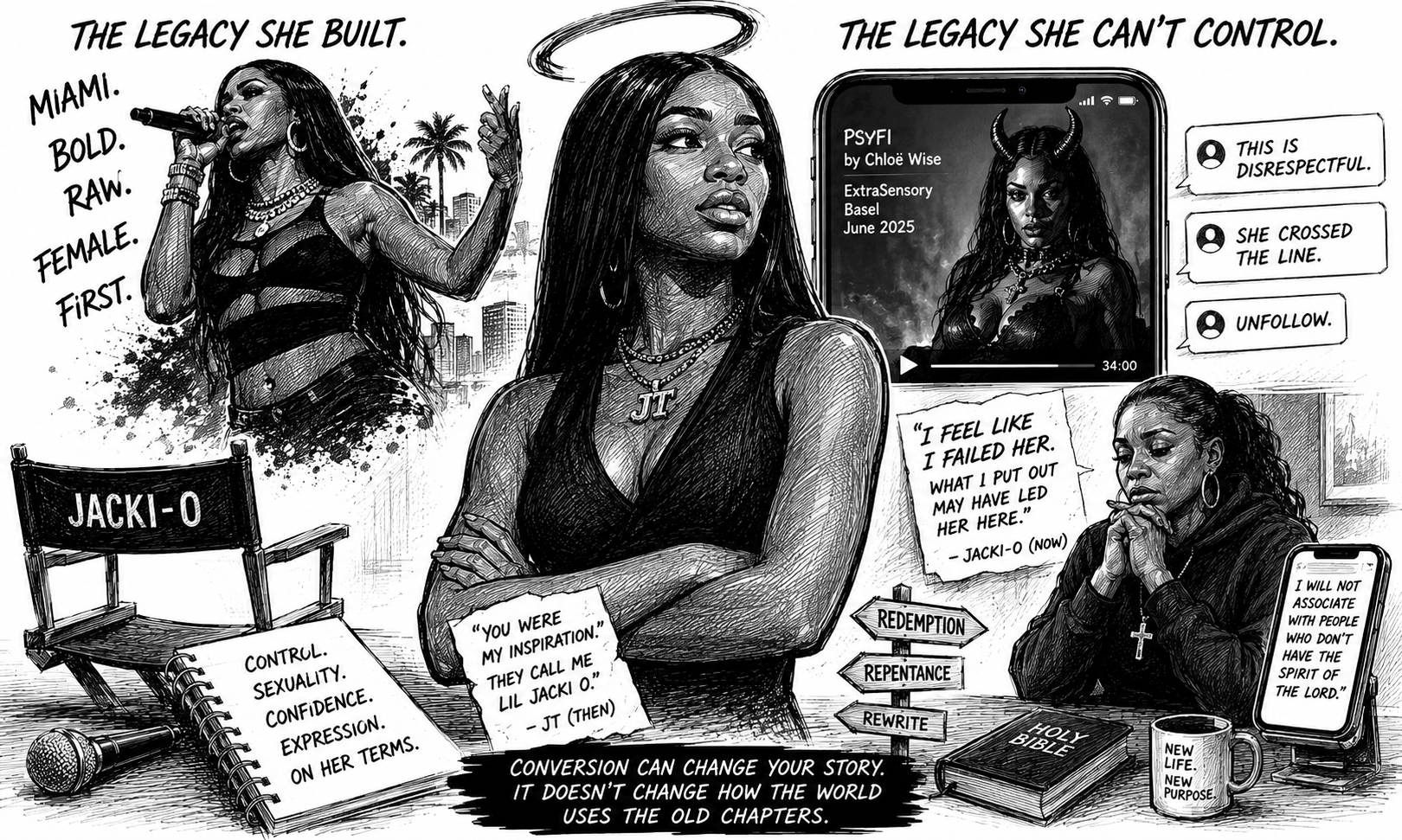
Ariela Anís of Hollywood Unlocked reported that JT faced criticism after appearing as “Satan’s ex-wife” in PsyFi, a 34-minute video installation written and directed by Canadian artist Chloe Wise. The work opened in June as part of Wise’s ExtraSensory exhibition in Basel. Some fans treated the demonic imagery as artistic performance. Others threatened to unfollow JT and framed the role as evidence she had crossed a spiritual line.
The strongest response came from someone who once helped define the Miami rap tradition JT inherited. Angela Gillespie, formerly known as Jacki-O, wrote that JT had credited her as an early inspiration and that she now felt she had failed the younger rapper. Gillespie said she remembered JT approaching her as a child — asking for a photograph and explaining that people called her “Lil Jacki O.” Seeing her now dressed as the devil, Gillespie concluded that the public image she built during her rap career may have pointed JT toward a path she no longer endorses.
Conversion changes how people interpret their past. It does not let them reclaim ownership of everyone who encountered it.
Gillespie has publicly distanced herself from her former career. During an April interview with DJ Nasty on Miami’s 99 JAMZ, she described her life as Jacki-O as the “wrong move.” Her criticism of JT flows from that revised understanding of her own history: the rapper who once represented sexual autonomy and defiance now sees parts of that representation as spiritual damage.
That creates an uneven transfer of responsibility. Gillespie is entitled to reinterpret her own work. But by declaring that she “failed” JT, she places herself inside another woman’s artistic decision and turns influence into a form of moral custody. JT’s costume becomes evidence in Gillespie’s testimony about who Jacki-O used to be.
Public repentance often works this way. A person rejects a former identity, then begins judging the people who still recognize value in what that identity produced. The conversion may be personal, but the correction becomes public. The audience is asked to accept that the old work was not merely something the artist has outgrown — it was a harmful instruction that others should now regret following.
JT’s earlier private message complicates that narrative. She reportedly told Gillespie that she remained a fan, respected her spiritual growth, and hoped they might someday collaborate if she returned to music. The response, according to circulating posts, was a block — and a declaration that Gillespie would not associate herself with people who did not have “the spirit of the Lord” in their lives.
Admiration did not create access. It created a test JT had not agreed to take.
The exchange exposes a generational conflict inside women’s rap. Earlier artists fought to make sexual directness, theatrical provocation, and female control commercially viable. Some later rejected the terms of that fight — particularly after religious conversion. Younger artists inherited the permissions without inheriting the repentance. What one generation now names as a warning, another still understands as creative freedom.
Power moved from the artist performing the work to the elder claiming authority over what the performance means. Gillespie’s spiritual transformation allowed her to recast JT’s role as evidence of cultural decline and her own earlier career as one of its causes. JT became the object through which that conversion was publicly proven.
The pressure will not stop with this dispute. As more artists revisit their careers through religion, sobriety, motherhood, or age, younger performers will increasingly be asked to answer for meanings their predecessors assigned retroactively. Cultural influence will keep moving forward. The fight will be over whether the people who opened the door also retain the authority to decide who should have walked through it.