
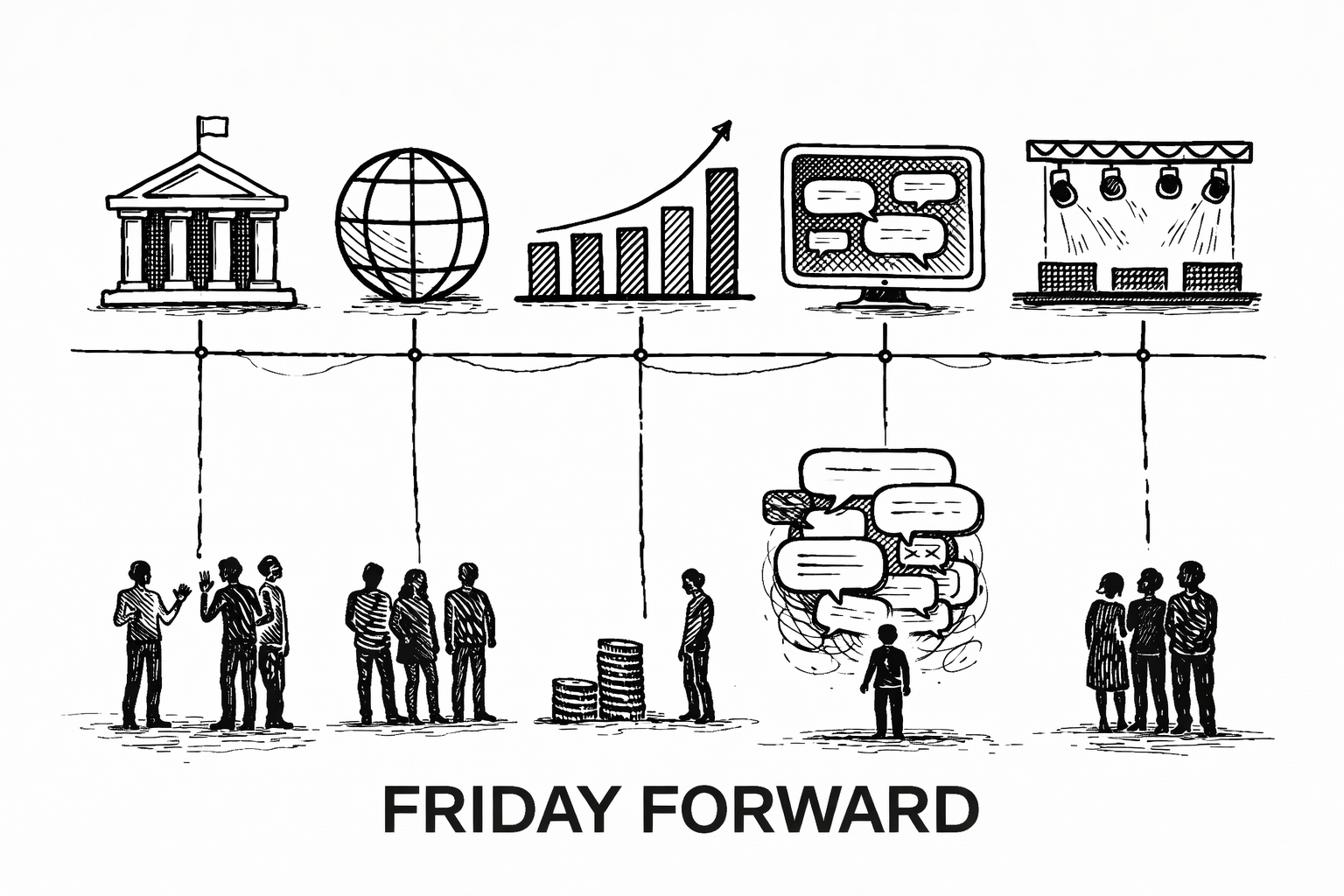
Each week, we pull the stories that stayed with us — and look at what they reveal. Not everything in the feed is noise. Some things land. This week, a pattern emerged: the gap between what systems promise and what they deliver — and who absorbs the cost when that gap widens.
1. The UN Said Yes. The U.S. Said No.
123 countries stood in a room this week and named the transatlantic slave trade the gravest crime against humanity. Three voted no. One of them was us. The U.S. ambassador delivered his explanation of vote and then declared, in the same breath, that President Trump has done more for Black Americans than any other president.
What stayed with us is not the resolution — it’s the juxtaposition. The world moved toward acknowledgment. The U.S. moved away from it. And the communities most directly descended from what that resolution named are the ones left to make sense of the distance.
“History does not disappear when ignored. Truth does not weaken when delayed. Crime does not rot. And justice does not expire with time.” — Ghana Foreign Minister Samuel Ablakwa
2. Equal Pay Day Was Yesterday. Black Women’s Is in July.
The gender wage gap widened for the second consecutive year — the first back-to-back regression since the 1960s. Women now earn 81 cents for every dollar men earn. Black women earn 68.3 cents for every dollar earned by white men — roughly $20,500 less per year. Black Women’s Equal Pay Day won’t arrive until July 21.
What stayed with us is the enforcement story underneath the data. The tools built to close this gap — pay audits, disparate impact liability, pay transparency legislation — are being removed in real time. The gap widens. The mechanisms disappear. That is not coincidence. That is policy.
“We are reversing decades of hard-won progress.” — Deborah Vagins, Equal Pay Today
3. The Friend Group Audit Nobody Asked For
Remote work removed the last reliable reason to leave the house. For communities where showing up for each other is cultural infrastructure — not just social preference — that loss runs deeper than loneliness research typically captures. The share of Americans reporting no close friends has quadrupled since 1990. Adults under 30, despite being the most digitally connected generation in history, report the highest rates of social isolation.
What stayed with us is the class dimension the wellness conversation keeps sidestepping. Rebuilding social infrastructure after disruption requires discretionary time and money that are not evenly distributed. The advice to put yourself out there was designed for people with margin. Loneliness at this scale is not a personal failure. It is a systems problem being diagnosed as an individual one.
“Getting intentional about rebuilding community is not just a wellness practice. For many people, it is an act of resistance against a design that keeps making it easier to stay home and harder to stay connected.”
4. Jay-Z Adds Third Yankee Stadium Date — and the Culture Is Paying Attention
Three nights at Yankee Stadium. A Roots Picnic headline celebrating 30 years of Reasonable Doubt. A GQ interview that reads less like a profile and more like a position paper. Jay-Z’s 2026 is not a victory lap — it is a campaign. The distinction matters.
What stayed with us is the deliberateness of it. Every move this year has been staged around legacy, ownership, and the argument that the next step is the building itself. The culture is watching because he keeps proving the architecture of Black excellence is not incidental. It is constructed.
“Whatever it is, it just needs to be a true representation of how I feel.” — Jay-Z, GQ 2026
5. Black Twitter Was Infrastructure. What Replaced It Isn’t.
Bryson Davis named something this week that a lot of people feel but rarely articulate precisely. Black Twitter wasn’t a corner of the internet. It was a system — one that surfaced information, translated it, and pushed it forward until it couldn’t be ignored. What made it work was coherence: one shared space, one timeline, one room. What replaced it is distributed, personalized, and controlled by platform algorithms that have no social graph at their center.
What stayed with us is the question he left open: if there’s no longer a space where the conversation can come together in real time, what happens to the idea of a shared public? Not a niche, not an audience — a group of people moving through the same moment at once. It’s not clear that anything has replaced what existed. The fact that we’re still looking for it suggests we understand, at least, what we lost.
“The voices are still there. The system that once connected them is not.”
6. The Comment Section Is Now the Story.
Leena opened with the Tank and Tyrese Verzuz — the live comment feed scrolling up her 75-inch screen, thousands of people reacting to the same moments in real time. Community at its best. But she followed it with the harder observation: the same architecture that creates that feeling of togetherness has quietly reorganized how journalism decides what to cover. Engagement metrics reward outrage over depth. Stories that activate travel faster than stories that inform.
What stayed with us is the tension she named honestly — the comment section can be community, and it can be editorial corruption. The difference depends entirely on whether the people making coverage decisions know which is which.
“The story is still the story. The comment section is the noise around it. The job is knowing which is which.”
7. The U.K. Wave Is Real. The Foundation Is American.
FLO dropped “Leak It.” Kwn’s U.S. tour sold out in 30 minutes. Dave is hitting Dallas. The industry is calling it a takeover. Leena named something the trade publications won’t: most Black Americans aren’t deeply familiar with these artists, and the most recognizable U.K. rap name in everyday American conversation is known more for his celebrity adjacency than for his music living in anyone’s playlist.
But the bigger observation was about ethnogenesis — Black Americans building a culture so generative it defines global popular culture, under the most horrific circumstances in modern history, out of a generosity so foundational they never built walls to protect what they made. That is not main character syndrome. That is the record.
“The culture was built here, under conditions that no one else shared, by people who had nothing else to build with.”
8. Roots Picnic 2026 Is a Thesis Statement.
Jay-Z headlines May 30 celebrating 30 years of Reasonable Doubt. Erykah Badu headlines May 31. Kehlani, Brandy, Mariah the Scientist, De La Soul, a full Waiting to Exhale tribute. The lineup is not nostalgia — it is a curatorial argument about the connected lineage of Black music and who gets to honor it on their own terms.
What stayed with us is what it felt like the first time — the frankincense and the oils, the Temple University reunion, the business suit traded for Timberlands on the Amtrak from Harlem, De La Soul on the stage. What Roots Picnic has always understood is that Black music is not content. It is community. The 2026 lineup remembers that.
“The inner kid who showed up that first year — he’s still here. He always will be.”
9. R&B Is Having a Moment. But Not All of It Is Earned.
Kehlani performed “Folded” on the Jennifer Hudson Show this week — live, no net, sounding like she was in the studio. That is the standard. Brandy, Whitney, Jodeci, Keith Sweat — artists whose voices were the instrument, not the software. Kehlani passes. Teyana Taylor passes. The texture in her voice carries lived experience the way a scar carries a story.
What stayed with us is the preservation argument underneath the celebration. R&B’s longevity has always depended on the voice being real. When the architecture of the studio becomes the artist, the genre loses something it cannot get back. The moment is real. Not all of the voices in it are.
“The artists doing the most meaningful work in R&B right now share one thing: they put something real on the line every time they open their mouths.”
10. Soul Food and the Question of Change
Soul food was never meant to stay the same. It was built from what was left over — the cuts no one else wanted, the greens others overlooked, the scraps transformed by necessity and skill into something worth gathering around. Younger cooks are adapting recipes — smoked turkey instead of pork, air frying instead of deep frying, plant-based interpretations of dishes once built entirely around meat.
What stayed with us is the framing the piece refused to abandon: these changes aren’t rejections of tradition. They are extensions of it. The same ingenuity that created soul food in the first place, applied to the ingredients, knowledge, and circumstances of this moment. Soul food originated in adaptation. That’s not a departure from its history. It may be the most faithful expression of it.
“The cuisine endures not because it is frozen in time, but because communities keep deciding how to carry it forward.”
Some things don’t just pass through the feed. They reveal a pattern. This week’s pattern was clear: systems under pressure, communities absorbing the cost, and the ongoing work of naming what the culture is carrying — its losses, its standards, its history, and its ingenuity. That is what SSC is here to do.
See you next Friday.