
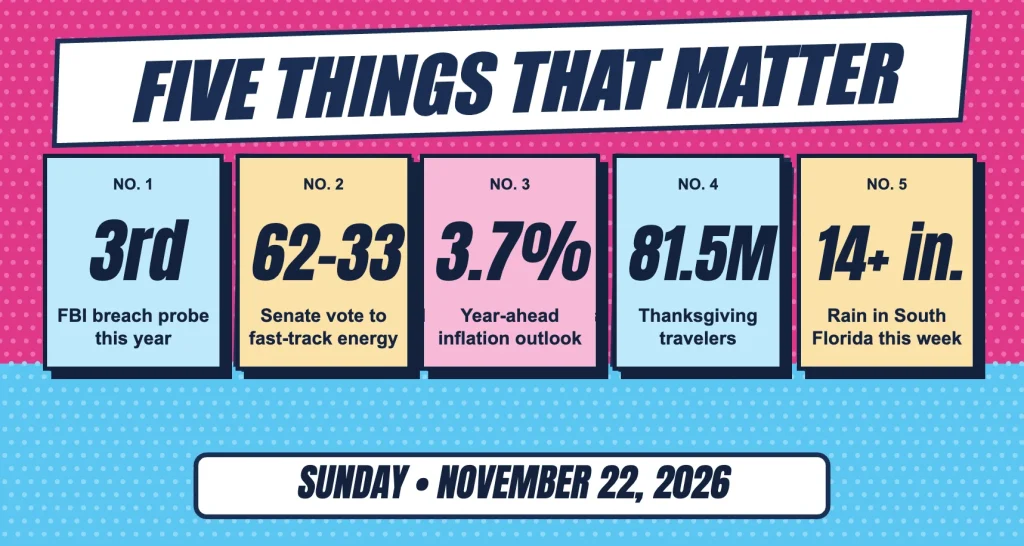
The FBI is investigating an apparent hack of the database police check at every traffic stop. Donald Trump threatened companies that build data centers abroad as the Senate voted to speed up power for the ones at home, households now expect less inflation, fewer people will travel for Thanksgiving as costs rise, and Florida’s dry season keeps arriving under water.
Sunday’s stories share a theme: the systems people count on are under strain, and most of the bill lands on households. A crime database, the power grid, a grocery budget, a holiday trip and a flooded street all depend on someone else’s decisions. Here are five things that matter on November 22.
1. The FBI Is Investigating a Hack of the Database Police Check at Every Traffic Stop
The FBI is investigating an apparent hack of the National Crime Information Center, the database local, state and federal police use to check warrants, missing persons, criminal histories and stolen property, the Associated Press reported. CNN first reported the breach, the scope isn’t yet clear and the FBI declined to comment. Asked about it on Fox News, Trump said, “We just heard about it and I will say that it’s not good.”
It’s the bureau’s third known incident this year, after a March breach of an internal system holding surveillance information and a September hack of its job portal claimed by the ShinyHunters group. The AP said there’s no sign it’s tied to the string of outages the administration has blamed on routine upgrades, though the public still hasn’t been told much about those either, as we noted when Trump told Americans to relax without saying why the outages happened. The question to watch is whether records were only read or also changed, because a false warrant in NCIC can turn a routine traffic stop into an arrest.
2. Washington Wants Data Centers Built Here, and Fast
Trump on Friday threatened “a tremendous tax” on U.S. companies that build AI data centers abroad, the AP reported. He named no rate or legal mechanism and said he hadn’t yet told his staff about the idea. A day earlier, the Senate passed the Bipartisan American Affordability and Jobs Act 62-33, which shortens approvals for power plants and transmission lines and requires data centers to pay for the energy they use, according to the AP.
Both moves push the AI buildout toward American towns at the same moment many of those towns are pushing back, as we reported in AI Data Centers Are Heading to the Rural South. Black Workers Want It in Writing. Environmental groups including the Sierra Club say the bill weakens reviews under the Clean Water Act and Endangered Species Act and limits court challenges. Watch the House, which passed a narrower, more industry-friendly version last year, and whether the “pay for their energy” language survives.
3. Households Expect Less Inflation. They Still Feel It.
Consumers now expect prices to rise 3.7% over the next year, down from 4.7% in October and the lowest reading since February, according to the University of Michigan’s final November survey, Bloomberg reported. Sentiment rose to 51.5 as gas prices fell and the outlook for business conditions improved. Long-run expectations eased to 3.3%.
Lower expectations matter because they shape what workers ask for and what businesses think they can charge. But survey director Joanne Hsu said consumers still overwhelmingly expect inflation, not unemployment, to cause them more hardship over the next year or two, Kitco reported. And the median hides a worried tail: UBS economist Paul Donovan noted that almost 15% of consumers expect prices to rise more than 15%, Fortune reported. Watch whether gas keeps falling through the holidays, because that’s what moved the mood this month.
4. Thanksgiving Travel Dips for the First Time in Four Years. Cost Is the Reason.
AAA expects 81.5 million Americans to travel at least 50 miles from home between Tuesday and next Monday, a 0.1% dip that ends three straight years of records, according to AAA’s forecast. About 72.9 million will drive. “The number of travelers is slightly lower partly because of higher travel costs this year,” said Stacey Barber, AAA’s vice president of travel.
The costs are real. Regular gas averaged $3.82 a gallon on Nov. 15, up from $3.08 a year earlier, and if prices hold, Thanksgiving Day gas will top the previous record of $3.58 set in 2022, the AP reported. Average domestic round-trip airfare is up about 17% to roughly $800, according to AAA booking data. Fliers are also coming off a rough stretch, after United’s outage hit Chicago hardest, so build in extra time and check your airline’s app before you leave the house.
5. Florida’s Dry Season Keeps Arriving Under Water
Parts of South Florida took more than 14 inches of rain in three days this week, and Gov. Ron DeSantis expanded a state emergency to Broward and other coastal counties, FOX Weather reported. Crews rescued more than 90 residents from a flooded Broward apartment complex, Broward canceled school for the whole week, and the St. Johns River hit an all-time high near Cocoa. Fort Lauderdale and West Palm Beach have already logged their wettest Novembers on record, the National Weather Service said, according to the AP.
It’s the second round this month. Melbourne had its rainiest day on record on Nov. 2, with 11.5 inches, Scripps News reported, and forecasters have tied the wet start to a strengthening El Niño. For families still repairing homes from the first flood, a second one means new claims, missed work and kids out of school during the holiday week. Watch for federal disaster aid requests, and for whether insurers treat these as one storm or two.
The Bottom Line
Every story today is about a system people rely on without thinking about it, until it fails or gets more expensive. A crime database, the power grid, prices at the pump, the holiday trip home and the drainage under a Florida street all run on decisions made far from the people who live with them. When those systems strain, households usually find out last and pay first. Context matters.
Five Things That Matter is produced by the Social Storytellers Collective News Desk. Get the End of Day Closing Note free in your inbox.