
Part of Technology — an ongoing series examining how the systems we build are reshaping how we live, connect, and see ourselves.
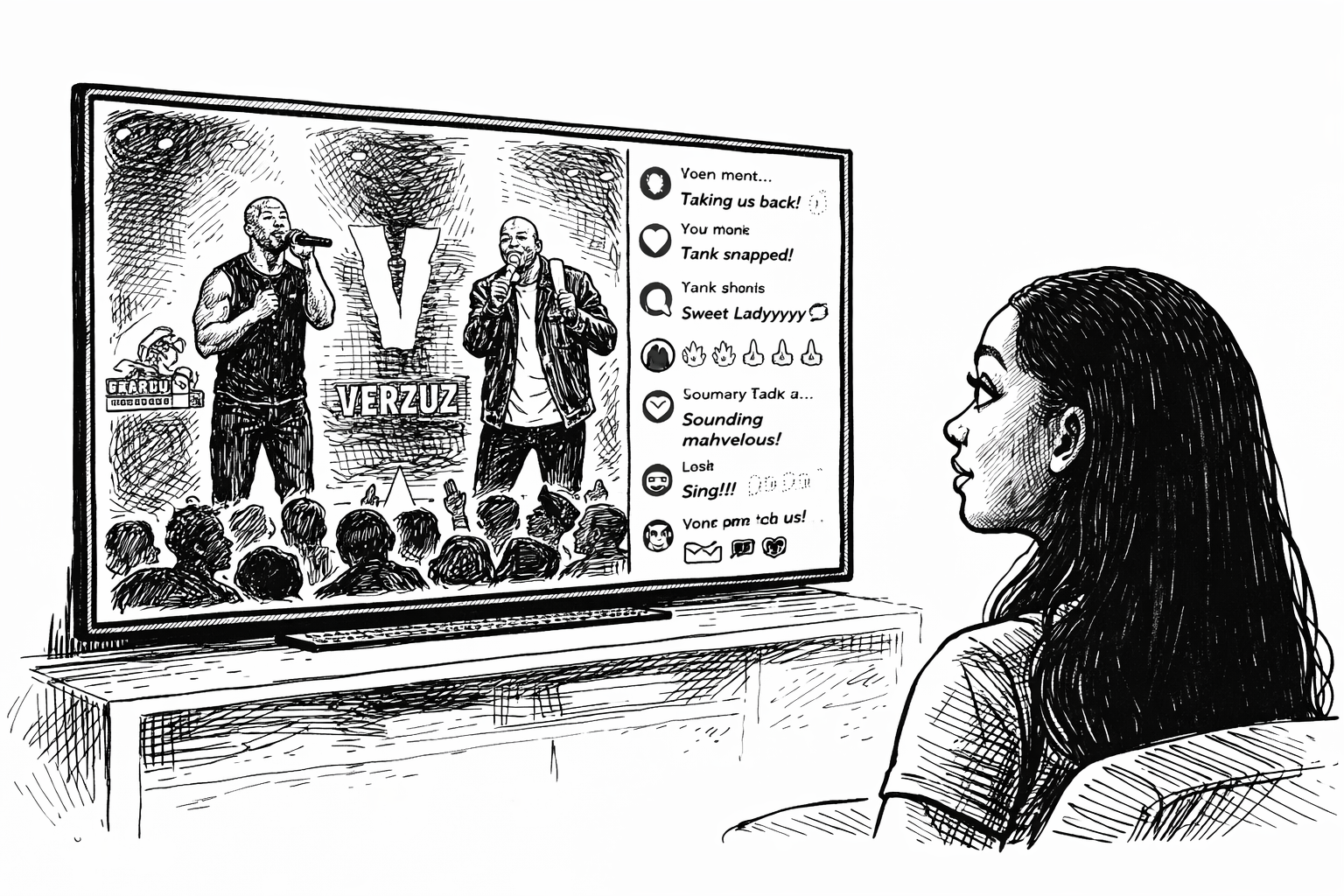
I was watching the Tank and Tyrese Verzuz on Apple Music this evening. As much as I was enjoying their live performances of some of my favorite songs, I kept finding myself drawn to the right side of my 75-inch screen — the live comment feed scrolling in real time. People reacting to the same moments I was reacting to, calling out the same songs, feeling the same things at the same time from wherever they were. There was something genuinely special about it. It made the experience feel less like watching and more like being somewhere together. That kind of engagement — immediate, collective, emotionally alive — is one of the most compelling things platforms have built.
It is also one of the most consequential. And not always in the ways we notice.
What I experienced watching Verzuz is the best version of what the comment section can be — a real-time expression of shared feeling that extends the reach of a cultural moment. But the same architecture that made that possible has quietly reshaped something else: how journalism decides what to cover, how urgently it covers it, and how long a story stays in circulation. The comment section used to be the response to the story. Now, increasingly, it is the story — or at minimum, it is shaping which stories get told. The architecture of social platforms has made audience reaction as visible as the content itself, and newsrooms have quietly reorganized around what that visibility rewards.
The mechanics are not complicated. A tweet from a politician generates 40,000 replies before a reporter has filed a response piece. A quote tweet with a pointed reaction gets more engagement than the original article. A comment thread surfaces an angle the original story missed — or invents one entirely — and that angle becomes the follow-up. Likes, replies, quote tweets, and reshares are no longer just metrics. They are editorial signals, and newsrooms — whether they acknowledge it openly or not — are reading them. A 2023 Reuters Institute Digital News Report found that 36% of editors and senior journalists said audience metrics directly influenced their story selection decisions. A separate study from Columbia Journalism Review found that stories with high social engagement were significantly more likely to receive follow-up coverage, regardless of their news value by traditional journalistic standards. What gets rewarded gets repeated. What gets ignored gets dropped.
The problem is not that journalists pay attention to their audiences — that has always been part of the job. The problem is what this particular audience signal optimizes for. Engagement metrics reward outrage, novelty, and emotional activation over depth, nuance, and accountability. A story that makes people angry generates more comments than a story that makes people think. A story that confirms existing beliefs travels faster than one that complicates them. When those metrics become editorial direction, the incentive structure of journalism quietly shifts from informing the public to activating it. As Why It Feels Like Some Stories Are Missing examined, the fragmentation of the media landscape doesn’t just create gaps in coverage — it shapes which communities and which stories ever make it into the frame at all.
For Black and Brown communities, that shift carries a specific cost. Stories about these communities that generate high engagement tend to cluster around crisis, conflict, and controversy — not because that is the full picture, but because that is what the engagement architecture rewards. Meanwhile, stories about institutional policy, community resilience, and structural change — the stories that most directly affect everyday life — generate less immediate reaction and therefore receive less sustained coverage. The comment section doesn’t just shape what gets covered. It shapes what gets seen as worth covering in the first place. As The Trust Gap: Why Traditional Media Is Holding Its Ground examined, trust in media is not eroding uniformly — it is eroding fastest in the communities that have the most at stake in whether journalism does its job well.
What the Verzuz experience reminded me is that the comment section at its best is community — people showing up for the same moment, feeling it together, extending something that would otherwise be private into something shared. That version of engagement is worth protecting. What it requires is an honest reckoning with the difference between an audience signal and an editorial standard. The comment section can tell you what people are reacting to. It cannot tell you what people need to understand. Those are not the same thing — and the gap between them is where journalism either holds its ground or quietly gives it away.
The story is still the story. The comment section is the noise around it. The job is knowing which is which — and having the institutional courage to act accordingly, even when the metrics are pointing somewhere else.