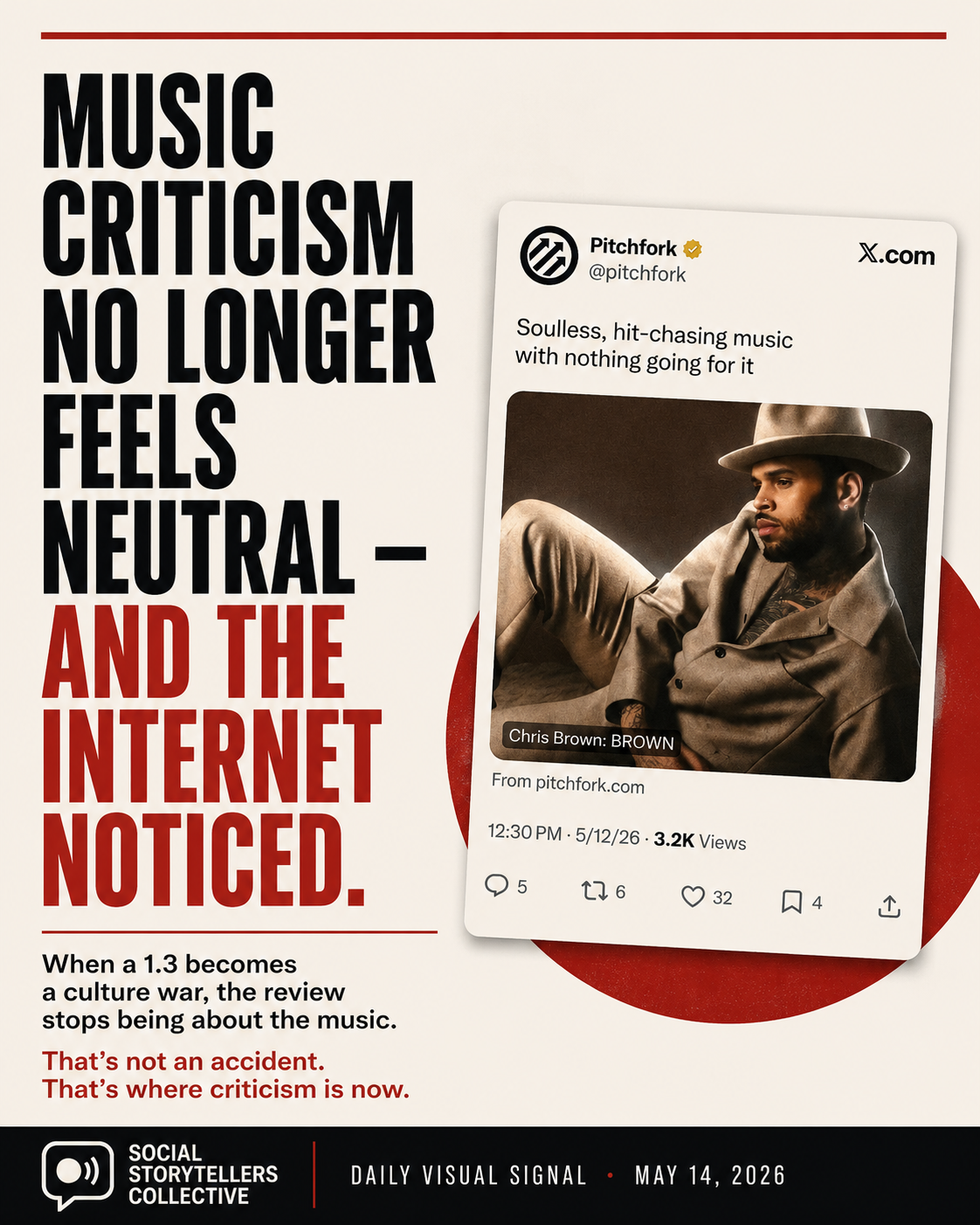
When Pitchfork gave BROWN a 1.3, the score traveled faster than the review. That speed is the story.
SSC reported on the initial review and its immediate fallout in Chris Brown, Pitchfork, and the Collapse of Cultural Consensus — examining how the score landed inside a culture already primed for exactly this argument, how Brown’s fan base operates as a reputational defense system strong enough to outlast institutional disapproval, and how the internet has restructured public redemption arcs in ways that have weakened critical authority well before this review was ever written. What happened after that piece published is what this one is about.
Pitchfork kept going. The publication posted to X: “This album is a real piece of shit.” The tweet pulled 1.6 million viewsby midday. Then a second post: “Soulless, hit-chasing music with nothing going for it.” The publication wasn’t clarifying its position. It was escalating it — and each escalation pulled the story further from music criticism and deeper into something that looked more like a campaign.
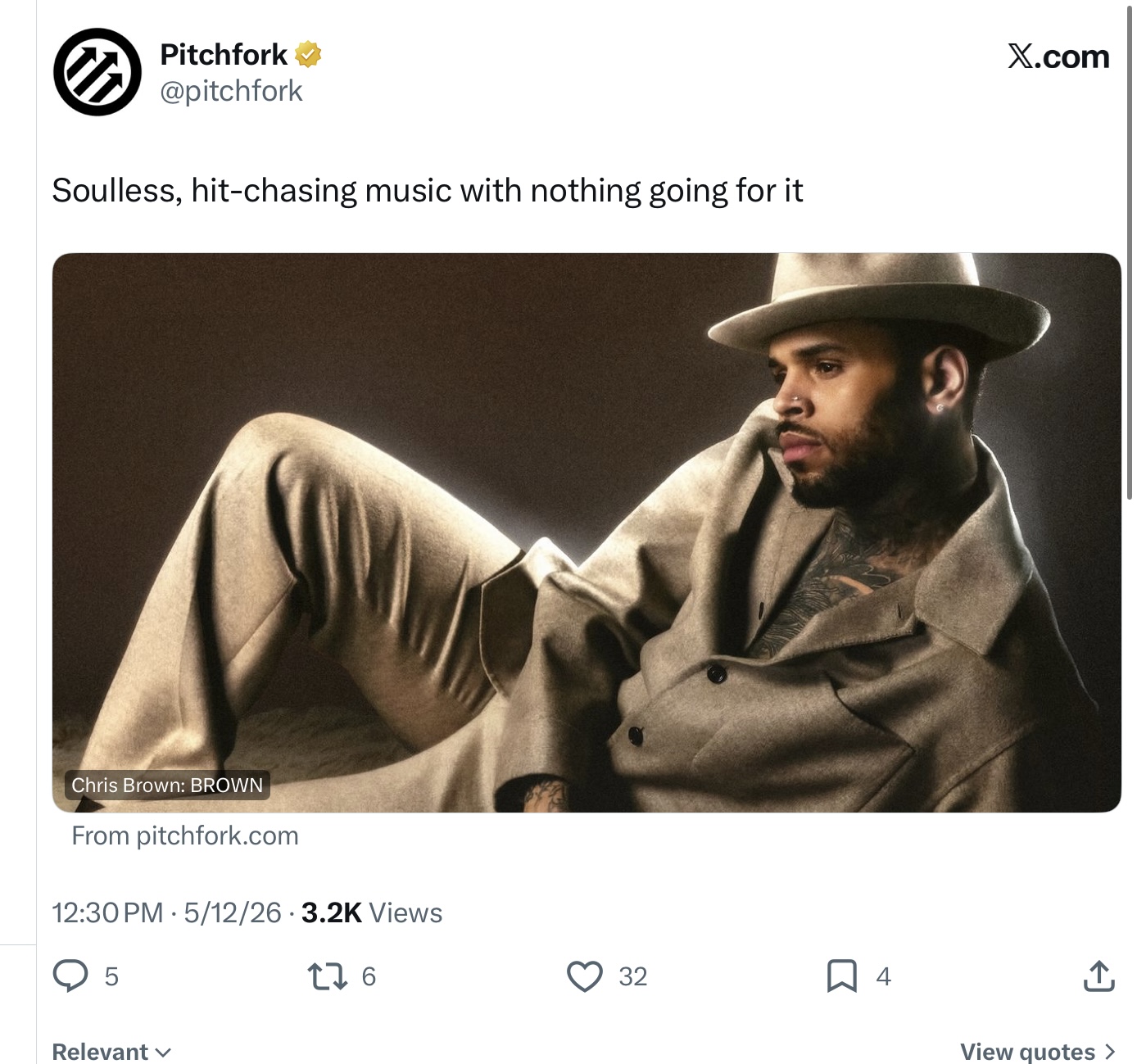
That distinction matters. Critics can dislike an album. Publications that editorialize their contempt on social media after the review has already generated controversy are no longer functioning primarily as criticism outlets. They are functioning as participants in the cultural argument they claim to be observing. Audiences noticed the difference immediately.
The screenshots that spread fastest were not about the tweets. They were about the numbers. Sexyy Red’s 8.0 for Hood Hottest Princess placed next to BROWN’s 1.3. For most of the people sharing them, the comparison was not really about lyrical complexity or production quality. It became symbolic — a proxy for a larger argument about taste, authenticity, class coding, gender politics, and which artists critical institutions position as culturally valuable versus culturally expendable.
Some argued Pitchfork consistently rewards work that feels ironic, internet-native, or aesthetically disruptive while treating more traditionally commercial R&B with a different register of seriousness. Others read the comparison through respectability politics — asking why music rooted in hypersexual chaos and meme culture can receive institutional praise while an artist with Chris Brown’s commercial longevity receives open contempt. Neither argument is fully satisfying. Both are doing real work in the culture.
Underneath both arguments is something larger: audiences increasingly distrust the premise of objective cultural authority altogether. Review scores are now read through ideology, identity, platform culture, and perceived institutional bias before they are read as music evaluation. People are not just asking whether an album sounds good. They are asking what the score represents — and who benefits from that representation.
That shift has fundamentally changed what criticism does. Reviews no longer function primarily as consumer guidance. They operate as cultural positioning statements that audiences embrace or reject depending on what they already believe about media institutions, fandom, gender dynamics, and celebrity treatment. The music becomes almost secondary.
This dynamic is not unique to music. SSC reported this week on Are Black American Beauty Creators Being Passed Over for the Diaspora? — a story about a Dallas-based creator asking why the beauty industry that profits from Black American culture consistently reaches past the community that built it when distributing brand deals and platform amplification. The structural argument is identical: institutions that extract cultural value from Black communities while gatekeeping the economic and critical returns are not operating neutrally. They are making choices. And increasingly, the communities on the receiving end of those choices are naming them publicly and precisely.
Pitchfork’s decision to post not one but two contempt-laden tweets after the review was already generating controversy suggests the publication understood exactly what room it was walking into — and chose to amplify rather than clarify. That is a choice. The internet treated it accordingly. Every subsequent post became more evidence in a cultural argument that had already moved well past the album itself.
In that environment the reaction will always be larger than the review. Every score becomes a proxy war over legitimacy. Every tweet becomes a data point in a broader argument about who gets to define cultural value — and whether that authority can still be trusted.
Pitchfork did not create that dynamic. But the decision to keep posting — after the backlash, after the screenshots, after the conversation had already shifted — suggests that somewhere between the review and the second tweet, the publication stopped trying to evaluate music and started trying to win an argument.
Those are different jobs. And the internet, for better or worse, is very good at telling them apart.