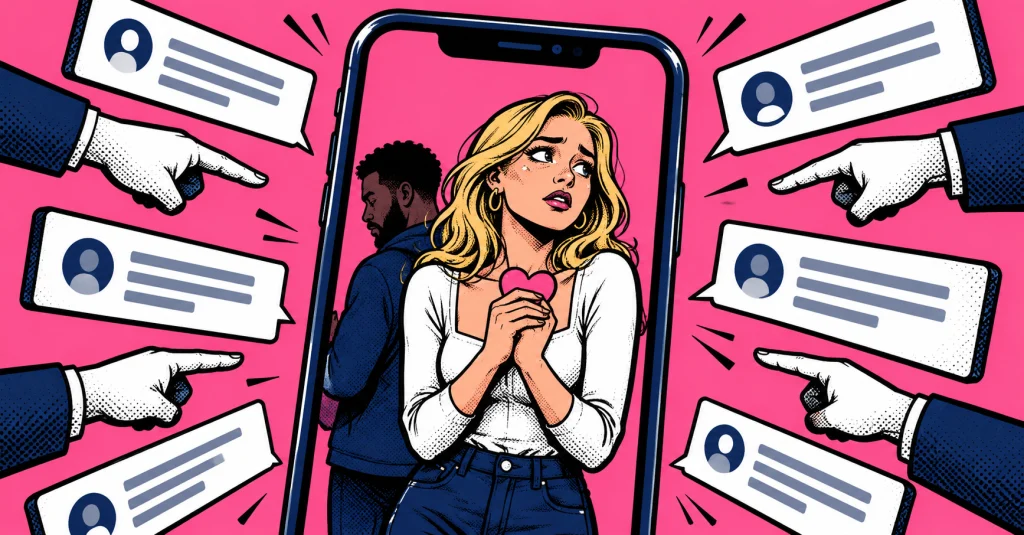
A creator’s explanation video shows how platforms turn a personal preference into a public trial, and why the people being discussed never get a say.
Sarah M. Stone reported for Yahoo on October 22 that social media creator Stephie Jo, who is white, posted a TikTok video to answer critics of her dating preferences. She said her attraction to Black men comes from chemistry and connection, not race, and that she would date a man of any race. She also said the scrutiny only starts when the man is Black, telling viewers that “no one seems to care when it’s a man of any other race.” She described her account as a personal one that began with a video about her boyfriend before comments turned it into a debate about interracial relationships.
Platforms convert audience curiosity into an obligation to explain. Stephie Jo said that after the first video, commenters, some of whom she called racist, ran stereotypes through her page, and she began answering them publicly. Each answer gave the audience more to contest. The account stopped being about her boyfriend and became about the argument over him, and the commenters, not the creator, now set its subject. That is the power move: the authority to say what an account is about shifted from the person who made it to the people who respond to it.
The demand for an explanation arrives unevenly. When a white woman publicly prefers Black men, audiences treat the preference as a statement about race and ask her to justify it, while pairings that attract no such reading go unquestioned, which is the asymmetry she describes. Some critics have long argued that attraction organized around a racial group’s traits can reduce individuals to types. Those concerns are why a personal preference can read as a public claim, and why the burden of answering falls on the person being asked instead of the audience asking.
Her answer shows how the format makes the trap tighter. Stephie Jo made a five-part series listing traits she finds attractive in Black men, and she says she noted that not every Black man fits the list and that the traits show up across races. A list organized by group still produces the generalizations it disclaims, and viewers argued about whether the list was right. She said her direct messages filled with non-Black men insisting they had the same traits, and that they seemed determined to prove they were better than Black men while saying Black men weren’t worth anything. Praise for one group read as a ranking, and the reaction was a fight over the ranking.
The engine behind this is the same one SSC traced in June, when a pink bag in an athlete’s Instagram carousel became a referendum on masculinity. In that analysis, the comment section performed social regulation while engagement systems rewarded participation that repeated familiar judgments. Here the thing being regulated is whom someone may find attractive. Every explanation video draws replies, replies draw more explanations, and reach follows conflict.
Who gains and who loses in this loop is specific. The commenters gain a role as judges without having to stand behind a verdict, and the creator becomes both defendant and moderator of her own page. Black men, the subject of the series, appear in the exchange as traits on a list, and nothing in the reporting includes their views. A debate about who is attractive to whom is happening around them, with no seat for them in it.
Expect that loop to keep running. As more creators build followings around their relationships, the comment section will increasingly set the topic and the creator will answer it. The more Stephie Jo explains, the more her account is about explaining, and the platform will keep rewarding that cycle whether or not anyone’s mind changes.