
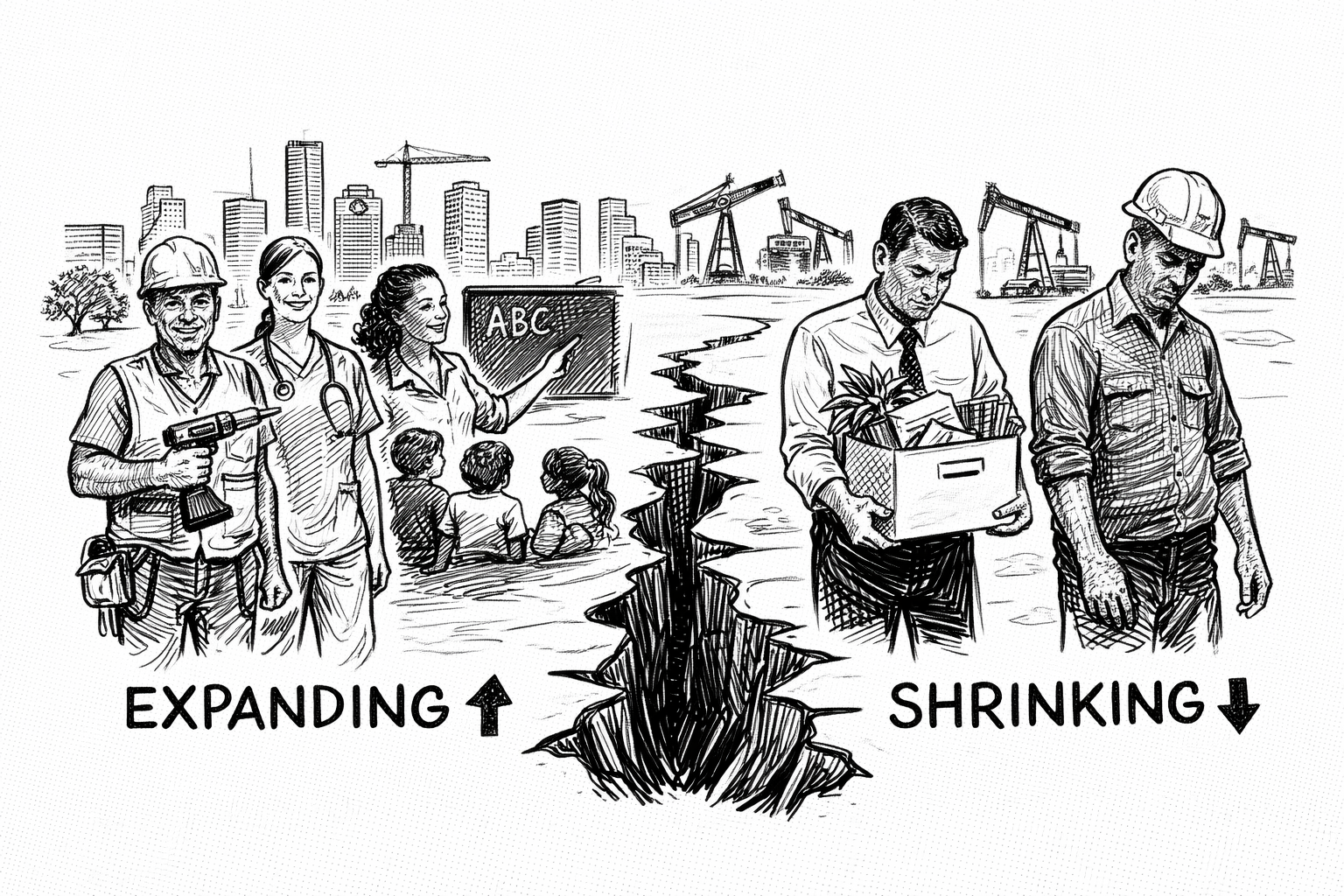

Houston’s 2026 economic outlook is, by headline measures, a positive one. The region is projected to add 30,900 jobs, bringing total employment to a record 3.52 million. Health care alone accounts for 14,000 of those projected gains, with additional growth expected in construction and public education. The numbers suggest a city with momentum, and on that narrow basis, they are accurate.
The composition of that growth is where the story complicates.
Traditional entry-point sectors — the industries that historically provided accessible, stable employment for workers without four-year degrees or specialized credentials — are contracting. Manufacturing is expected to lose 3,400 jobs. Administrative support, which has long served as a reliable pathway into the workforce for workers across skill levels, is projected to shed 7,500 positions. Oil and gas extraction, a foundational sector of Houston’s economic identity and a consistent employer of working-class labor, is expected to lose another 3,200. Federal data reinforces the directional split: education and health services are up 2.8% year over year, while professional services and manufacturing have declined. The sectors growing are largely credential-dependent. The sectors shrinking are largely the ones that did not require credentials to enter.
That distinction matters enormously in a city whose workforce is majority Black and Latino — a population that, as a direct consequence of decades of unequal access to higher education, underfunded public schools, and discriminatory credentialing barriers, is statistically underrepresented in the sectors now driving growth and overrepresented in the sectors now contracting. Houston is one of the most diverse large cities in the country, and it is also a city where the racial wealth gap remains wide and where access to the professional networks, certifications, and institutional relationships that health care and professional services increasingly require is not evenly distributed. Growth in those sectors is real. But real growth and accessible growth are not the same thing, and conflating them produces a distorted picture of who the economy is actually working for.
There is also a support-system dimension that aggregate job numbers do not capture. Health care employment, for example, spans an enormous range — from hospital administration and specialized clinical roles to home health aides and care workers, the latter of which are among the lowest-compensated positions in the sector despite being among the most physically and emotionally demanding. The workers filling those roles in Houston are disproportionately Black and Latina women, many of whom are navigating the cost of credential attainment, unreliable transportation infrastructure, and the absence of affordable childcare simultaneously. The sector is growing. The conditions under which its least-compensated workers labor have not grown with it.
Houston is a legitimate economic success story by the metrics that economic success stories are typically told through. Record employment is not a fiction. But aggregate figures obscure the structural question that matters most for the communities SSC covers: not how many jobs are being added, but how many of those jobs are reachable by the people who need them most, under conditions that do not require absorbing costs the economy has never helped them cover. The city is expanding. The pathways into that expansion remain uneven, and in some sectors, they are actively narrowing. That gap between growth and access is not a footnote to Houston’s economic story. For a significant portion of its population, it is the story.