Cooperative Ownership in the Creator Economy
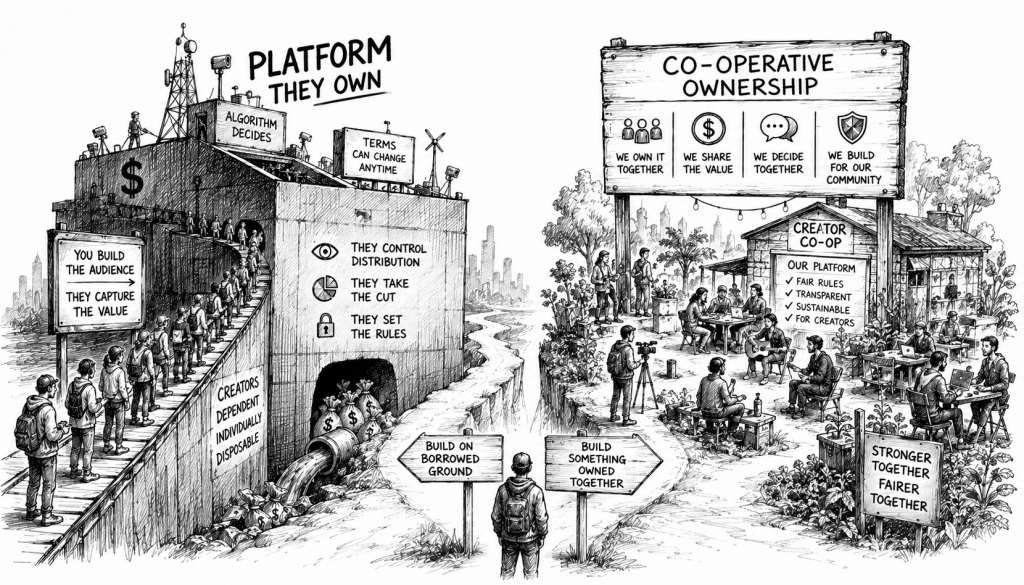
When creators organize into cooperative ownership structures instead of individual platform dependency, what changes about who captures the value of their combined audience and output? And why hasn’t this model scaled despite its structural advantages?
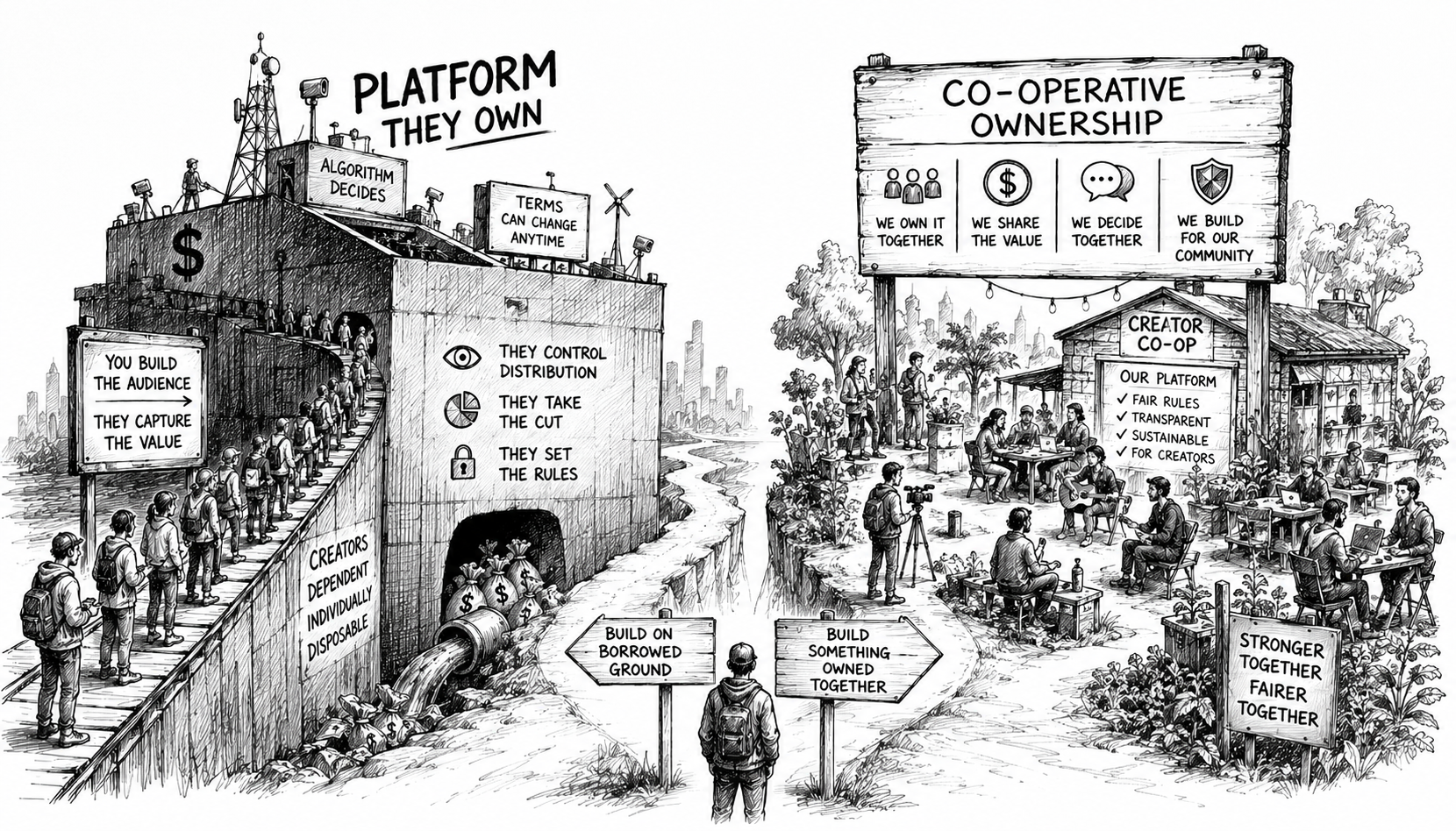
The creator economy is fundamentally built on platform dependency. Individual creators build audiences on platforms they don’t own. They generate content algorithms decide whether to distribute. They build subscriber bases on services that can change terms, reduce payouts, or change the revenue-share model without negotiation. That structure concentrates power toward platform operators and away from the creators whose output drives the platform’s value.
Cooperative ownership offers a structural alternative. When creators jointly own a platform, distribution channel, or revenue-generation infrastructure, they hold collective power to set terms, allocate revenue, determine content policies, and make strategic decisions together. The theoretical advantages are significant: creators keep more of the revenue they generate; they have explicit voice in platform governance; the infrastructure is designed to serve the creators’ interests rather than maximizing extractive monetization; and collectively they can compete with platforms that would otherwise dictate individual terms.
Examples exist at various scales. YouTube alternatives built cooperatively. Substack’s creator-friendly approach (though not structurally cooperative) positioned itself explicitly against platform extraction. Some musicians organized collective distribution services. Artist collectives structured themselves as cooperative businesses. The mechanisms work: cooperative structures do distribute power and revenue more equally than platform-dependent alternatives.
But the model hasn’t scaled. Most creators remain individually dependent on major platforms. Cooperative alternatives remain marginal. The structural advantages don’t automatically produce network effects strong enough to compete with dominant platforms. New creators entering the space face a question: build an audience on the platform everyone else uses, or bet on a smaller cooperative network where audience is smaller but ownership is distributed. Platform effects reward the concentrated model. Creators choosing cooperatively self-select into smaller networks. Smaller networks generate fewer opportunities. The powerful choice (platform dependency) becomes the rational individual choice.
There’s also a skills gap. Building and maintaining cooperative infrastructure requires technical, legal, and operational competencies that individual creators don’t possess. Platform companies employ teams of engineers, product designers, content moderators, payment specialists, and legal experts. Creator cooperatives often operate at much smaller scale with volunteer or partially funded teams. The infrastructure gap compounds the network gap.
The structural tension is that cooperative ownership solves a distribution problem (who gets the revenue) while operating in a network-effects market (audience size determines viability). Individual creators save time by joining an existing platform instead of building or joining a cooperative infrastructure. That time-savings is real. The revenue loss from platform extraction is abstract and spread across time. For the individual decision-maker, the platform remains the rational choice even though the collective outcome (creators remaining extracted from) strengthens the very platforms whose extraction the cooperative is meant to address.
What’s worth tracking is whether any cooperative alternative achieves scale large enough that new creators see it as the viable network rather than the niche option. Until that threshold is crossed, structural advantages in ownership and revenue distribution will remain advantages that most creators cannot afford to pursue.