Corporate America Can Schedule the Happy Hour. It Cannot Manufacture the Friendship.
Companies are spending more to recreate the informal relationships that hybrid work eroded. The investment reveals what they’ve lost — and why event planning can’t get it back.
Part of Culture in Motion — examining who defines culture, how it moves, and what it reveals about the moment.
NEWS DESK | SOCIAL STORYTELLERS COLLECTIVE
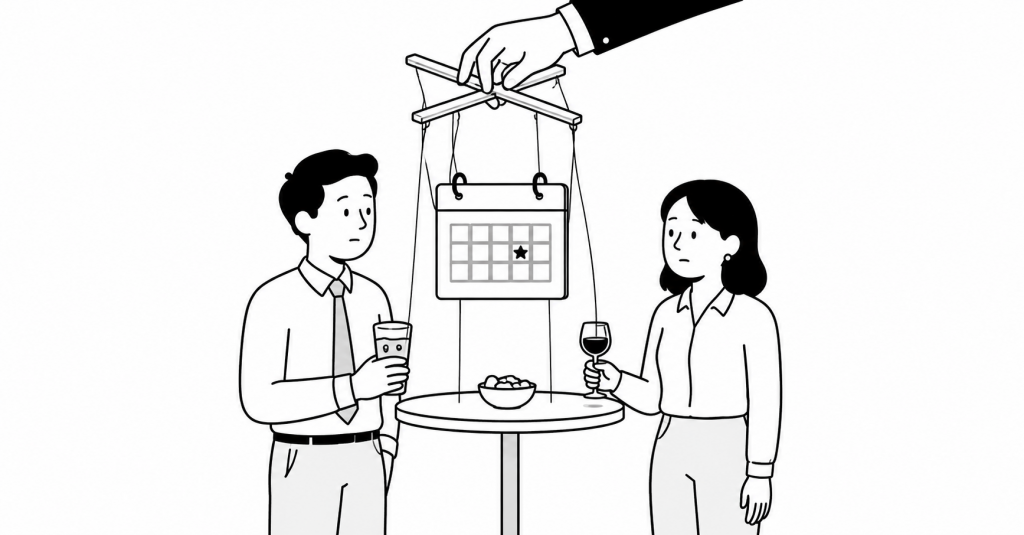
Business Insider’s reporting this week documents an unusual corporate trend: rather than accepting the decline of the traditional after-work happy hour, employers are increasingly investing in organized experiences — barbecues, custom hat-making, line dancing, fitness classes, curated gatherings planned months in advance — to encourage employees to socialize outside the office. The investment is real and growing. The question it raises is whether the thing being invested in can actually be purchased.
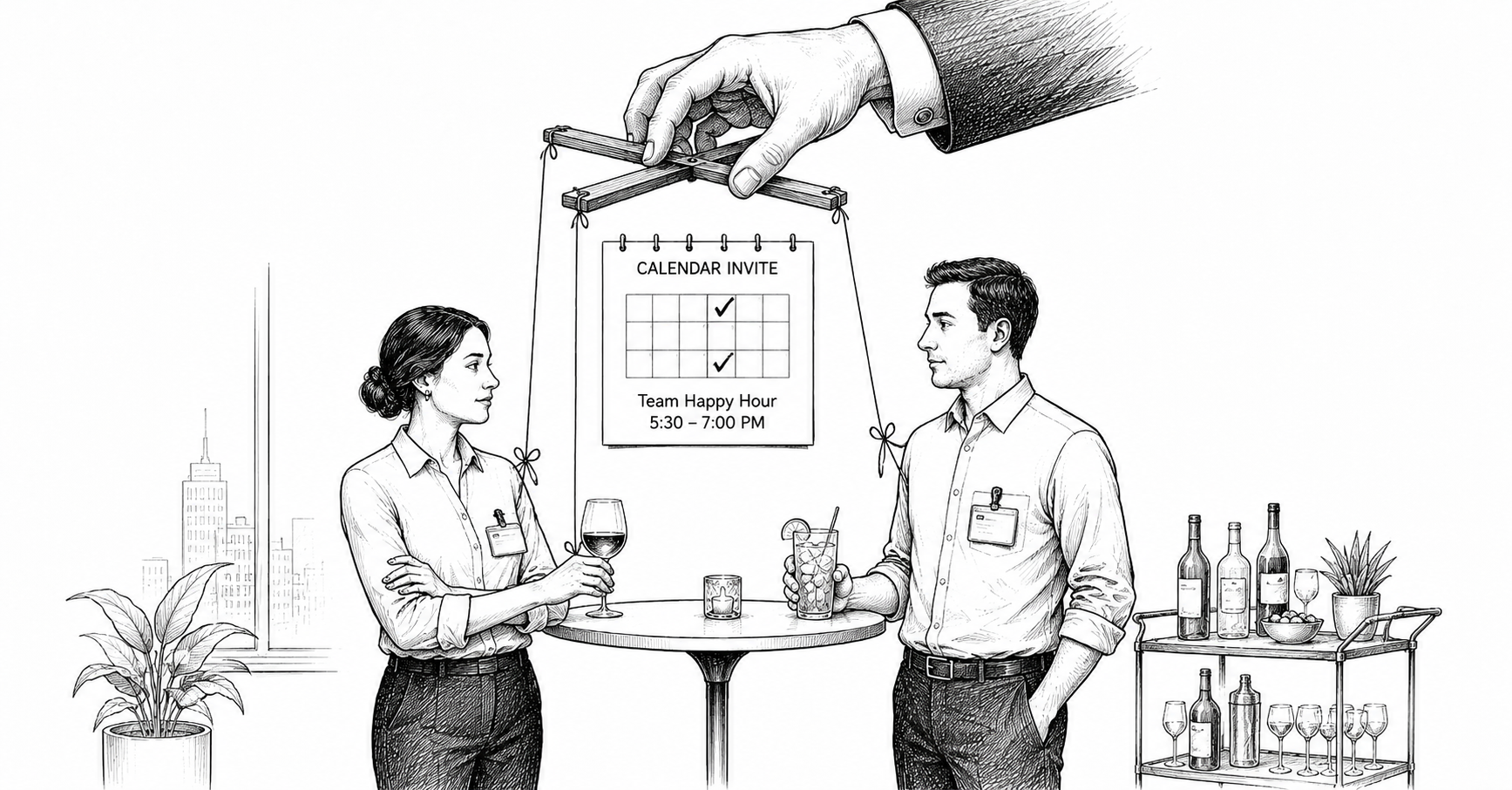
For decades, happy hour succeeded because it required almost nothing. Coworkers finished work, walked to a nearby bar, and spent an hour together. It was inexpensive, voluntary, and spontaneous — the conditions under which genuine social connection tends to form. Those conditions have largely disappeared. Alcohol prices have increased more than 25% since before the pandemic. Hybrid work has disrupted the predictable daily rhythm that once made an after-work drink a natural extension of the workday rather than a separate logistical event requiring time, transportation, and energy. What was once an impulse has become a calendar entry. And calendar entries are exactly what employers are now multiplying in response.
The logic is understandable. Organizations know that informal relationships improve collaboration, trust, and retention — and that the erosion of those relationships has real costs that show up in communication gaps, team friction, and the particular kind of institutional knowledge that travels through hallways rather than Slack channels. If employees are no longer building those relationships organically, employers hope that better programming can fill the gap. Corporate event companies report that businesses are replacing spontaneous gatherings with curated experiences designed to replicate the outcomes that spontaneity used to produce. The problem is that the outcome was never the product of the programming. It was the product of the conditions.
Several employees interviewed by Business Insider describe a distinction that the event budget cannot dissolve: the difference between choosing to spend time with a coworker and attending a company-sponsored gathering where that coworker is also present. At an informal gathering, employees choose who they engage with, how long they stay, and how much of themselves they reveal. At an employer-organized event, the attendance may be technically voluntary, but the workplace hierarchy is still fully operational. Managers are still managers. Performance reviews are still coming. Conversations are still filtered by the awareness of professional consequence. The open bar does not change the organizational chart. Employees know they are still at work, which means they are still performing a version of themselves calibrated for that environment — and friendship does not develop through performance. It develops through the gradual, repeated lowering of guard that happens when the stakes feel genuinely low.
That distinction points to a deeper structural problem that event planning cannot reach. As SSC documented in The Return to Office Isn’t About Collaboration. It’s About Control., the mechanisms companies use to rebuild workplace culture are increasingly organized around visibility and observability rather than the conditions that actually produce connection. The return-to-office mandate is one version of that logic — get people in the same building and assume the relationships will follow. The curated happy hour replacement is another. Both treat the physical or social proximity as the mechanism when proximity was always just the environment in which the actual mechanism — repeated, low-pressure, unscripted interaction — could operate. You cannot recreate spontaneity by scheduling it. You can create an event. The event is not the thing.
The disappearance of unstructured workplace interaction is the real story underneath the happy hour trend. Remote work, hybrid schedules, longer commutes, rising costs, and the general compression of discretionary time have reduced the casual moments where relationships develop without anyone organizing them. Those moments — the elevator conversation, the coffee run, the five minutes before a meeting starts — are where people learn who their colleagues actually are. They are also the moments most invisible to corporate culture strategy, precisely because they cannot be planned, measured, or budgeted. And so they are the moments that companies are least equipped to replace, even as they invest heavily in the events they hope will substitute for them.
Why This Matters
Corporate America is discovering that culture cannot be programmed into a calendar invitation — but it is learning that lesson slowly, through increasingly elaborate and expensive attempts to engineer what used to happen for free. The traditional happy hour may be fading, but what companies are really losing is not the drinks. It is the informal social fabric that makes workplaces function beyond job descriptions, that carries institutional knowledge between people rather than between documents, and that produces the trust that makes collaboration possible when the stakes are high and the instructions are unclear. Events can provide the opportunity for that fabric to form. They cannot provide the conditions. And the conditions are exactly what the last five years of workplace transformation have systematically removed.