Charlotte Is Carrying 10% More Layoffs Than Last Year. The Announcements Never Made the News.
Over 1,600 workers have lost jobs in the Charlotte region so far in 2026. Most of the companies cutting them never said a word publicly.
Part of Society, Economy & Wellness — examining how economic pressure reshapes labor, access, and everyday life.
NEWS DESK | SOCIAL STORYTELLERS COLLECTIVE
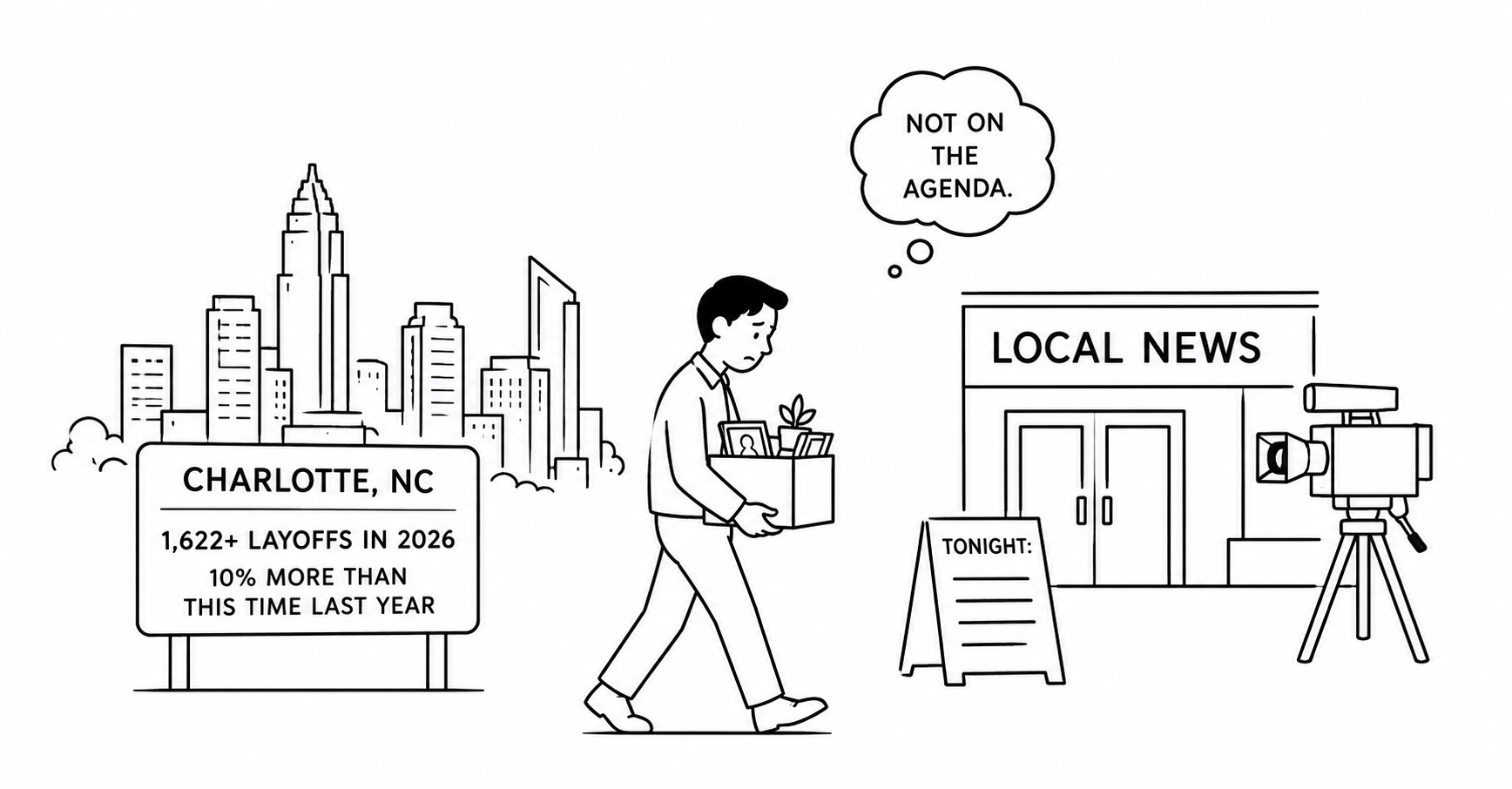
The Charlotte Observer’s Desiree Mathurin reported this week that over 1,622 layoff announcements have been made in the Charlotte region through July 2026 — a 10% increase over the same period last year, and 30.5% of all layoffs recorded statewide this year. North Carolina has seen over 5,310 people laid off through July. Charlotte is carrying nearly a third of that number, in a labor market that the headline unemployment data continues to describe as stable.
The pattern is the same one SSC documented in The Layoffs Didn’t Stop. They Just Got Quieter. — WARN Act filings moving through state labor departments without named announcements, without company statements, and without the kind of media coverage that follows a corporate earnings call. Most of the workers losing jobs in Charlotte this year found out through a notice filed to the North Carolina Department of Commerce, not through a news cycle that named them.
The largest single cut in the Charlotte region came from Family Dollar, which is closing its Matthews distribution center in August — eliminating 373 positions and ending distribution operations in North Carolina that began nearly 70 years ago. The Matthews closure is not a sudden decision. Since Family Dollar was acquired by Dollar Tree in 2015 in a deal that created a combined company with over $19 billion in annual sales, more than 1,600 Matthews jobs have been cut or relocated. The acquisition that promised scale delivered displacement, in installments, over a decade.
The April through July cuts reveal the same pattern at different scales. Nippon Electric Glass, a Japan-based manufacturer, is shutting down its Shelby factory — a plant that operated for nearly 70 years, previously under PPG Industries — and laying off 282 workers on August 31. Downlite International is closing its Monroe bedding facility, cutting 113 people. Lions Services, an east Charlotte nonprofit, laid off 107 workers after a contract ended with no comparable replacement. Three companies, three different industries, three closures that share the same structural characteristic: facilities that have operated for decades, in communities that built their workforce around them, being wound down in a single quarter.
The statewide comparison sharpens the picture. Between January and July 2025, over 3,840 people were laid off across North Carolina. The same period in 2026 has already produced over 5,310. That is a 38% increase statewide in one year, in a state whose labor market the aggregate data continues to describe as largely resilient. The WARN filings capture what the aggregate doesn’t — the specific number, the specific person: the worker in Matthews who built a 20-year career at a distribution center closing in August, the worker in Shelby whose plant has operated since before their parents were born. The unemployment rate folds those people into a percentage point and moves on.
As SSC documented in America Has More Jobs Than Ever. Why Does Everyone Feel Replaceable?, the official statistics were designed to measure a labor market that no longer exists. The Charlotte data is the regional version of that argument. A 38% increase in North Carolina layoffs year-over-year is not a blip. It is a direction. And it is being documented primarily through WARN filings that most workers never see until they are personally handed one.
Why This Matters
Charlotte is the second-largest banking center in the United States and one of the fastest-growing metros in the Southeast. Its labor market narrative is almost always told through those facts — the corporate relocations, the new headquarters, the skyline under construction. The WARN data tells a parallel story about the workers at the distribution center in Matthews, the glass factory in Shelby, the bedding facility in Monroe — facilities that have operated for decades, that built their communities’ employment base, and that are closing in 2026 in filings that generate no headline and no public statement. That story does not cancel the growth narrative. But it names who is not in it.