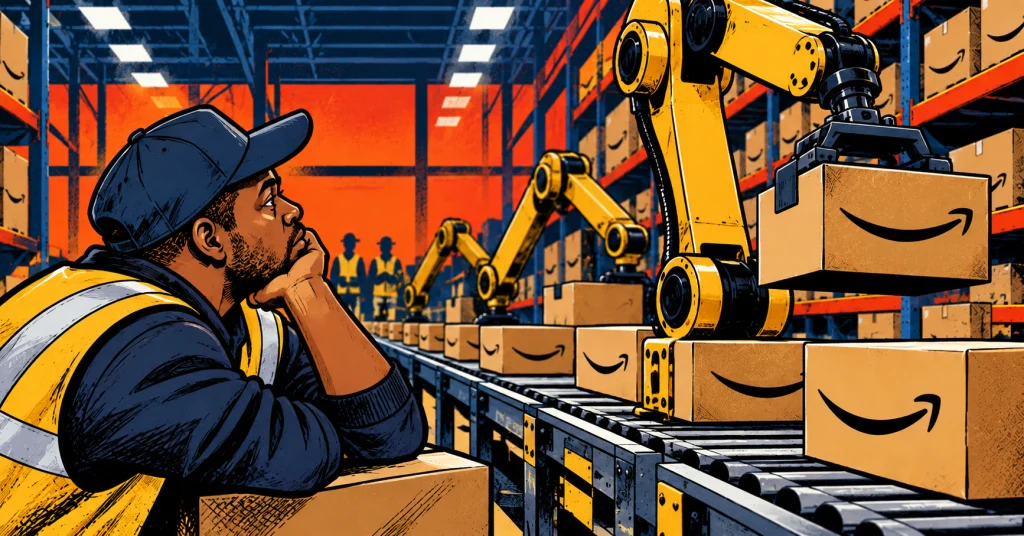
Internal projections suggest Amazon could avoid hiring more than 600,000 U.S. workers by 2033 as robots take over more of its warehouses. The bigger question is what happens when a company’s growth no longer brings the jobs it once did.
For decades, a growing company like Amazon came with an unspoken promise: more warehouses, more deliveries and more customers would mean more jobs. Amazon became one of America’s largest private employers by building a vast network of facilities that needed people to move, sort, pack and ship millions of products, often in communities where factory jobs had disappeared. Now the company is building toward a future in which its business can keep growing without its workforce growing alongside it.
Internal strategy documents reported by The New York Times last October showed Amazon’s robotics team projecting that automation could let the company avoid hiring more than 600,000 U.S. workers by 2033, even as it sells twice as many products. By 2027, the team expected to avoid hiring more than 160,000, saving about 30 cents on every item picked, packed and delivered. The longer-term goal was to automate as much as 75% of operations. These were internal projections and ambitions, not companywide staffing targets, and Amazon spokesperson Kelly Nantel said the documents reflected one team’s view, not the company’s overall hiring strategy. Still, the takeaway is clear: Amazon hasn’t announced a plan to lay off 600,000 people. The projection describes hundreds of thousands of jobs that might never be created.
The technology isn’t hypothetical. Amazon passed one million warehouse robots in 2025, and it expects to more than double its robotic arms by the end of this year, Ars Technica reported this month. The company says automation makes work safer and creates skilled jobs. Facilities with its most advanced systems need 30% more workers in maintenance, reliability and engineering roles, and its recordable injury rate fell 43% between 2019 and 2025. But the picture isn’t simple. A 2025 study coauthored by George Mason University’s Brad Greenwood found that robot-equipped warehouses had 40% fewer severe injuries but 77% more strain injuries, which Greenwood links to the faster pace robots can set.
The bigger shift is harder to see. When a company lays people off, there’s an announcement, a number and a story. Workers get notices, may qualify for unemployment and retraining, and local officials can measure the damage. A job that’s never created makes no news. There’s no one to interview and no layoff total to report. The effect shows up slowly: fewer openings, more competition for the ones that exist and fewer ways in for people trying to start or restart a career. That’s a different kind of labor disruption, and it’s harder for policymakers to see, let alone address.
Think about a town where a new distribution center once meant hundreds of jobs that paid steady wages without a four-year degree, plus business for the restaurants and gas stations nearby. If a future facility ships the same volume with far fewer people, the warehouse may still pay taxes and generate revenue, but the jobs that made it worth courting won’t grow at the same rate. We’ve seen versions of this before. When Audi announced a $4 billion Georgia plant, the 4,500 jobs came with a five-year wait. With automation, some of those jobs may never come at all.
Amazon points to the technical jobs automation creates, and those matter. But a robotics technician job doesn’t do the same work in the economy as an entry-level warehouse job. It requires different skills, it may be in a different place, and there may be far fewer of them. Retraining can help, but only if it’s affordable, tied to real openings and possible for workers who can’t afford to stop earning while they learn. Without that, automation can open doors for some workers while closing them for others.
Amazon isn’t alone, and its choices tend to set the pace for everyone else. It has already cut roughly 30,000 corporate jobs since last year. This week, Microsoft offered buyouts to 60,000 employees while pouring billions into AI, and companies have cited AI in more than 120,000 announced U.S. job cuts this year, more than any other reason. If Amazon proves a company can grow dramatically without hiring proportionally, competitors in retail and logistics will feel pressure to follow. And if growth stops reliably producing jobs, communities will need new ways to judge what a corporate investment is actually worth to them.
Then there’s the question of who keeps the savings. Automation could mean safer jobs, lower prices or better-paid technical roles. It could also simply mean higher profits. None of those outcomes is automatic. As we’ve reported, corporate America is booming while workers’ paychecks buy less. How the gains from automation get shared will depend on company decisions, competition and public policy, not on what the robots can do.
Amazon’s projections aren’t destiny. Its actual hiring will depend on demand, how well the technology works and where the company chooses to grow. But for years, we’ve measured corporate labor decisions through layoffs, hiring announcements and monthly jobs reports. Those numbers still matter. They just may miss a future where companies do more work with far fewer new people.
For the workers who would have filled those jobs, a job that never exists can matter just as much as one that disappears.