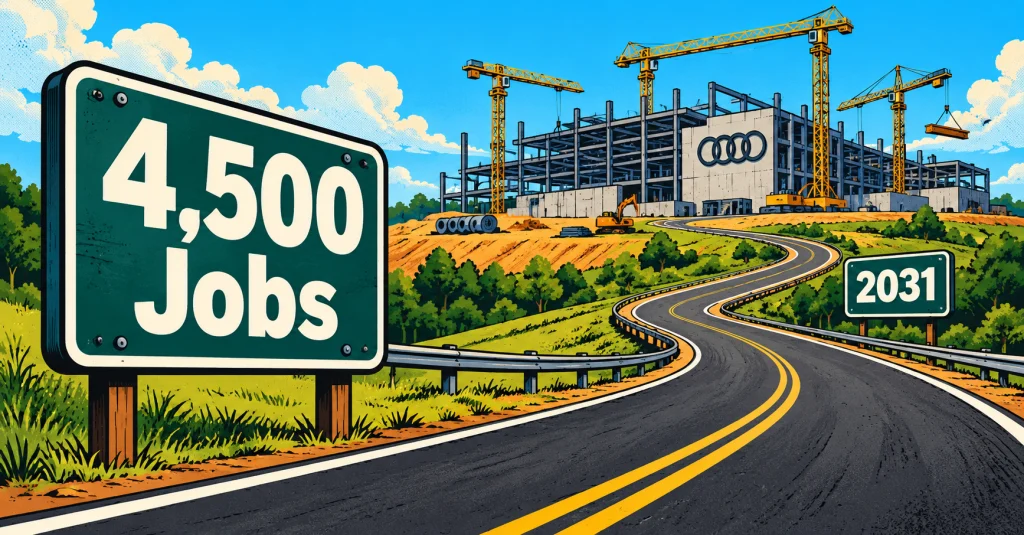
The German automaker plans to create 4,500 jobs at its first U.S. manufacturing plant, but full production is not expected until 2031. For Georgia communities, the promise of economic growth now comes with a five-year timeline.
Imagine living in a community where a major employer announces thousands of new jobs, only to learn that the factory producing those opportunities will not be fully operational for another five years. For workers looking for a better-paying position, recent graduates deciding whether to remain in their hometown and small businesses hoping for new customers, the announcement offers something worth anticipating. It does not necessarily offer something they can use today.
That is the situation facing communities in Middle Georgia after German luxury automaker Audi announced plans to establish its first American manufacturing facility near Macon. President Donald Trump highlighted the investment during a Saturday campaign rally in Perry, describing a $4.2 billion project expected to produce approximately 200,000 vehicles annually and create 4,500 jobs. Audi and Georgia officials put the planned investment at approximately $4 billion. The factory will focus on premium SUVs for the North American market, according to the Associated Press and Audi’s October 25 announcement.
The numbers are substantial, especially for a region seeking long-term economic development. But Georgia’s official timeline places site grading in 2027, factory construction in 2028 and full production in 2031. That means thousands of permanent manufacturing positions are still years away, with hiring expected to unfold as the project develops rather than arrive all at once.
A Major Investment With a Long Timeline
Georgia has spent years positioning itself as a destination for automotive manufacturing. The state has attracted investments from major vehicle manufacturers and suppliers, developing an industrial network that offers access to transportation infrastructure, trained workers and established supply chains. Audi’s decision adds another international automaker to that growing manufacturing economy.
The company selected the Middle Georgia Megasite, a development site supported by Peach, Houston and Macon-Bibb counties. State officials say the location offers existing utility infrastructure and completed site assessments that can help accelerate development. Audi also cited Georgia’s workforce and proximity to automotive suppliers as factors in its decision.
For the company, building an American factory addresses more than employment or political considerations. Audi currently relies on international production to serve the U.S. market, exposing its business to trade restrictions, currency fluctuations and transportation costs. Manufacturing vehicles domestically could improve competitiveness while allowing the company to respond more directly to American consumer demand.
Trump credited his administration’s tariffs with encouraging the investment. Audi, meanwhile, described the project as part of a broader strategy to strengthen its North American business and reduce exposure to trade and currency risks. Both explanations are relevant, although the company’s stated rationale extends beyond tariffs alone.
Who Gets the 4,500 Jobs?
The employment commitment may prove to be the project’s most consequential measure for surrounding communities. A factory of this size can generate demand for production workers, technicians, engineers, logistics specialists, maintenance personnel and managers. Suppliers and service businesses may also expand as manufacturing activity increases.
Yet an announcement of 4,500 jobs does not establish how those positions will be distributed, what qualifications applicants will need or how many will be accessible to existing residents. Nor does it establish the average wages, benefits or advancement opportunities workers will receive.
Georgia officials say the state’s Quick Start workforce development program will collaborate with Audi on customized training, including instruction through campuses in the Technical College System of Georgia. That preparation could become particularly important for residents who have experience in other industries but lack the technical credentials required for modern automotive manufacturing.
The difference between creating jobs in a community and creating opportunities for people already living there is significant. Training availability, hiring practices, transportation and wages will help determine whether the factory expands economic mobility for local households or primarily attracts workers who already possess specialized skills.
The Economics Beyond the Factory
Large manufacturing projects can reshape regional economies well before the first vehicle leaves an assembly line. Construction companies may receive contracts, suppliers may seek nearby facilities and local businesses may prepare for increased demand. Public agencies, meanwhile, must consider whether roads, utilities, housing and other services can accommodate the additional activity.
Those opportunities also introduce financial questions. Communities pursuing major employers sometimes provide tax incentives, infrastructure improvements or other public support to secure projects. The value of any such arrangements depends partly on whether promised investment and employment targets are reached.
For Audi’s Georgia project, the public announcements reviewed do not establish a complete incentive package or a detailed schedule for hiring all 4,500 workers. Those details will be important as state and local officials evaluate the public return on the investment.
The project also arrives during a politically consequential week. Trump announced it just days before the November 3 midterm elections, when economic conditions, manufacturing employment and household costs are central issues for voters. An investment announcement provides elected officials with an immediate example of potential economic growth, even though the employment and production benefits will unfold across several years.
Georgia residents will have considerably more time to assess the results. The relevant milestones will include whether construction proceeds as scheduled, how many employees are hired locally, what those positions pay and whether the surrounding communities experience lasting improvements.
Audi’s investment represents a substantial commitment to American manufacturing. But for the families who may eventually depend on those jobs, the announcement is the beginning of an economic story, not its conclusion. The $4 billion figure describes what the company intends to invest. The 4,500 jobs describe what it expects to create. The years between now and 2031 will determine how much of that promise becomes reality.