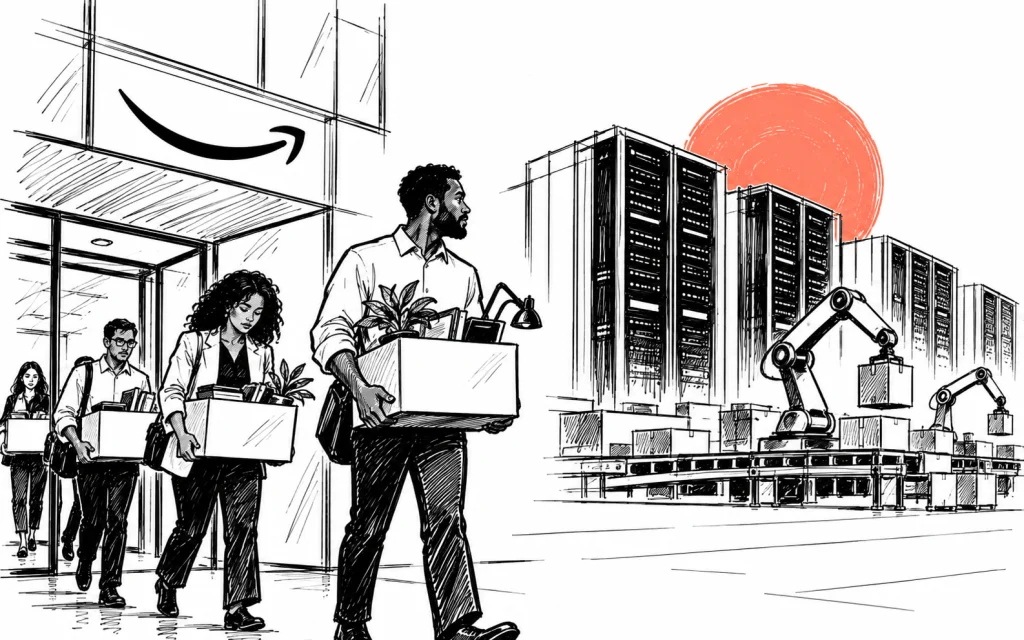
Amazon has cut another group of white-collar jobs, primarily inside the Stores division that runs its core e-commerce business, extending a restructuring cycle that has already eliminated roughly 30,000 positions since last year. Fewer than 1,000 workers were affected in the latest round, according to Reuters. The cuts touched areas including customer service and selling-partner services, with employees in the United States, India and the United Kingdom receiving notices. The number is small compared with Amazon’s overall workforce, but the pattern is becoming more important than the size of any single round.
The Layoffs Are Becoming Continuous
Amazon’s latest cuts arrived during Prime Big Deal Days, one of the company’s biggest shopping events. That timing captures the contradiction facing white-collar workers across large technology and retail companies: strong sales activity and aggressive investment no longer guarantee stable headcount.
Amazon described the move as an adjustment to parts of its Stores business so the organization could better support company priorities. Founder and executive chairman Jeff Bezos separately said the company had overhired during the pandemic, when online shopping surged and Amazon rapidly expanded its workforce.
That explanation accounts for some of the retrenchment, but it does not fully explain why the cuts are continuing in smaller waves long after the initial correction. Amazon’s larger 30,000-job reduction began last year and continued into January. Now employees are facing narrower reductions that can hit individual functions or teams without a single companywide layoff announcement.
Smaller Cuts Can Create Longer Uncertainty
That rolling approach changes the experience of a layoff cycle. A single large restructuring creates a defined event. Repeated smaller cuts can leave workers uncertain for months about whether their team is next.
Reuters reported that affected employees used internal Slack channels to ask about severance, medical leave and whether they would have time to seek internal roles before departure. The pattern also makes workforce reductions harder to track: a company can say each individual round is small while still producing a substantial cumulative reduction over time.
Amazon is not shrinking everywhere. Business Insider reported that the company is planning roughly $220 billion in spending on AI infrastructure, including data centers and chips. That contrast is increasingly common across corporate America: fewer roles in some traditional white-collar functions alongside enormous capital investment in automation, AI and infrastructure.
The Workforce Is Being Reallocated, Not Simply Reduced
The question is no longer simply whether a company is growing or shrinking. It is which kinds of work it wants to keep, which functions it wants to automate and where it wants to concentrate future investment. Amazon’s Stores division sits at the center of the company’s retail operation, yet even that unit is being restructured.
Amazon has not said the latest cuts were directly caused by AI. Cost control, pandemic-era overhiring and organizational redesign are all part of the story. But the company is simultaneously telling investors that AI is a major strategic priority while continuing to reduce corporate headcount.
A New Normal for White-Collar Work
The larger labor-market signal is that layoffs no longer need to come during a recession or a collapse in demand. Companies can cut jobs while revenue is strong, markets are high and major investment programs are expanding. A profitable company can still decide that a role no longer fits its structure.
Amazon remains one of the world’s largest employers, with more than 1.5 million workers globally. The latest round represents only a fraction of that total. But for white-collar employees, the relevant comparison is not Amazon’s warehouse workforce. It is the shrinking pool of corporate jobs being repeatedly reorganized.
For SSC, the latest cuts show how restructuring has evolved. The big layoff announcement may no longer be the only warning sign. The new model can be smaller, repeated and spread across months — while the company continues spending heavily everywhere it believes the future is being built.