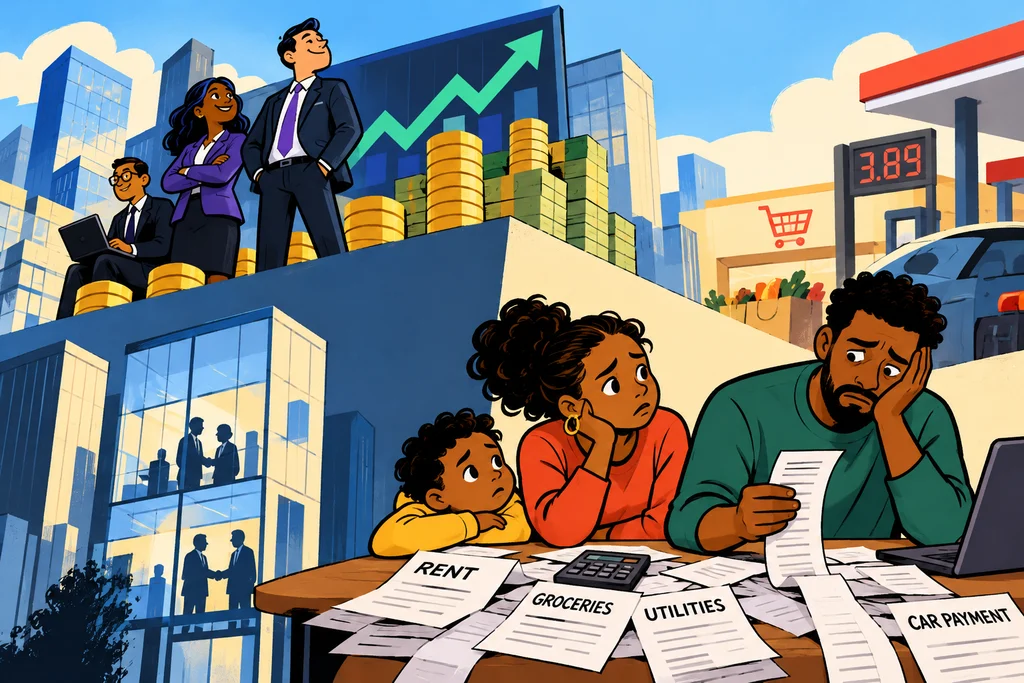
A worker earning a little more than last year might expect a little extra at the end of the month. Instead, the raise disappears at the gas pump, in the grocery aisle and into the ordinary costs of keeping a household running. The paycheck has grown, but what it can buy has shrunk, and that experience is getting harder to square with claims that the American economy is booming.
Donald Trump and his administration have repeatedly called the economy strong, pointing to business investment, corporate profits and continued job growth. Those numbers reflect real activity. They do not necessarily describe the finances of the people whose spending keeps the economy moving.
The latest federal data shows the divide clearly. Corporate profits from current production jumped by $400.9 billion in the second quarter, at a seasonally adjusted annual rate, after rising $74.4 billion in the first, according to the Bureau of Economic Analysis. Over roughly the same stretch, average hourly earnings adjusted for inflation fell 0.7% from September 2025 to September 2026, the Bureau of Labor Statistics reported. Companies are earning more, while an hour of work is buying less.
A Strong Economy That Feels Weak at Home
The math is simple. Consumer prices rose 3.7% over the year through September, while average hourly pay rose 3.0%, so most workers got a raise on paper and a pay cut in practice. In September alone, real hourly earnings fell 0.5% from August.
Energy is doing much of the damage. Higher gas prices hit households directly, and they also raise the cost of moving goods, which can show up later on store shelves, the same chain SSC traced in how diesel prices travel through the economy. Those costs stack on top of pressure from rent, insurance, groceries and borrowing.
The administration argues the broader economy remains resilient and that gloomy sentiment surveys understate its strength. Unemployment is still low by historical standards and investment continues. But strong totals cannot answer a separate question, whether households are actually seeing their standard of living improve.
The AI Boom Is Creating Wealth. Who Is Receiving It?
Artificial intelligence has become one of the biggest forces in business investment, with technology companies pouring money into data centers, chips, power and software. That spending supports construction, manufacturing and corporate earnings, and it helps explain why parts of the economy keep expanding even as affordability worsens.
The gains are not spread evenly. Moody’s Analytics chief economist Mark Zandi said in January that AI added more to 2025 growth than expected, in large part through rising AI stock prices that created “positive wealth effects on consumer spending by well-to-do shareholders,” Newsweek reported. In other words, a big share of the boost runs through people who own stock, not people who live on wages.
Wall Street has a name for that pattern. JPMorgan Asset Management’s 2026 outlook projected a “K-shaped” expansion in which affluent households and well-capitalized companies pull ahead while middle-income consumers stay “soggy,” Benzinga reported. AI may eventually lift productivity, lower costs and create new jobs, but future benefits do not pay this month’s bills for households losing ground today.
Companies Are Producing More Without Hiring More
The job market adds another twist. Employment in finance, insurance, information and professional services is down about 2% since the end of 2022, while inflation-adjusted output in those industries is up about 16%, according to Burning Glass Institute chief economist Gad Levanon, Business Insider reported. Businesses are learning to do more with fewer people, a shift SSC has followed as AI became the top reason for layoffs and companies like eBay cut jobs while growing.
Higher productivity is how economies get richer over time, and nobody should want less of it. The question is who gets the gains. If they show up as higher wages and new jobs, workers share in the boom, but if they mostly show up as profits and stock prices, the people doing the work can end up with heavier workloads, fewer promotions and less security while their employers post strong results.
Consumers Cannot Absorb Every Increase Forever
American households have kept spending through years of disruption by trimming extras, delaying big decisions and leaning on credit, a pattern SSC has tracked as more families live paycheck to paycheck. That adaptability has kept the economy moving, but it is not unlimited. When more of every paycheck goes to gas, utilities and groceries without matching raises, less is left for restaurants, travel and the other purchases that feed corporate earnings.
That is the uncomfortable math for corporate America. Companies have every incentive to hold down labor costs and pass along higher expenses, but their customers are largely the same workers whose pay is falling behind. A business can improve its results this quarter while weakening the consumer base it will need next year.
Whether the economy is booming depends on which numbers you watch. Judged by profits and investment, there is real reason for optimism, but judged by what a paycheck buys, many workers are losing ground. Until wages consistently outpace prices and the gains from growth reach more people, talk of a booming economy will keep describing a reality many Americans do not see in their own bank accounts.