Cellphone Privacy Becomes a Constitutional Battleground
The Court said digital convenience does not erase privacy, but the ruling leaves police, platforms, and users fighting over who controls location history.
AP reported on June 29 that the Supreme Court ruled constitutional privacy protections apply to cellphone users’ location history, sending a geofence warrant case back for further review. The case involved Okello Chatrie, who was convicted after police used a warrant to identify phones near the scene of a 2019 Virginia bank robbery.
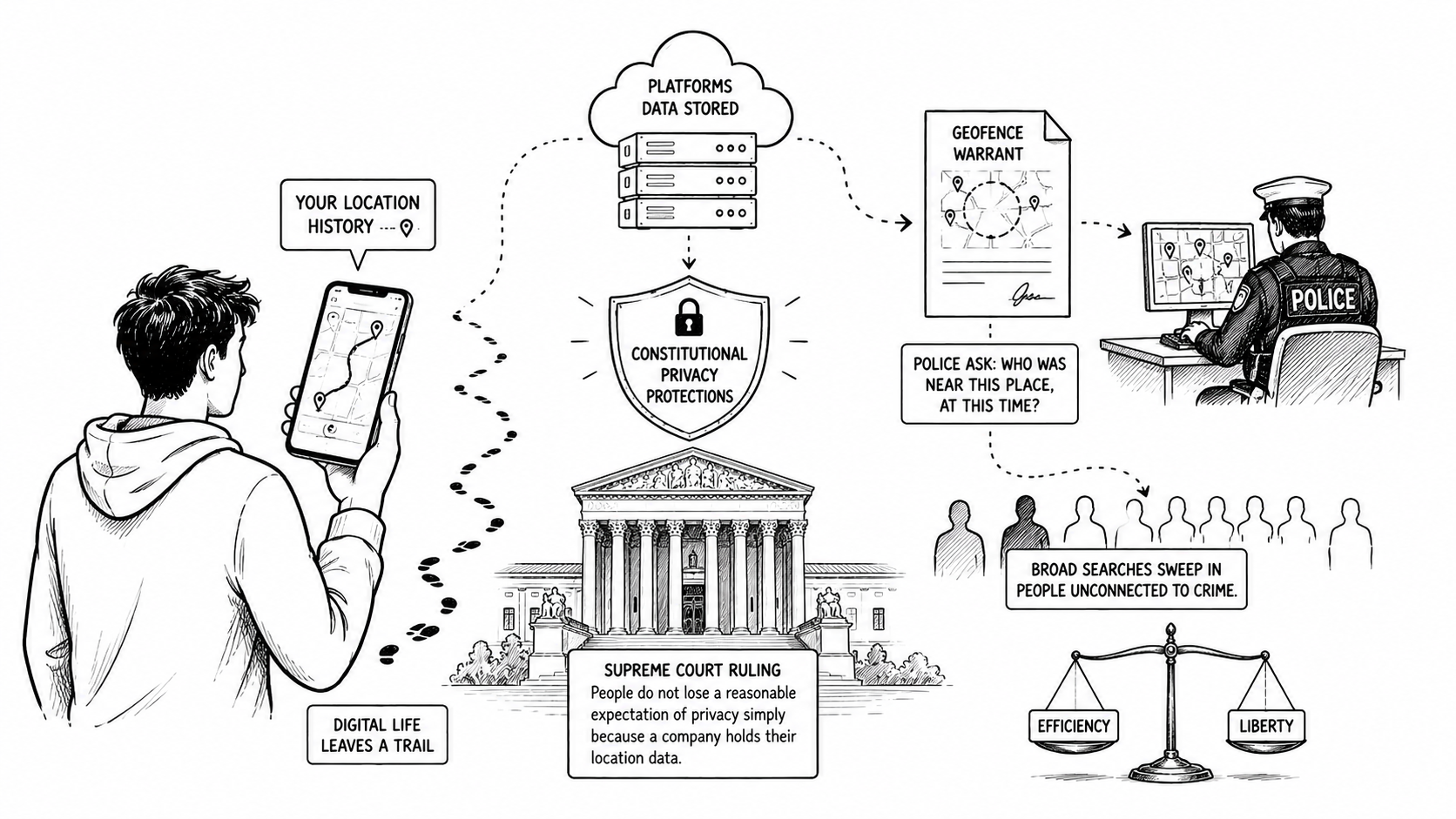
Digital life produces records before anyone decides to investigate. Phones map movement, apps collect location signals, and platforms store pieces of daily life that used to disappear the moment a person walked away. The legal fight starts when police treat that stored movement as a searchable database rather than a private trail.
That is the mechanism behind the geofence warrant. Investigators do not begin with a suspect and then seek evidence. They begin with a place and time, ask a platform which devices were nearby, and work backward toward people. The search changes direction. Suspicion no longer produces surveillance; surveillance helps produce suspicion.
The Court’s ruling matters because it rejects the idea that using a phone means surrendering constitutional protection. AP reported that Justice Elena Kagan wrote the 6-3 decision. The Court did not settle every Fourth Amendment question in the case, but it made the central point clear: people do not lose a reasonable expectation of privacy simply because a company holds their location data.
That principle is now carrying more weight than the old legal categories were built to hold. The Fourth Amendment was written for homes, papers, and physical searches. Modern policing often runs through companies that were not designed as law enforcement institutions but now hold information the state wants. Google, Apple, wireless carriers, and app companies sit between constitutional rights and investigative power.
That position gives platforms a strange kind of public authority. They collect data for commercial reasons, store it inside private systems, and then become gatekeepers when government agencies ask for access. The user rarely sees the handoff. The warrant turns a commercial archive into an investigative tool.
Power moved in this ruling from police discretion toward constitutional oversight, but only partially. The Court did not ban geofence warrants outright. It did not say every location search violates the Constitution. It said the privacy interest exists, which means courts must take the search seriously instead of treating location history as information users casually abandoned.
That distinction will shape the next phase. Police departments will keep arguing that geofence warrants solve crimes efficiently. Civil liberties groups will keep arguing that broad location searches sweep in people who have no connection to the crime except proximity. Platforms will keep trying to manage legal demands without becoming full public actors.
The public is left inside that triangle. Most people cannot function without a phone, and most phones cannot function without producing data. Consent becomes thin when participation in modern life requires the device.
That is why the ruling is bigger than one bank robbery. It is a test of whether constitutional rights can survive when the search target is not a drawer, a car, or a house, but a pattern created by routine participation in digital systems.
The next privacy fights will turn on databases that feel ordinary until the state asks to search them. Location history was the warning shot. Payment trails, app activity, health data, transit records, and connected-car information will force the same argument in new form: whether public life now requires leaving evidence everywhere.