YouTube Doubled the Price of Admission. New Creators Will Have to Prove Scale Before They Get Paid.
SSC News Desk
Building an audience on YouTube used to be the hard part. Starting February 1, 2027, that changes. New creators will need twice as much evidence of scale before the platform starts sharing advertising revenue with them.
YouTube announced this week that it is doubling the entry thresholds for its YouTube Partner Program. Beginning February 1, 2027, new creators seeking access to advertising and YouTube Premium revenue-sharing will need 8,000 qualified watch hours over the previous 365 days, or 20 million qualified Shorts views over 90 days. The current thresholds are 4,000 watch hours and 10 million Shorts views — both requirements are doubling at once.
For a Shorts creator, the math is unforgiving. Twenty million qualified views in 90 days works out to more than 222,000 qualified views every day for three straight months before crossing the threshold once. That is not a milestone someone stumbles across. It requires an audience that is already large and consistently showing up.
What makes this announcement more consequential than a standard threshold adjustment is the Shorts maintenance requirement. Existing Partner Program members will not have to meet the new entry standard — their accounts are grandfathered. But beginning February 1, all creators receiving Shorts revenue sharing will need to maintain 10 million qualified Shorts views per 90-day rolling period to keep that revenue stream active. Fall below it and Shorts monetization stops until the number climbs back over. Long-form revenue can continue. Shorts revenue does not wait.
That is roughly 111,000 qualified Shorts views per day just to hold position. For creators who built their channel around Shorts as a growth engine, this is not an entry barrier — it is a performance floor that never stops moving.
YouTube’s public explanation centers on the platform’s scale. The company says it now generates more than 200 billion daily Shorts views and more than one billion hours of television viewing each day. It also reports that more than 3 million creators are already enrolled in the Partner Program, and expects total creator payouts to increase in 2027. From YouTube’s position, doubling the threshold is about directing revenue toward creators generating sustained audience engagement rather than those who crossed a minimum threshold and stalled.
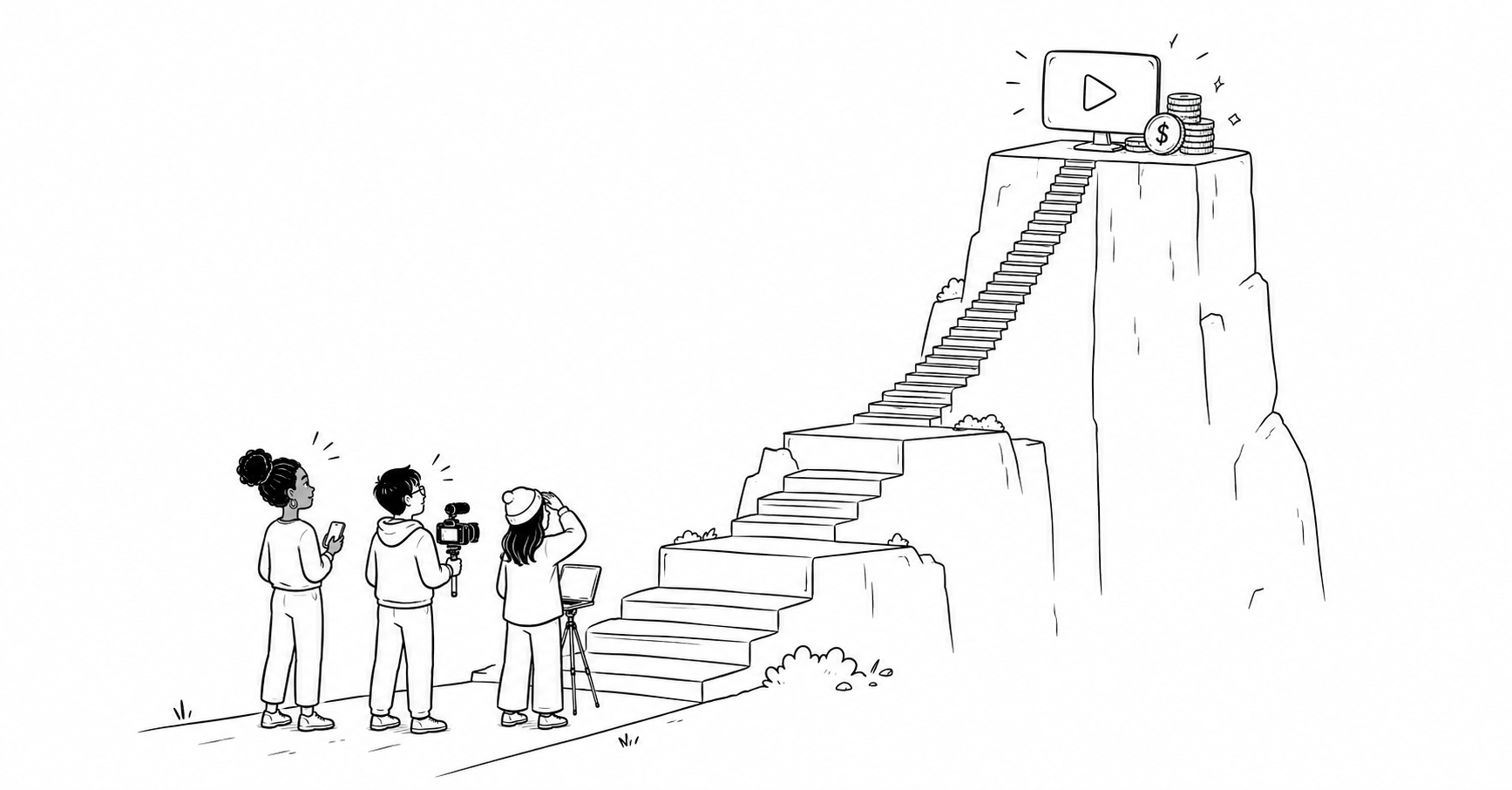
That framing is accurate and incomplete. The creator economy spent a decade building its appeal around a specific promise: publish, grow an audience, and eventually convert that attention into income. YouTube’s new rules do not eliminate that path. They insert a significantly longer gap between step two and step three. A creator can spend years accumulating watch hours, build a real and loyal audience, and still find themselves below the point where the platform shares its advertising revenue. The lower-tier expanded Partner Program — which requires 500 subscribers and either 3,000 watch hours or 3 million Shorts views — remains available and still provides access to fan funding and shopping. What it does not provide is advertising revenue. That window is moving further away.
The lower-tier program unchanged is the part YouTube will emphasize. The Shorts maintenance requirement is the part that deserves closer attention. Monetization has historically been framed as something a creator earns and keeps. For Shorts, it is now something a creator earns and must continuously re-qualify for. That is a different relationship between a platform and the people building on it. It means that a bad quarter — a format shift, an algorithm change, a content experiment that doesn’t land — can cost a creator their revenue access on one of their most active distribution channels, even after years of participation.
YouTube remains one of the largest and most accessible distribution systems ever built. Anyone can upload a video and reach a global audience. But distribution and economic participation are not the same thing, and the gap between them is widening. The next generation of creators will grow audiences on a platform that is increasingly willing to make a distinction between reaching people and being paid by the platform for doing it. Attention remains democratic. The revenue that follows it is becoming selective.