What the Obama Presidential Center Cost Before It Opened
The Obama Presidential Center opens on Juneteenth — a deliberate choreography. A museum dedicated to the country’s first Black president, opening on the federal holiday commemorating the end of slavery, in a historically Black neighborhood on Chicago‘s South Side. The symbolism is complete. The story underneath it is more complicated.
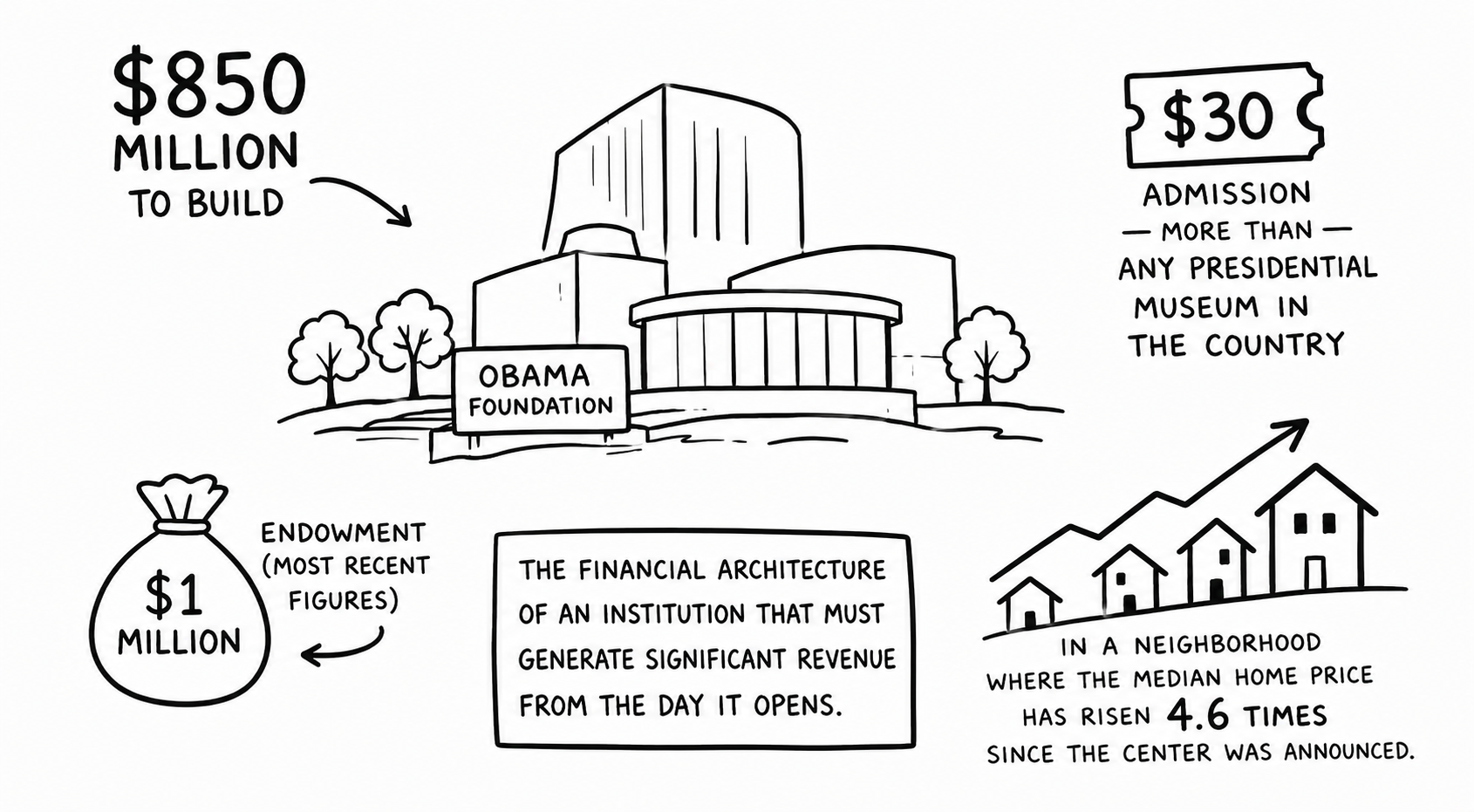
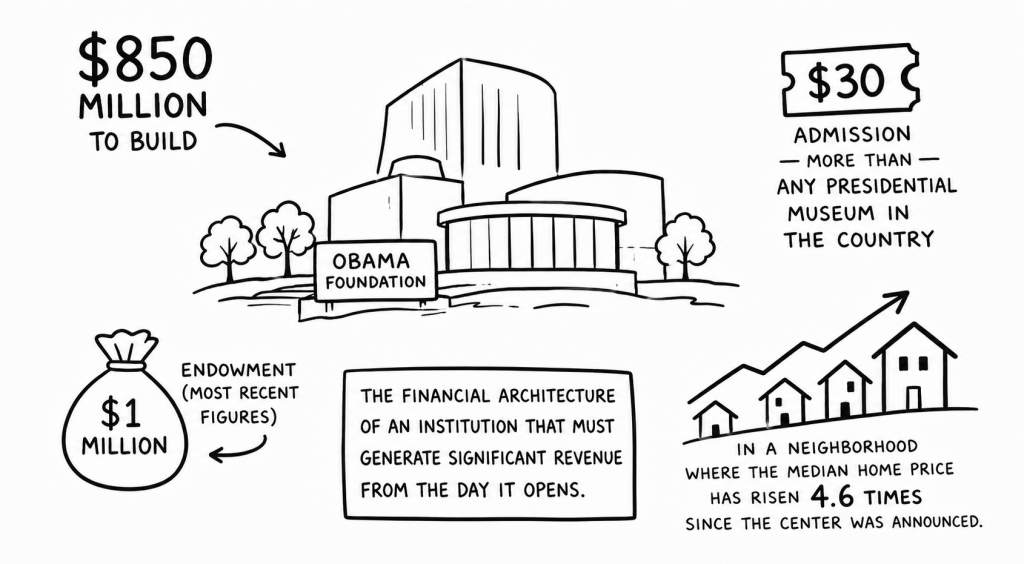
The campus cost $850 million to build. Admission will cost $30 — more than any presidential museum in the country. The Obama Foundation‘s endowment, as of the most recently reported figures, carried a balance of approximately $1 million. That is the financial architecture of an institution that must generate significant revenue from the day it opens, in a neighborhood where the median home price has risen 4.6 timessince the center was announced.
Woodlawn was a predominantly Black neighborhood before the OPC was announced. It remains predominantly Black. What changed in the decade between announcement and opening was the price of staying. Home prices rising 4.6x over that period is not a coincidence of market conditions — it is the documented pattern of what happens to land near a major civic investment when the anticipation of proximity value gets priced in before the investment delivers anything. The residents who were there before the announcement absorbed that appreciation as a cost: higher rents, higher tax assessments, and the sustained pressure of a housing market that had revalued the neighborhood around them.
Illinois lawmakers passed the Woodlawn Housing Preservation Ordinance in 2020specifically to address this. The ordinance required preservation of affordable housing in the corridor surrounding the site. The Illinois Answers Projectfound its enforcement largely ineffective. The protection existed as a political commitment. As a mechanism for keeping existing residents housed through the development cycle, the record suggests it did not hold.
Meanwhile, the Obama Foundation projects $3.1 billion in economic impact over the next ten years from the center’s presence. That number describes activity — tourism, hospitality, retail, construction — that may or may not reach the people who lived in Woodlawn through a decade of anticipation. Economic impact projections count dollars moving through a geography. They do not count whether existing residents remain in that geography to receive them. The question of who captures the value of an investment versus who provided the community that made the investment desirable is not answered by the projection. It is the question the projection tends to obscure. And separately: Black-owned subcontractors who built the campus are reportedly still awaiting payment — a concrete version of the same structural problem, one level closer to the ground.
None of this cancels what the Obama Presidential Center represents. The country’s first Black president building a permanent institution in a Black neighborhood on the South Side of Chicago is a monument to a form of political ascent that was not considered possible within the living memory of people still alive. Juneteenth is not an arbitrary opening date. It is a statement about the arc the Obama Foundation is asking visitors to understand themselves as part of.
What Juneteenth does not resolve is the structural question the center’s own footprint has already posed: whether a monument to Black power that functions as a displacement engine for the Black neighborhood it was placed in has produced the kind of power that protects the people it was built to honor. That is not a reason to oppose the OPC. It is the question the OPC‘s own mission requires it to answer — not at the opening ceremony, but across the decade of housing enforcement, contractor payment, and community access that follow it. The monument opened. The reckoning is what comes next.
— SSC Society & Culture Desk | Social Storytellers Collective
Editor’s Note, June 19, 2026: A reader flagged additional detail on the Obama Foundation’s endowment that strengthens the case made in this piece, and it’s worth stating precisely. The Obama Foundation’s 2020 annual report committed $470 million of its fundraising goal to seed an endowment meant to sustain Obama Foundation activities and the center’s operations “for generations to come,” against estimated annual operating costs of roughly $40 million. As of the center’s opening, reporting based on the foundation’s own filings shows approximately $1 million has been deposited into that fund, with the balance largely unchanged since 2021. The foundation has stated it is in compliance with its agreement with the city, which required the creation of an endowment but did not specify a dollar target, and has said it is “fully funded with generous private contributions” and plans “significant investments” in the endowment going forward. We’re noting this here because it sharpens, rather than changes, the structural argument above: a specific $470 million commitment sitting at roughly $1 million is a different and more precise story than an undefined funding gap.