Governments Are Redefining Childhood for the Digital Age
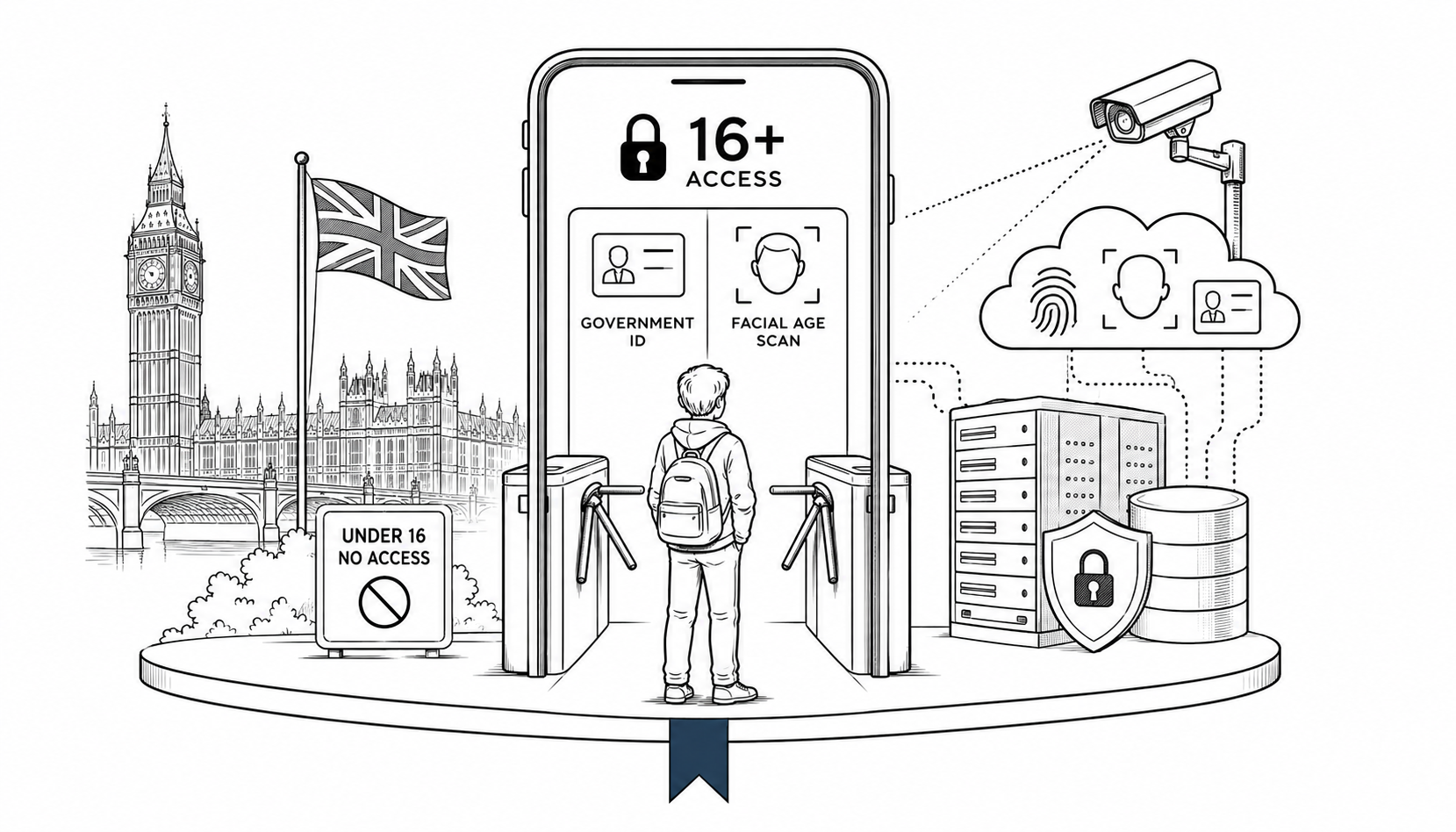
Britain announced this week that it will ban social media access for users under 16, backed by age-verification requirements that will require anyone opening a new account to prove their age with a government-issued ID or pass a facial age scan. The regulations are expected before the end of the year, with implementation in Spring 2027. Users who are 16 or 17 will still have access, but live streaming and direct communication with strangers will be switched off by default.
The policy has public support. 9 in 10 parents back the ban. Two-thirds of young people agree that under-16s should not have access to at least some platforms. The Information Commissioner’s Office has called on platforms to implement facial age estimation, digital ID verification, or photo matching, after finding that self-declaration — the current industry standard — is easily bypassed. The political conditions for this kind of intervention have been building for several years, and Britain is now acting on them.
What the UK is building is not a content moderation system. It is an age-gating infrastructure — a layer of identity verification between a person and a communications platform, enforced at the account level. For the first time in the internet’s mainstream history, using a social platform will require proving who you are to a government or government-accredited body before you begin. The question is not whether platforms influence children. That debate is settled. The question now is whether governments should control the architecture of childhood access to the public digital world — and Britain has answered yes.
The implications run beyond children. Age-verification infrastructure, once built, is infrastructure. A system designed to verify that someone is over 16 can verify other things. The biometric and identity data involved — facial scans, government IDs — does not disappear after a single check. The ICO has said platforms must use these tools. It has not yet fully answered who holds the data, under what conditions, for how long, and what purposes it can serve beyond the age check it was built for.
Other governments are watching. Australia has enacted similar restrictions. France is debating them. European Union regulators have indicated that the Digital Services Act provides mechanisms for comparable requirements. What Britain is implementing at the national level, other governments may implement through different regulatory vehicles — and each implementation will face the same unresolved question: you cannot build a wall around childhood online without also building the surveillance architecture that the wall requires.
— SSC Policy Desk | Social Storytellers Collective