Walmart Was Supposed to Win the Slowdown. Its Shoppers Are Pulling Back Too.
Walmart cut prices on 11,000 items and is collecting $2.9 billion in tariff refunds. U.S. traffic still slowed. The miss says less about one retailer than about how much room households have left.

Walmart reported Thursday that U.S. comparable sales rose 2.6 percent in its fiscal second quarter, against analyst estimates ranging from 3.1 to 3.8 percent depending on the survey, and the stock fell roughly 6 percent on a day the company beat on revenue and earnings and raised its full-year outlook. Some of the shortfall is regulatory rather than behavioral — drug price caps cost about 0.8 percentage points through health and wellness. What remains is still the slowest U.S. comparable growth in about six years, and the composition underneath it is where the consumer signal lives.
Customer traffic increased 1.5 percent, half the 3 percent Walmart recorded in the prior quarter, while spending per transaction rose 1.1 percent. Walmart is growing. What changed is the rate, and at the country’s largest retailer, decelerating traffic tends to register before the same pressure appears elsewhere.
The Trade-Down Playbook Has Been Running for Years
The standard expectation in a consumer slowdown is that Walmart wins. Households swap restaurants for groceries, national brands for private label, and pricier stores for one built around price. That rotation has delivered market share through several cycles, and it is still delivering: Walmart’s largest share gains this year are coming from households earning above $100,000 a year, which means the trade-down is now reaching people who were not previously trading anywhere.
This quarter complicates the pattern anyway, because arriving at Walmart is no longer the end of the adjustment. Once there, shoppers appear to be deciding what to leave in the aisle.
Price Cuts Cannot Reach Costs Incurred Elsewhere
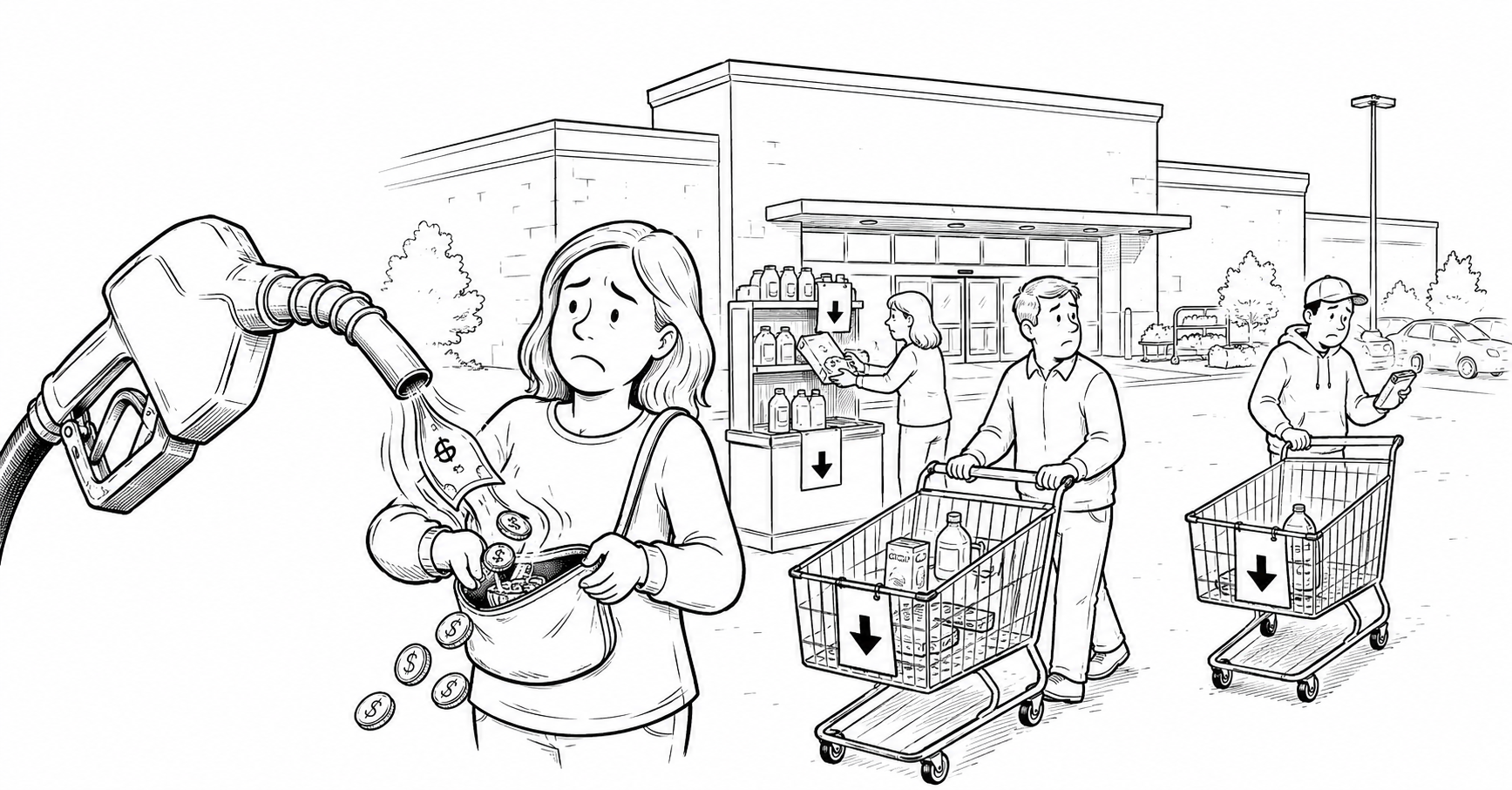
The company has been unusually aggressive on price, reducing prices on roughly 11,000 items, with $2.9 billion in tariff refunds under IEEPA providing additional room. Chief Financial Officer John David Rainey said gasoline above $4 a gallon carries a psychological weight that produces trade-offs, and that June made those trade-offs visible inside the quarter. AAA put the national average at $4.10 this week. Walmart now expects fuel to run more than $2 billion above what it assumed for the year.
Inflation does not have to appear everywhere to constrain a household. Money spent filling a tank is unavailable for apparel, electronics, home goods or the unplanned item at the end of a grocery run. Walmart can cut prices on thousands of products and still lose the sale to an expense incurred twelve miles away at a pump it does not operate.
The macro data had already pointed here. U.S. retail sales unexpectedly declined in July for the first time in nine months. Walmart’s report brings that down to the cart: households are still spending, and the room for optional spending is narrower.
The Store Is Slowing While the Platform Compounds
Walmart’s quarter also shows why calling the company a retailer is becoming imprecise. U.S. e-commerce grew 24 percent and global e-commerce 23 percent, while Walmart Connect, its U.S. advertising arm, rose 43 percent. Advertising and membership now generate roughly a third of operating income. Those lines can expand while physical traffic gets harder to grow, because Walmart increasingly earns by selling access to shoppers rather than only by selling goods to them.
That diversification is what let the company raise full-year guidance on a disappointing comp number. A corporation can strengthen financially while the consumer signals inside its stores weaken, and the two facts can be reported the same morning without contradicting each other. Strong results at a company whose margin increasingly comes from advertising do not describe the health of the households walking its aisles.
Trading Down Has a Floor
For years, economic pressure worked in Walmart’s favor because Walmart was where a stretched dollar went. There is a stage past trading down, and it is buying less.
A 2.6 percent comparable increase is not a contraction, and Walmart’s shoppers have not stopped shopping. But when a company with this much purchasing power, this much price reduction and billions in tariff relief still watches traffic growth cut in half, the explanation does not reduce to whether it priced a television correctly. Price sensitivity is converting into behavior: substituting, postponing, and eliminating rather than relocating.
The third quarter is the clean test, because Rainey said the tariff refunds land in prices then. A full quarter of externally funded price cuts either moves traffic or it does not. If it does not, the binding constraint is income rather than price, and no amount of discounting reaches it.
Watch what that does to Walmart’s usefulness as an indicator. As advertising and membership take a larger share of operating income, the company’s earnings will keep beating while its store data keeps softening, and the gap between those two numbers will widen every quarter. Walmart has been the closest thing the U.S. has to a public read on household finances. It is quietly becoming a media business that also sells groceries, and media businesses do not tell you what the country can afford.