Public Bathrooms Are Where Equality Becomes Physical
A Temple historian’s new book argues that America’s fights over equality have often ended at the same place: the bathroom door.
Bryant Simon, Laura H. Carnell Professor of History at Temple University, has written For Customers Only: Public Bathrooms and the Making of American Inequality, scheduled for release Sept. 8 by the University of Chicago Press. Temple describes the book as the first to tell the larger history of public bathrooms in the United States. Simon’s central argument is simple and sharp: public bathrooms are not just infrastructure. They are a measure of who gets to move freely through public life.
That framing changes what seems like a mundane civic issue. Bathrooms are usually discussed as a maintenance problem, a safety problem, a business problem or a culture-war problem. Simon’s research pushes the issue somewhere more fundamental. If a person cannot meet a basic bodily need while moving through a city, workplace, school, store, park or transit system, then access to public life is conditional. Equality becomes theoretical when the body has nowhere to go.
Simon told Temple that nearly every major social movement he studied had a bathroom-door moment. Civil rights, gay rights, trans rights and homeless rights all collided with restroom access because bathrooms were used to exclude people and make them less equal. That history reveals why these fights carry so much force. The issue is not only whether a facility exists. It is who it was built for, who is allowed to use it, who is policed at the door and who is made to feel exposed, unsafe or unwelcome.
The racial history is especially direct. Simon points to the 1940s, when Black Americans faced not only the humiliation of segregation but also the practical denial of basic needs. If restrooms were unavailable, inaccessible or intentionally neglected, segregation moved from law into the body. One case Simon found involved a Black janitor in Atlanta who was instructed by a white supervisor not to clean the Black bathroom and to leave it purposefully dirty. That detail explains the mechanism better than abstraction does. Inequality was not only announced by signs. It was maintained through conditions.
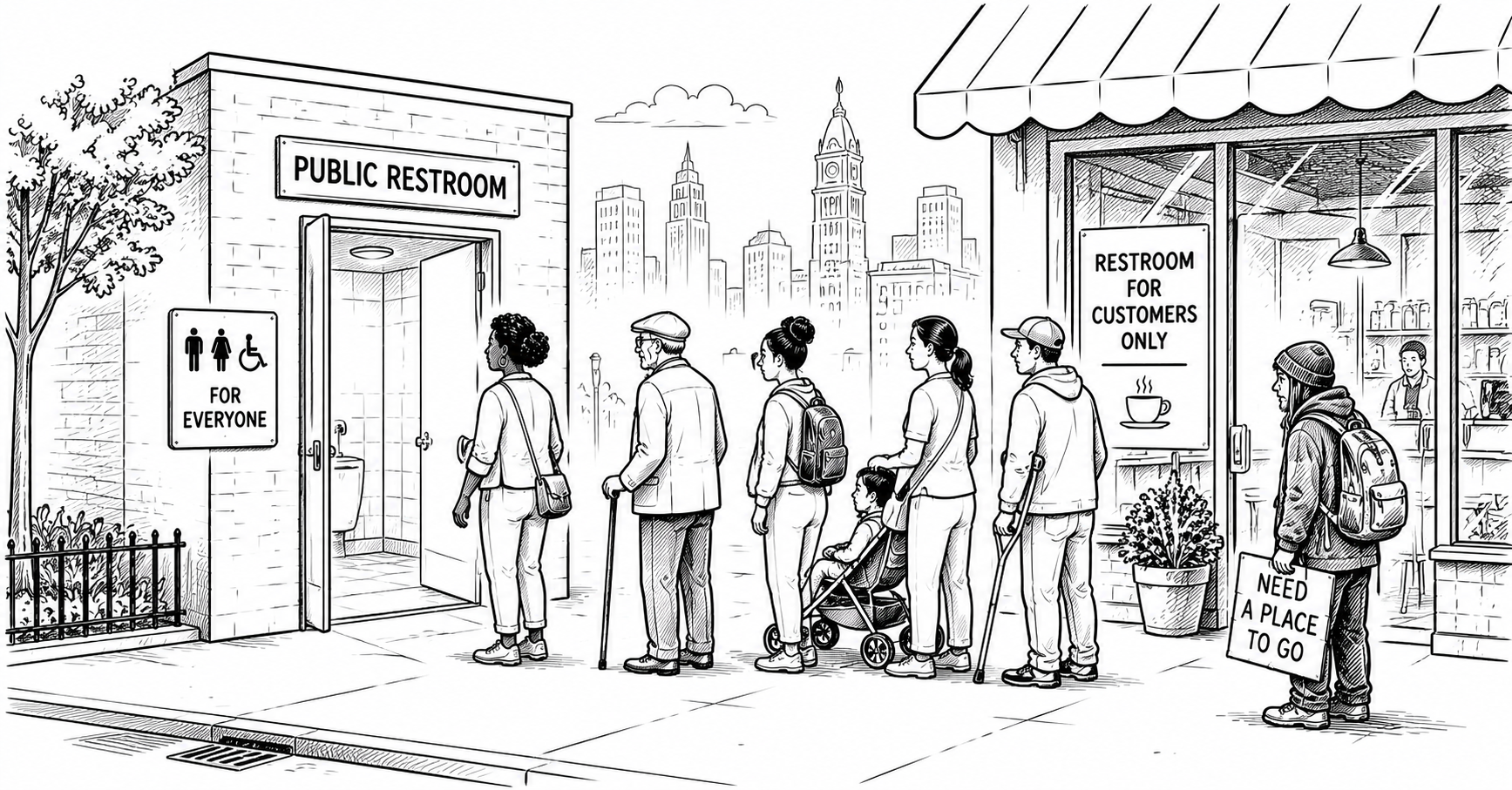
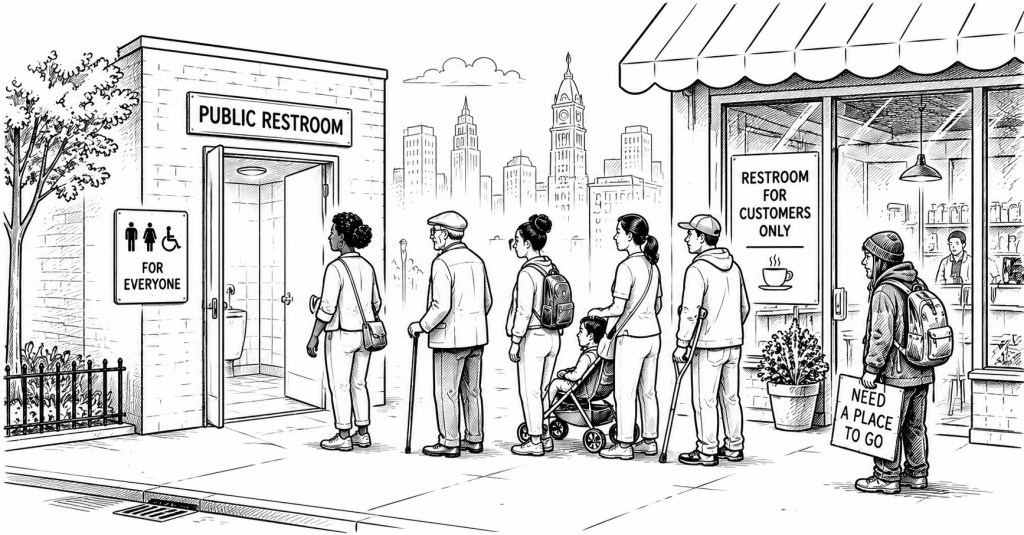
The modern version is privatization. As local governments closed public restrooms because they did not want to manage homelessness, drug use, maintenance or disorder, the need did not disappear. It shifted to private businesses. The bathroom became something accessed through purchase. “For customers only” is not just a store policy; it is a civic admission fee. If a person needs a restroom downtown and the available option requires buying coffee, food or merchandise, then public space has quietly become paywalled.
That system sorts people by money, mobility and social acceptability. Someone with a credit card, clean clothing and time to make a purchase can often solve the problem. Someone who is homeless, disabled, elderly, pregnant, working outside, managing a medical condition or caring for children may have fewer options and more urgent need. The infrastructure failure becomes individualized as inconvenience, embarrassment or disorder, when it is actually a public design choice.
This is why Simon’s argument belongs inside larger debates about cities. Public bathrooms are not peripheral amenities. They shape whether people can spend time in parks, use transit, work outdoors, attend protests, care for children, age in place, manage illness or simply exist in public without being forced into a private transaction. The absence of restrooms does not create equality by treating everyone the same. It punishes the people whose need is hardest to hide.
Philadelphia may be offering a different model. Simon notes that while some cities build downtown bathrooms partly to contain homelessness, Philadelphia is placing public restrooms directly in neighborhoods. That distinction matters. A restroom built only as a tool of containment is still governed by suspicion. A restroom built as neighborhood infrastructure treats bodily need as ordinary and shared.
The smaller story is a new book about public bathrooms. The larger story is how public life gets privatized one basic need at a time. When government exits the restroom business, businesses do not simply fill the gap. They convert access into a condition of consumption.
That is why the bathroom door keeps appearing in social movements. It is where policy becomes physical. It is where dignity is either protected or withheld. And it is where America’s promises about equality meet one of the simplest questions a city can answer: when people need to go, have we built a place for them?