
Lucid’s Layoffs Show the EV Market Has Moved From Vision to Demand
The electric-vehicle maker is cutting 18% of its U.S. workforce, eliminating its COO role, and scaling production around a harder reality: growth no longer protects companies from the mat
Lucid is cutting again.
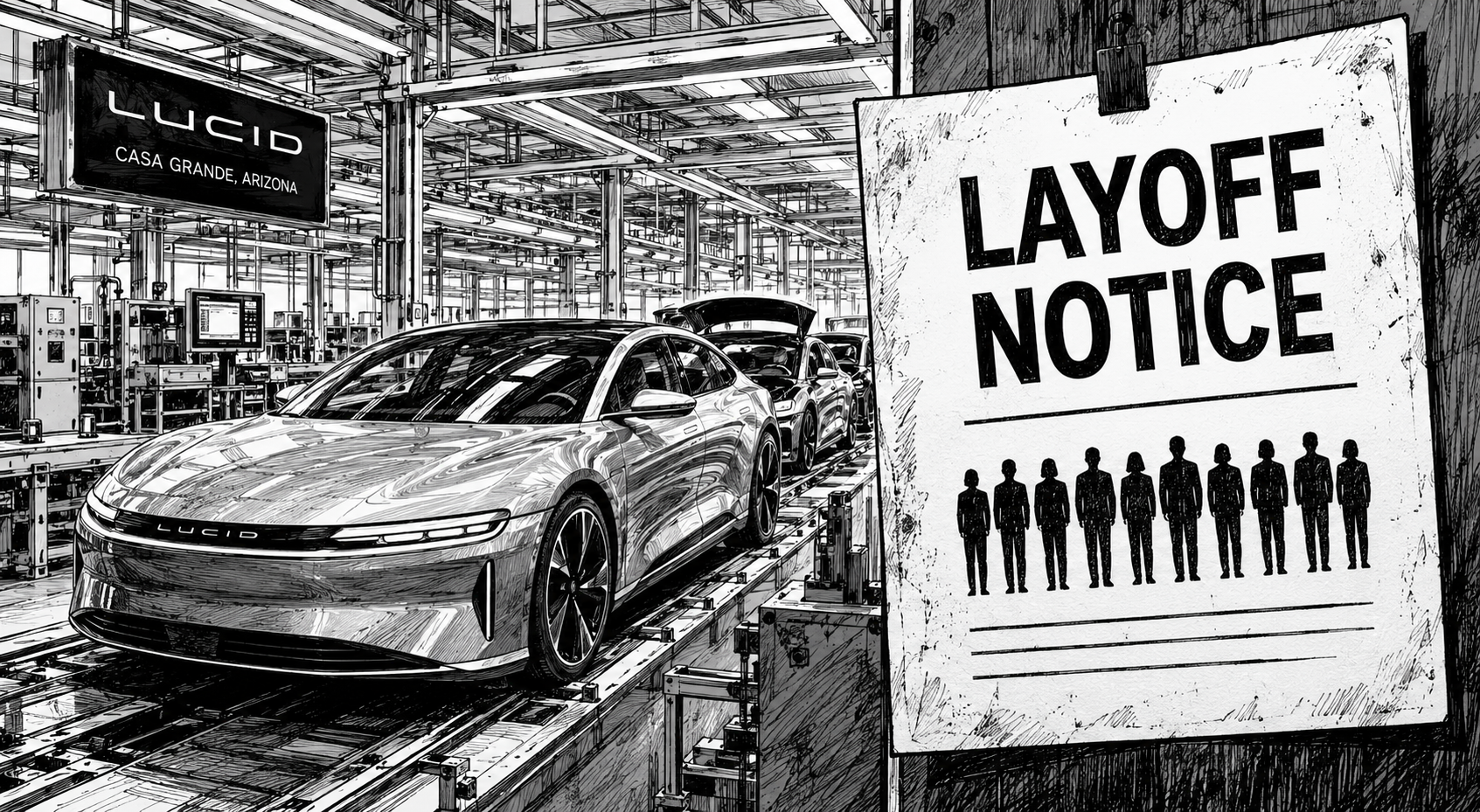
The electric-vehicle maker announced Monday that it will reduce about 18 percent of its U.S. workforce, a move that affects full-time employees, contractors, and hourly production workers in manufacturing. The company is also eliminating the second shift at its AMP-1 factory in Casa Grande, Arizona, and removing the chief operating officer role entirely. Marc Winterhoff, who had served as interim CEO before Silvio Napoli took over, is leaving the company as part of that restructuring.
The mechanics are straightforward. Lucid says the cuts are meant to streamline the organization, lower operating expenses, and align production plans with anticipated demand. The company expects the restructuring to generate roughly $158 million in annualized savings and cost about $32 million in severance, benefits, and employee transition expenses. Most of the plan is expected to be completed by the end of the third quarter.
But the signal is larger than one company’s layoff notice.
Lucid is not simply trimming excess headcount. It is adjusting its labor structure to match a market that no longer rewards EV companies for ambition alone. For years, the electric-vehicle sector operated on a growth thesis: build capacity, invest heavily, expand the product roadmap, and wait for adoption to catch up. That model worked when capital was cheaper, demand curves looked steeper, and investors treated production scale as evidence of future dominance. The current market is less forgiving.
Lucid’s own numbers show the tension. The company reported $1.35 billion in annual revenue for 2025 and delivered more than 15,000 vehicles, but it also posted a net loss of about $2.7 billion. In the first quarter of 2026, revenue rose to $282.5 million, but net loss widened to more than $1 billion. That combination — higher sales, deeper losses, and continued cash burn — is the central pressure point for many EV manufacturers outside Tesla and China’s largest producers.
The cuts also come just four months after Lucid reduced its U.S. workforce by 12 percent in February. That earlier round excluded hourly production workers. This one does not. That distinction matters because it suggests the adjustment is no longer limited to corporate overhead. It has moved closer to the factory floor.
For Lucid, the production question is especially sensitive because the company’s future depends on moving beyond the premium Lucid Air sedan. The Gravity SUV is central to its near-term growth story. Its midsize platform is supposed to move Lucid closer to a broader market. The company is also leaning into autonomy and robotaxi partnerships with Uber and Nuro. Those are not small ambitions. They require capital, manufacturing discipline, software development, supplier reliability, and consumer demand arriving on schedule.
That is where the restructuring becomes revealing. When a company says it is “aligning production plans with anticipated demand,” it is acknowledging that the forecast matters more than the factory’s theoretical capacity. The question is no longer whether Lucid can build more vehicles. The question is whether it can build the right number of vehicles at the right cost for a market that is more price-sensitive than the early EV cycle suggested.
The elimination of the COO role adds another layer. In a manufacturing business, operations are not peripheral. They are the business. Removing the role does not mean operations are less important; it likely means the new CEO wants tighter direct control over execution, cost, production cadence, and accountability. Napoli, who formally assumed the CEO role at the beginning of June, has now made his first major structural move: fewer workers, fewer executive layers, and a sharper line between demand and output.
That is the mechanism worth watching. EV companies are entering a phase where the story is shifting from technology promise to operational proof. Range, design, and software still matter. But so do gross margins, labor structure, supplier control, pricing flexibility, and the ability to scale without burning through capital faster than demand can absorb inventory.
Lucid still has advantages. It has respected engineering, a premium brand position, Saudi-backed financial support, and a product pipeline that could broaden its addressable market. But those advantages now have to survive a colder market. Luxury EV buyers have more options. Mainstream consumers are more price-conscious. Automakers are reassessing product timelines. Public markets are less patient with companies that need years of investment before consistent profitability.
The Lucid layoff is not only a workforce story. It is a correction in the EV growth model.
The first phase of the sector rewarded companies for proving that electric vehicles could be desirable, high-performing, and technologically advanced. The next phase is asking a different question: can they be manufactured, priced, delivered, and supported at a scale that makes the business work?
Lucid’s answer, for now, is to get smaller before trying to get bigger.