
Nigerian Employers Are Moving Business Risk Onto Workers’ Paychecks
When the Downturn Arrives, Someone Has to Absorb It

A business facing a weak market has a limited set of moves. It can cut costs, borrow against better months ahead, shrink its headcount, or close. What some Nigerian employers are doing instead is subtler and, for workers, more consequential: keeping the staff, keeping the storefront, and converting the wage bill from a fixed obligation into a variable one that rises and falls with sales. The payroll stops being a cost the business carries and becomes a risk the workforce shares.
Vanguard’s Elizabeth Adegbesan reported on September 21 that businesses across major commercial hubs are abandoning fixed salary structures in favor of commission-based models, moving the burden of weak sales onto staff, with the pattern appearing across retail outlets, technology startups and manufacturing firms. The framing in the reporting is blunt: bring in revenue or you are not paid.
The individual arrangements make the mechanics clear. David Amaechi, managing director of a mid-sized consumer electronics retail chain, told Vanguard that foot traffic had fallen more than 40 percent year on year and that he faced a choice between closing and converting his 25 staff to performance pay. Base salary now covers basic transport, with roughly 70 percent of take-home pay dependent on sales volume — a structure he describes as aligning expenses with actual revenue. On the other side of the same arrangement, Chioma Nnaji, a sales representative at a dry-cleaning service, described a 60 percent cut to her basic salary replaced by a five percent commission on clothes washed, leaving her with less than half her previous earnings in a slow month, with rent due and food prices rising.
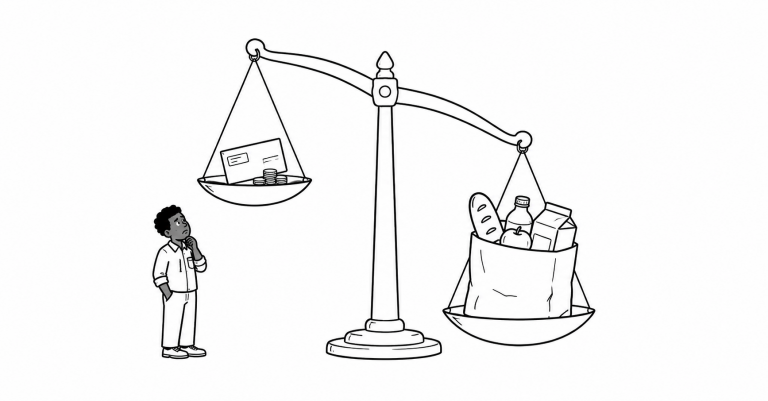
Set those two accounts beside each other and the transfer is visible in a single frame. The retailer’s expenses now move with his revenue. The sales representative’s income now moves with his revenue too. The volatility did not disappear; it changed address.
What makes this more than a hard-times story is the specific nature of the risk being moved. A commission is a reasonable instrument when the worker meaningfully controls the outcome — where skill, effort or persuasion determines whether a sale closes. That logic is why commission has long been standard in insurance and real estate. It does not hold when the binding constraint is that customers cannot afford to buy. A sales representative can be excellent and still sell nothing into a market where households have reallocated spending toward necessities. Tying pay to sales in that environment does not sharpen incentives. It penalizes workers for macroeconomic conditions they have no instrument to affect.
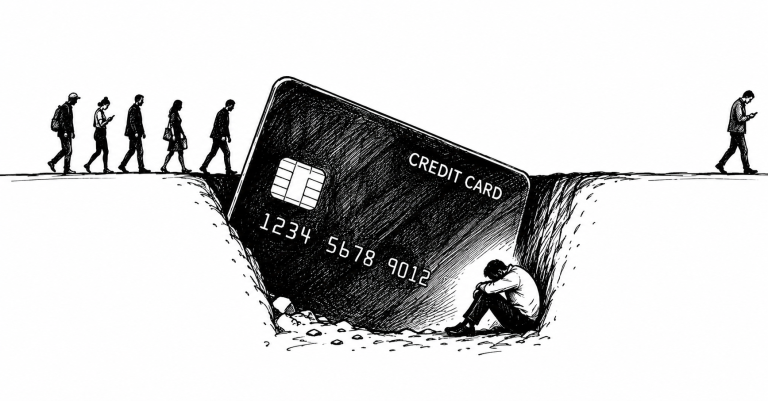
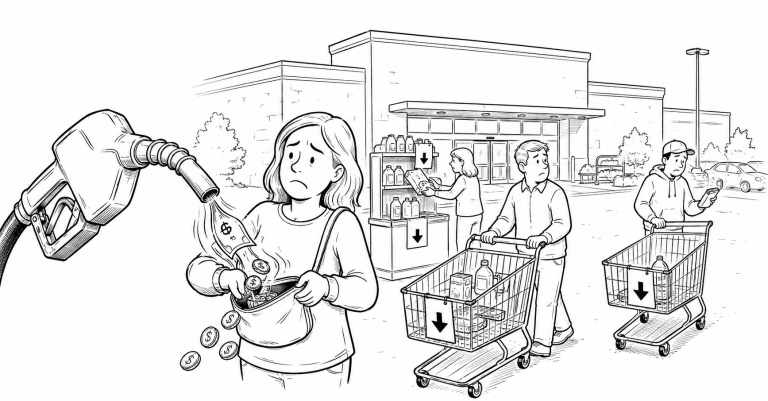
The surrounding numbers matter here. National Bureau of Statistics data compiled by Proshare put headline inflation at 15.39 percent in August 2026, down marginally from 15.43 percent in July but well above the level at which the current minimum wage was set. That is the full squeeze: the same weak purchasing power that suppresses a worker’s commission is simultaneously raising the cost of the rent and food that commission has to cover. Income becomes variable exactly as expenses become more inflexible.
The structural shift worth naming is what this does to the category of formal employment itself. The value of a salaried job was never only its size. It was its predictability — the ability to sign a lease, commit to school fees, borrow, or plan on the basis of a number known in advance. Strip out the predictability and formal employment starts to resemble gig work conducted indoors: a worker bearing demand risk without owning the business, without setting prices, and typically without the equity or upside that would compensate someone for accepting that risk. In most arrangements, risk and return travel together. Here the risk has moved to the workers while the ownership has not.
There is a real case on the employer’s side, and it should not be waved away. Employers argue performance-linked pay helps manage cash flow and retain staff during downturns, and the alternative Amaechi describes — closing — would leave 25 people with nothing rather than something variable. A job paying unpredictably is not obviously worse than no job at all, and workers pushed into the informal economy would lose what protections formal employment still carries. That is a genuine tradeoff, not a rationalization.
But the tradeoff deserves to be examined rather than accepted as inevitable, because the arrangement is rarely negotiated between equals. A worker presented with a 60 percent base-pay cut in a slack labor market has little leverage to propose alternatives — a floor beneath the commission, a temporary arrangement with a defined end, a higher commission rate to compensate for the risk assumed. These are ordinary features of well-designed variable compensation, and their absence is what distinguishes risk-sharing from risk-shifting.
One caution about the evidence. The Vanguard report is qualitative rather than statistical. It draws on named employers and workers in major commercial hubs, not a national survey, and no official data currently measures how widespread the conversion has become. That limit cuts in an uncomfortable direction. Because the shift happens inside individual employment contracts rather than through policy, it generates no announcement, no filing and no statistic. A worker whose salary was restructured is still counted as formally employed. Whatever its true scale, it is largely invisible to the instruments that would otherwise detect it — which means it can spread considerably before anyone is in a position to say that it has.
Source: Elizabeth Adegbesan, Vanguard, Sept. 21, 2026; inflation figures from National Bureau of Statistics data compiled by Proshare, as reported.