When the Influencer Is Not Real, the Trust Economy Breaks
Brands are using AI-generated people to sell products, and the problem is not novelty. It is the collapse of a basic consumer signal.
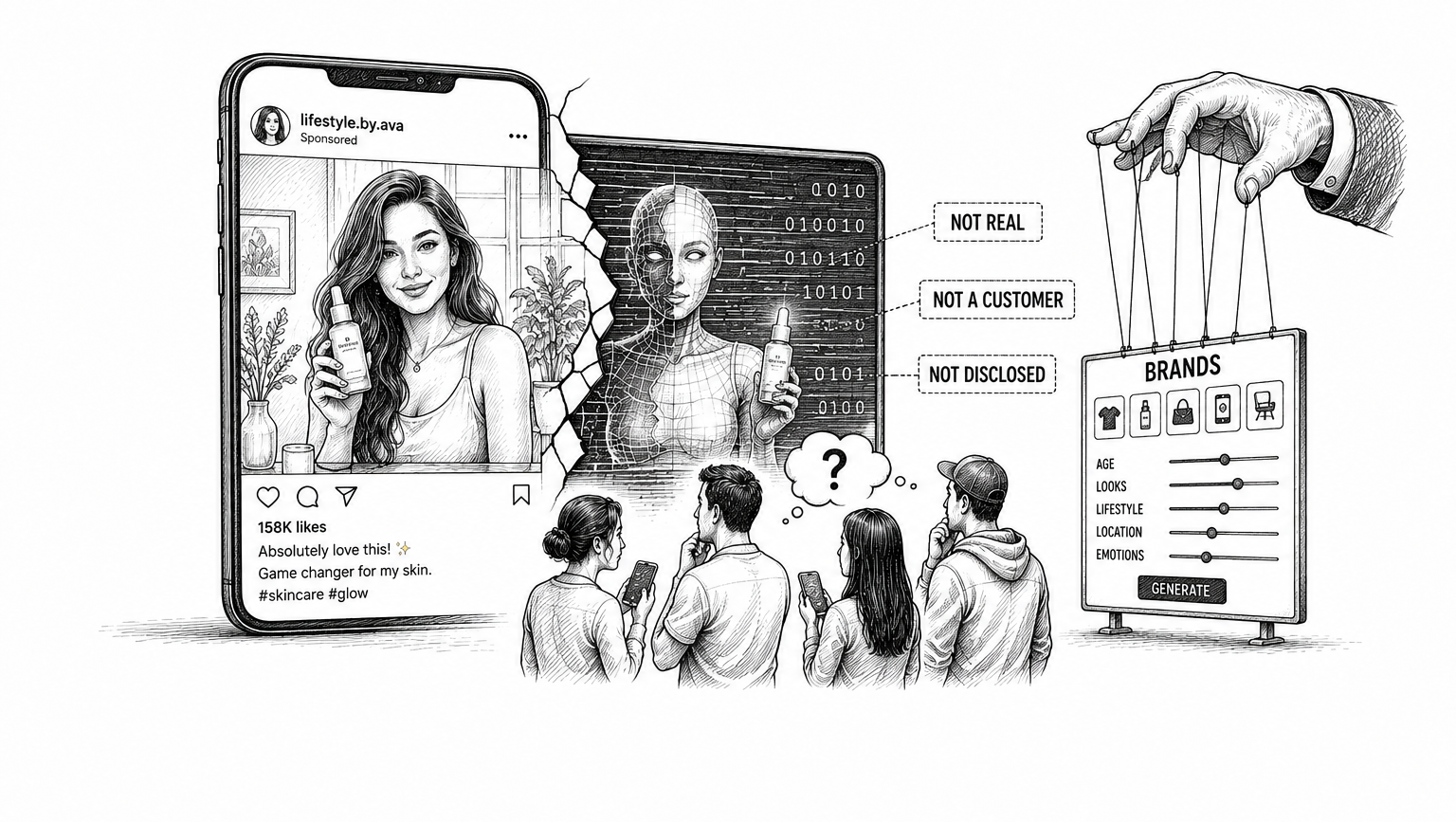
The Guardian’s Sarah Marsh reported Sunday that brands are increasingly using AI-generated influencers in social media ads, including promotional content that appears to show real customers using real products. The investigation found synthetic influencer content tied to consumer apps and fashion marketing, with some AI-content creators reportedly asked to sign nondisclosure agreements that prevent them from discussing the work.
The mechanism is simple: social proof has become cheaper to manufacture than to earn.
For years, influencer marketing rested on an uneasy bargain. Audiences knew creators were often being paid, but the person on screen was still presumed to be real. Their home, their skin, their wedding, their body, their reaction, their boredom, their delight — all of that made the ad feel adjacent to lived experience. AI-generated influencer content removes the person while keeping the emotional format.
That is why this story matters beyond advertising. Brands are not only automating creative production. They are automating the appearance of trust. A product review no longer needs a satisfied customer. A testimonial no longer needs a person who bought the product. A lifestyle image no longer needs a model, a location, a photographer, or even a body that obeys ordinary anatomy.
Marsh reported that one example involved Once, a photo app promoted through videos appearing to show a bride pleased with disposable camera-style wedding photos. Another involved Maket, an app that uses AI for home design and planning; the company told The Guardian that AI-generated influencers were one way to test marketing concepts at small scale. A Dubai-based fashion brand, Ashle, removed images after The Guardian asked about AI use, though the company said the removed designs were no longer part of the collection.
The incentive is obvious. AI influencers give companies control. They do not age, negotiate, complain, miss deadlines, expose behind-the-scenes terms, or deviate from brand guidelines. They can be built for the exact demographic a brand wants to reach, then adjusted endlessly until the content performs.
The cost moves to the consumer. People now have to inspect ordinary-looking promotional content as if it might be synthetic, undisclosed, and strategically designed to mimic amateur authenticity. That raises the cognitive burden of online life. The user does not simply decide whether they trust the product. They must first decide whether the “person” endorsing it exists.
Consumer-protection systems are not built for that level of ambiguity. The UK Advertising Standards Authority told The Guardian that its rules do not explicitly prohibit brands from posting AI-generated promotional content without disclosing it. The European Union’s AI Act will begin requiring clear labeling for AI-generated or manipulated content such as deepfake images, audio, and video in August, but those rules will not apply in the UK.
The data shows why disclosure cannot be treated as a minor technical question. Which? found that 70% of people could not correctly identify all the real and fake videos shown in its deepfake investigation. If most viewers cannot reliably tell what is real, then disclosure becomes the only practical guardrail between persuasion and deception.
Power moved from audiences and creators to brands and platforms. Human creators lose some bargaining leverage when a synthetic version of relatability can be generated on demand. Consumers lose the ability to read social media through familiar cues. Brands gain a new advertising layer that looks like everyday life but does not have to answer to everyday reality.
The next fight in consumer trust will not be whether AI content is allowed. It will be whether brands are required to tell people when the human layer of the ad has been removed.