The Quietness Is the Story: What We Know About Nolan Wells, and What We Don’t
An 18-year-old Black college athlete went to a Mississippi island with a group of friends on the Fourth of July. He was the only Black person there. He was the only one who didn’t come back.
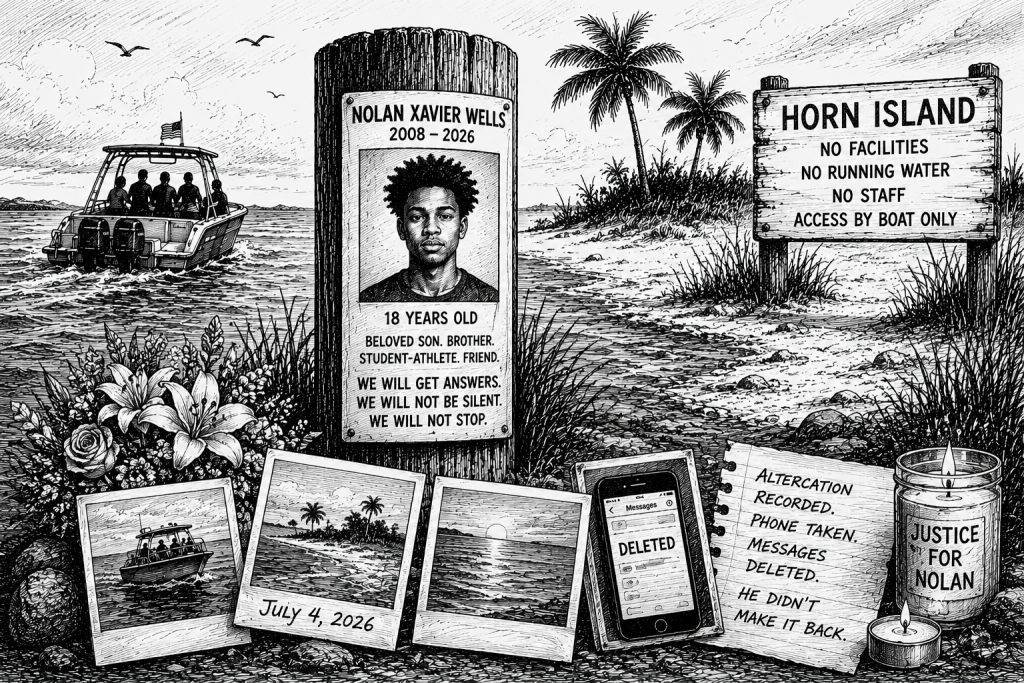
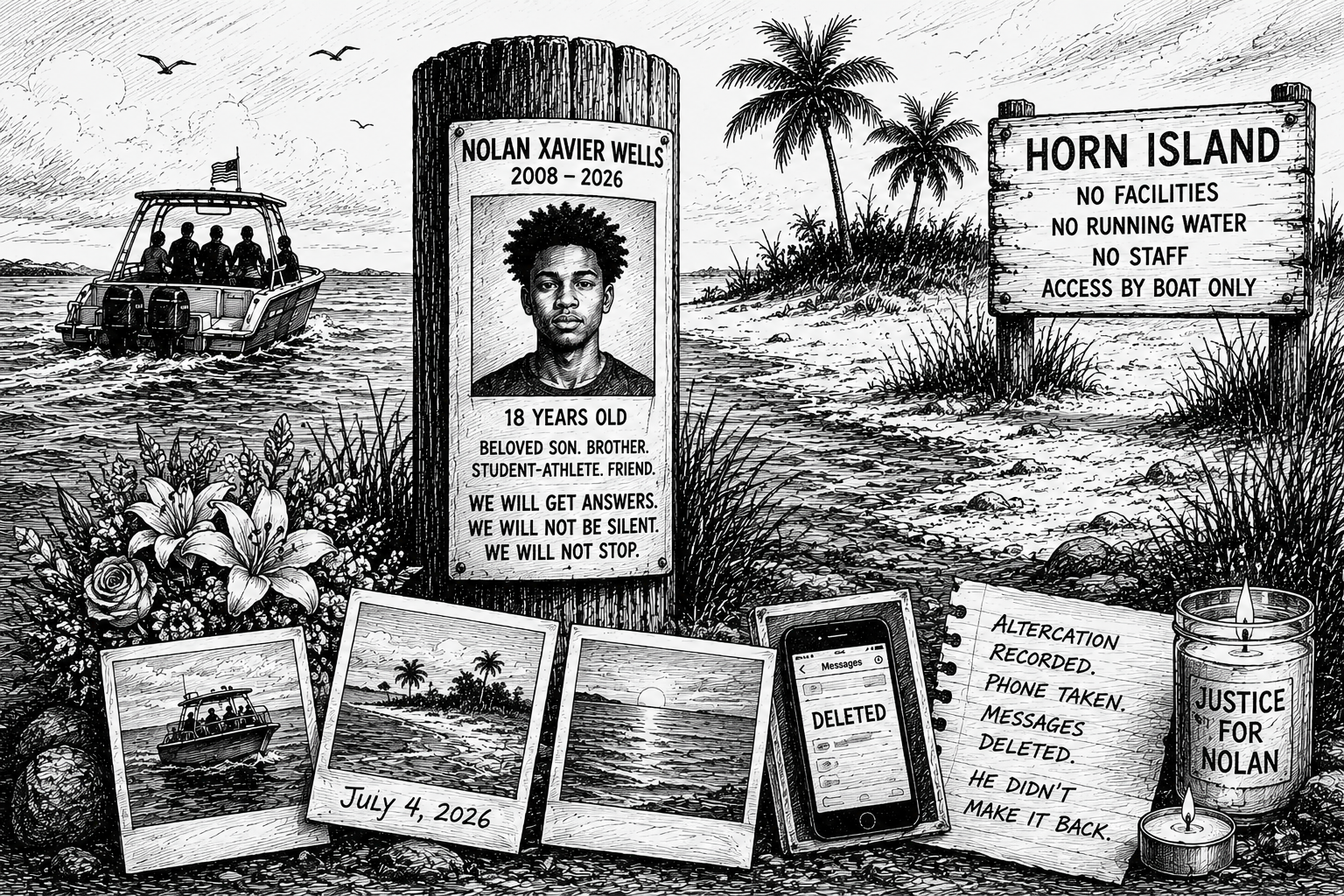
Nolan Xavier Wells was 18 years old, a student-athlete from Ocean Springs, Mississippi, with a football future ahead of him. On July 4, 2026, he joined a group of high school friends on a boat trip to Horn Island — a remote, undeveloped barrier island off Mississippi’s Gulf Coast, accessible only by private vessel, with no facilities, no running water, and no staff. The island is a popular Independence Day destination. It has no witnesses on payroll.
His friends returned to the dock that afternoon. Nolan was not with them.
His mother, Christine Wonsley, reported him missing around midnight. A search involving the Jackson County Sheriff’s Office, the U.S. Coast Guard, the U.S. National Park Service, the Mississippi Department of Marine Resources, and the United Cajun Navy launched and ran through the night. On Monday morning, a U.S. Park Service ranger found a body on the northwestern portion of Horn Island. It was Nolan.
Authorities say they believe he drowned. They say they do not suspect foul play. They say the investigation is ongoing.
His family does not accept the drowning narrative. His father described Nolan as an elite athlete who knew how to swim. The family has retained civil rights attorney Ben Crump and commissioned an independent autopsy to be conducted in Washington, D.C. — outside Mississippi. They are not waiting on the state to tell them what happened to their son.
That decision carries its own history.
What the friends said. What the phone said. What was deleted.
According to Jackson County Sheriff John Ledbetter, the group departed from a private dock in the Ocean Springs area. When the boat returned to shore, Nolan was not on it. The sheriff said, based on accounts from those present: “From what we understand, he chose to stay there.”
That framing — he chose to stay — is the official explanation for why an 18-year-old was left alone, without his phone, on an uninhabited island in the Gulf of Mexico at night.
Ben Crump provided a different account. He told ABC News that students recorded an altercation on the boat — “Nolan and somebody yelling at one another.” He said his friends took Nolan’s phone with them when they left the island. And when the Wells family eventually recovered his phone, messages had been deleted.
No explanation for the deleted messages has been offered by authorities or the friends. The altercation, as of the writing of this piece, has not been officially connected to Wells’ disappearance — though the sheriff’s office has said it is investigating the incident and a related viral TikTok video that showed a heated confrontation on Horn Island that day.
What is not in dispute: Nolan Wells was the only Black person in that group. He was left on an island with no way to call for help, no water, and no way off. The people who left him there returned home. He did not.
The pattern that this fits into
This is Mississippi. That is not a caveat — it is context that Black Americans and anyone who has studied the history of this state cannot responsibly set aside when a young Black man dies under disputed circumstances, with questions about what happened still unanswered, in the custody of a local sheriff’s investigation.
The deaths of Emmett Till, the history of the Tallahatchie River, the names of men and boys who died in Mississippi and whose cases were closed, mishandled, or never meaningfully investigated — these are not distant historical footnotes. They are the reason Ben Crump’s involvement signals something specific, not merely precautionary. They are the reason the family arranged an autopsy in Washington rather than waiting on the state. They are the reason Black America is watching this case with a particular kind of attention — the kind that comes from knowing that the quiet is sometimes the loudest part.
The pattern does not require this case to be something it has not yet been proven to be. The pattern simply means the questions matter, the evidence must be preserved, the independent review must happen, and the answer “we believe he drowned” from a Mississippi sheriff is not a place to stop.
There is a specific and well-documented phenomenon of young Black men dying near water in America — not because the water is more dangerous for them, but because the conditions in which they encounter it, and the investigations that follow when something goes wrong, are not equal. The water does not discriminate. The scrutiny applied afterward often does.
What it means to be the only one
Nolan Wells was the only Black person on that boat. That detail is not incidental.
When something goes wrong in a group, the reconstruction of events depends on witnesses, on testimony, on who is believed, and on who holds the narrative. When one person does not return and cannot tell their own story, the version that survives belongs to everyone else. The only Black person in a group is also, in that moment, the person with the fewest structural allies if something goes wrong — the person most likely to be described as having “chosen” an outcome that benefits the account of those who remain.
None of this is an accusation against any specific individual. All of it is a structural reality that the investigation has an obligation to take seriously — more seriously than “we don’t suspect foul play” allows for when the evidence base is still incomplete, the toxicology is pending, messages are gone, and the family’s own attorney is describing an altercation that witnesses filmed.
His father said he could swim. The friends said he chose to stay. The phone came back with messages deleted. The autopsy is being done in another state because the family believes their son deserves a review that isn’t filtered through the same system that produced “we don’t suspect foul play” before the investigation was complete.
The quietness
What is striking about this case is not the noise around it — though there has been noise, social media engagement, online speculation, national attention picking up at the margins. What is striking is the silence underneath all of that. The silence of a young man who went to celebrate Independence Day with his friends and did not make it back. The silence of an island with no staff, no cameras, no record. The silence in deleted messages. The silence in the gap between what the friends reported and what Crump described. The silence in the hours between when the boat left and when his mother made the call at midnight.
The quiet is where the story lives. And the quiet is precisely what the investigation is obligated to fill — not with assumptions, not with a default toward “accidental” because the alternative is harder to process in a Fourth of July weekend on a Mississippi island, but with the full weight of inquiry that any family deserves when their child does not come home.
Nolan Wells was 18 years old. He was a college athlete with a future. He was somebody’s son. He was the only Black person on that boat, and he was the only one who didn’t make it back.
That is not a coincidence to be dismissed. It is a question that demands an answer.
The family is not waiting for someone to hand them one. They are building it themselves, autopsy by autopsy, attorney by attorney, question by documented question. That is what Black families in America have learned to do when the system offers quiet where clarity should be.
The investigation is ongoing. The autopsy results have not been released. The toxicology is pending. This article will be updated as facts become available.