
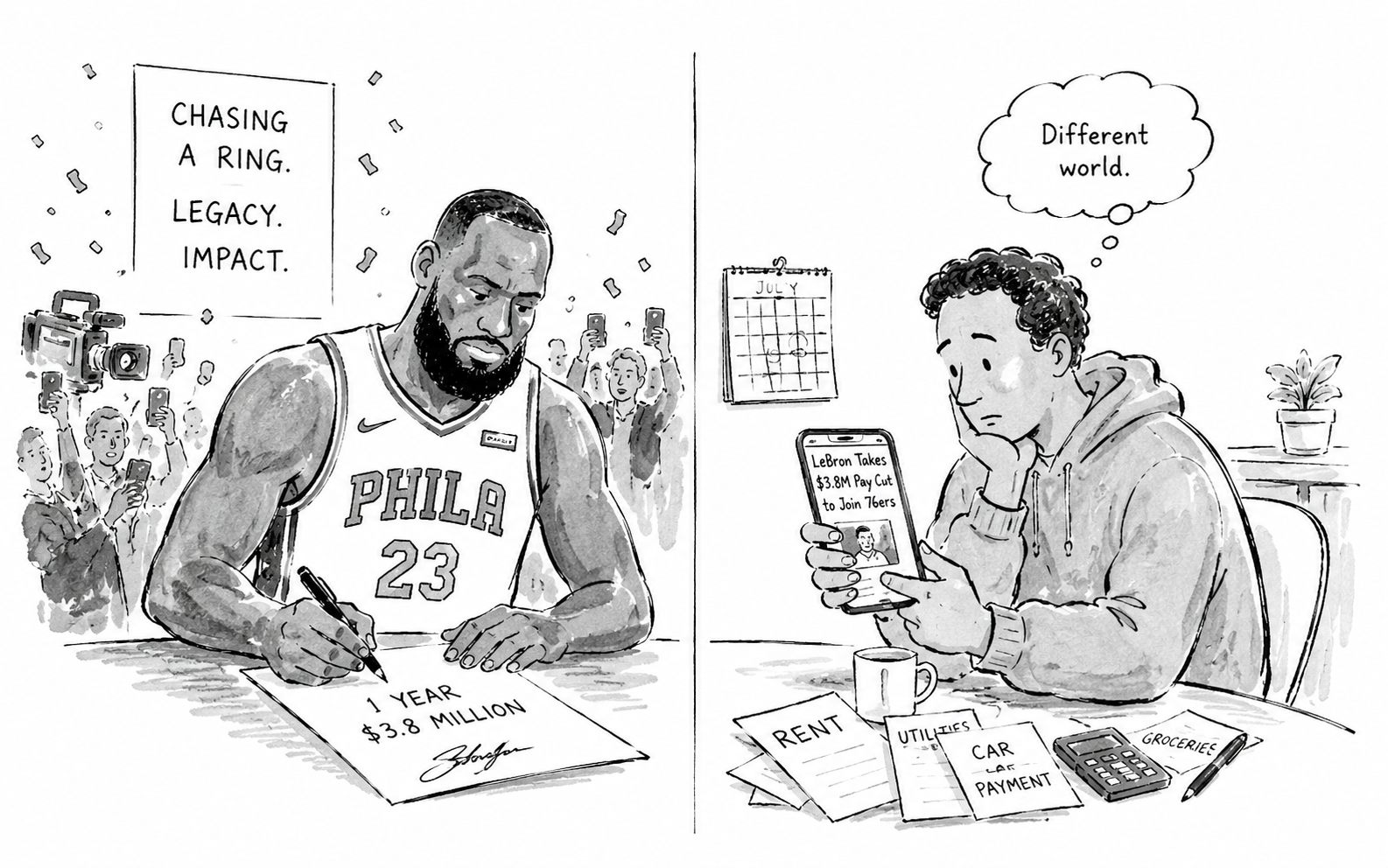
LeBron James Took $3.8 Million to Chase a Ring. The Lesson Doesn’t Transfer the Way People Think It Does.
When the most famous athlete in the world takes a pay cut, the conversation about what it means for everyone else needs a disclaimer.
Part of Society, Economy & Wellness — examining how economic pressure reshapes labor, access, and everyday life.
NEWS DESK | SOCIAL STORYTELLERS COLLECTIVE
LeBron James signed with the Philadelphia 76ers for $3.8 million next season — less than his rookie salary more than twenty years ago, and a fraction of the $47 million he earned last year. The decision immediately generated a wave of professional inspiration content: sometimes the best career move isn’t about the money. Sometimes impact matters more than income. Sometimes becoming part of something worth building is the whole point.
All of that is true for LeBron James. Almost none of it transfers to the workers reading it on their lunch break.
LeBron is 40 years old and has earned more than $400 million in NBA salary alone, not counting the endorsement portfolio that has made him a billionaire. His decision to take $3.8 million is not a sacrifice in any meaningful sense of the word — it is a reallocation of priority by someone whose financial security is so thoroughly established that the number on the contract is genuinely incidental to his actual financial position. He can take $3.8 million because $3.8 million is not what he is living on. He is optimizing for legacy, for a championship, for a final chapter that matches the arc he has been writing for two decades. Those are luxury goods in the career decision economy — available only after the foundational financial decisions have already been made and secured.
The advice that flows from this story — that workers should be willing to take pay cuts for the right opportunity, the right culture, the right challenge — is not wrong in the abstract. There are real circumstances where a lower salary at a better organization, or for a role with more learning, or alongside people worth working with, is the correct call. But those decisions are not symmetrical across the workforce. A worker who is one paycheck from covering rent, who has no investment portfolio, who carries student debt, who is supporting family members, who has no safety net beneath the safety net — that worker is not making the same category of decision that LeBron made. The money is not incidental to their life the way it is incidental to his.
As SSC covered in America Has More Jobs Than Ever. Why Does Everyone Feel Replaceable?, the labor market in 2026 is not rewarding the workers who take principled pay cuts to chase meaningful work with a soft landing if the bet doesn’t pay off. The contingent workforce is approaching 40% of all American workers. Entry-level positions have declined 35% over five years. The workers who took lower-paying roles for “impact” and found themselves let go six months later are not telling a LeBron story. They are navigating a labor market that does not distinguish between strategic sacrifice and financial desperation in its outcomes.
The LeBron story is worth telling on its own terms. It is a genuinely interesting late-career decision by one of the most studied competitors in sports history, and the Philadelphia 76ers as a destination makes basketball sense in ways that are fun to analyze. What it is not is a career template. The version of this story that applies to most workers is narrower and more conditional: if your baseline financial needs are met, if you have cushion beneath the decision, and if the opportunity is specific and traceable rather than vague and inspirational — then a pay cut can be a strategic move. Without those conditions, it is a risk that lands differently depending entirely on what you can afford to absorb if it doesn’t work.
Why This Matters
The instinct to draw universal career lessons from the decisions of billionaires is one of the more persistent habits of professional inspiration content — and one of the more quietly damaging ones, because it flattens the conditions under which decisions are made into a single motivational frame that obscures the structural differences underneath it. LeBron James took a pay cut because he could afford to. Most workers taking pay cuts cannot. Those are not the same story, and treating them as the same story does the most damage to the people with the least cushion to absorb the cost of following advice that was never actually written for them.