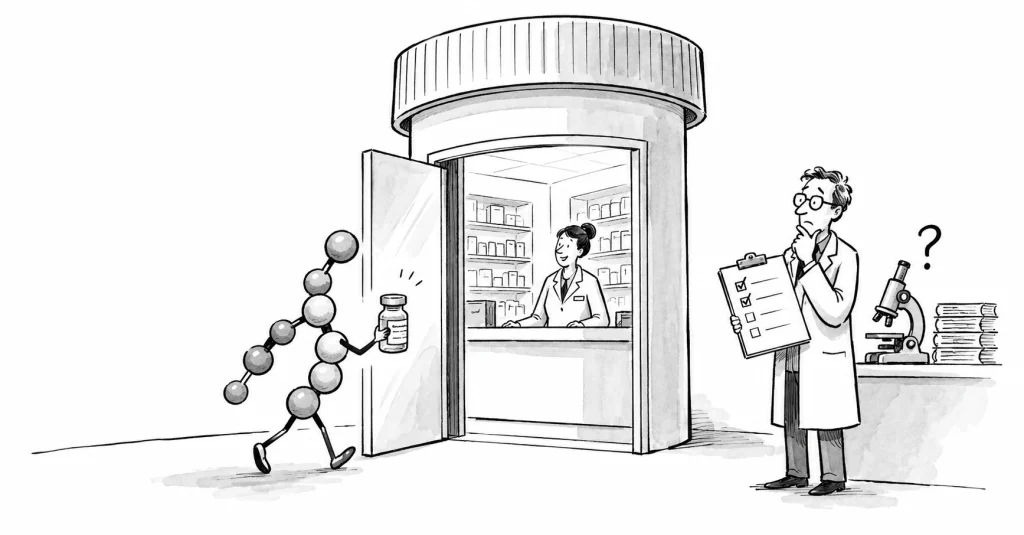
Federal officials are considering allowing compounding pharmacies to dispense certain experimental peptides while new regulations are developed. The proposal could bring an underground market into licensed pharmacies without resolving fundamental questions about safety and effectiveness.
HEALTH & POLICY | THE ACCESS SHIFT
The Food and Drug Administration’s advisory committee reviewed seven experimental peptides in July and recommended easing compounding restrictions on six, despite objections from the agency’s own scientists. Now, the Trump administration is considering a temporary pathway that could allow some of those substances to be dispensed through licensed compounding pharmacies while federal officials develop longer-term regulations. According to The Washington Post’s October 7 investigation, the proposal remains under discussion, with no announced implementation date or final list of eligible products. Health Secretary Robert F. Kennedy Jr. has publicly supported broader peptide access, but FDA scientists have warned that many of the products lack the clinical evidence needed to establish their safety and effectiveness. The administration is confronting a market that has already expanded beyond the government’s ability to oversee it, raising a question that goes beyond consumer choice: what happens when access to an experimental treatment expands before the science supporting it catches up?
A Market That Grew Faster Than Its Oversight
Peptides are short chains of amino acids, and some have established medical applications, including FDA-approved GLP-1 medications used to treat diabetes and obesity. But the substances at the center of the current debate are different. Experimental peptides have been marketed for everything from wound healing and inflammation to sleep, physical recovery and longevity, frequently without the rigorous human trials required for FDA drug approval. The Washington Post previously documented questionable manufacturing practices, including products reportedly prepared in homes and suppliers whose claimed manufacturing locations were empty offices. This is an industry where the promise of improvement has often moved faster than the evidence supporting it. SSC previously examined the regulatory confusion in The FDA Didn’t Approve 14 Peptides, reporting that underscores why decisions about availability must not be mistaken for drug approval. The administration’s proposal would potentially change where certain peptides could be obtained, not establish that those substances are effective treatments.
The FDA’s Scientists and Advisers Disagreed
That tension became especially visible during the FDA’s July 23–24 Pharmacy Compounding Advisory Committee meeting. The committee reviewed BPC-157, KPV, TB-500, MOTS-c, Semax, Epitalon and emideltide, ultimately recommending that six be considered for broader compounding access while rejecting emideltide. FDA career scientists had recommended against easing restrictions, citing insufficient evidence of safety and effectiveness. The disagreement also raised questions about the advisory process itself. The Washington Post reported that several committee members had connections to peptide-related businesses or clinics, prompting concerns about potential conflicts of interest. The FDA defended its vetting procedures, maintaining that members underwent the required ethics reviews. The committee’s recommendations are advisory rather than binding, and the agency has not approved the substances through the conventional drug-review process. What emerges is a regulatory decision in which professional judgment, commercial demand and incomplete scientific evidence are competing for influence.
Can Regulated Access Make an Unproven Market Safer?
Supporters of expanded access argue that restricting compounding has not stopped consumers from obtaining peptides. Instead, some buyers have turned to online sellers, overseas suppliers and wellness businesses operating with limited oversight. Scott Brunner, chief executive of the Alliance for Pharmacy Compounding, told The Washington Post that his organization has urged regulators to consider temporary enforcement discretion, allowing state-licensed pharmacies to prepare specified peptides for patients with prescriptions. Proposed safeguards include clearer patient disclosures, serious adverse-event reporting and collection of information about how the substances are used. The argument has practical force: licensed pharmacies may provide stronger quality controls than anonymous sellers. But product quality and clinical effectiveness are separate questions. A pharmacy may be better equipped to verify ingredients and handling procedures without being able to establish whether an experimental treatment produces its advertised benefits or carries unacceptable long-term risks.
The Business of Human Optimization
The peptide debate also connects to SSC’s examination of the expanding commercial market for physical enhancement. In The Enhanced Games Turns the Body, we explored the relationship between human performance and the commercial incentives surrounding bodily optimization. The peptide market operates within a similar environment, where the possibility of faster recovery, greater endurance or improved health can become a marketable product before researchers establish what an intervention reliably delivers. The administration’s proposed pathway could shift some transactions from informal sellers to conventional pharmacies, potentially changing how consumers perceive the products. A prescription and pharmacy label can create an appearance of medical legitimacy even when important scientific questions remain unanswered. For consumers, the challenge is understanding that a more regulated route to purchase does not necessarily mean a treatment has undergone the testing normally associated with FDA approval.
The Next Decision Is About More Than Peptides
The administration has not announced which peptides would qualify for temporary access, when a policy might begin or what safeguards would be mandatory. Those decisions will determine whether the government can reduce risks associated with illicit distribution while continuing to address the unresolved clinical evidence. Medical experts remain divided over whether temporary access with stronger oversight would improve consumer protection or expose more people to experimental substances whose effects are inadequately understood. For SSC’s The Access Shift, this is another example of how the terms of participation can change before the systems responsible for protecting consumers have fully adapted. Access may expand, businesses may gain a more conventional route to market and patients may encounter products through familiar healthcare channels. But the responsibility for demonstrating safety and effectiveness cannot be replaced by consumer demand. The next phase of peptide regulation will test whether federal officials can bring a rapidly growing market under meaningful oversight without treating availability as a substitute for evidence.
Sources: The Washington Post, October 7, 2026; FDA Pharmacy Compounding Advisory Committee, July 23–24, 2026; The Washington Post’s investigation of peptide oversight.