
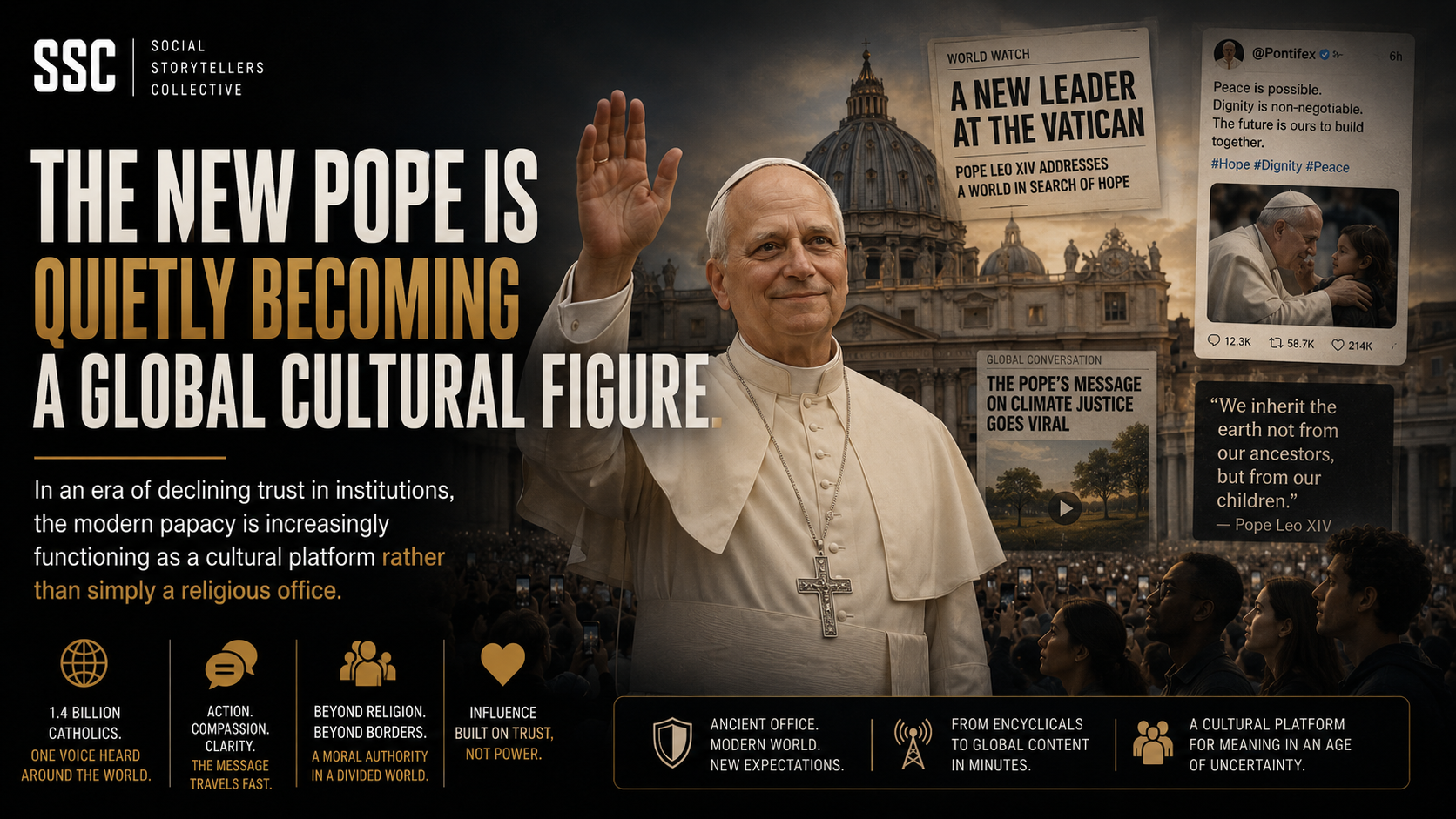
When Pope Leo XIV stepped onto the balcony overlooking St. Peter’s Square following his election in May 2025, the interpretation began before he finished his first sentence. Millions watched not simply to learn who would lead the world’s roughly 1.4 billion Catholics, but to take the measure of what kind of figure he might become. Before he had issued a single policy statement, observers were already sorting him into the cultural moment — what he represented, who he signaled, what his presence meant for an institution the world has complicated feelings about.
Then the genealogists started working.
Within hours of Robert Francis Prevost being named the first American pope in history, Jari C. Honora, a family historian at the Historic New Orleans Collection, published what he had found in the records: Pope Leo XIV’s maternal grandparents — Joseph Martinez and Louise Baquié — were Creoles of color from New Orleans’ Seventh Ward. Listed as Black in 1900 census records. Married in New Orleans in 1887, Joseph born in Haiti. The couple left Louisiana for Chicago between 1910 and 1912, where the pope’s mother, Mildred Martinez Prevost, was born shortly after. The Archdiocese of New Orleans has since traced nineteen of Leo’s ancestors as free people of color, with Louisiana roots stretching back to the 1720s. His brother John, still living in Chicago, confirmed the findings.
Pope Leo XIV identifies as white. He spent decades as a missionary in Peru and holds Peruvian citizenship. He is, by his own account, a Chicagoan shaped by a religious vocation rather than a racial identity. But the record is what it is — and in America, the record has a way of mattering even when the person it describes has moved on from it.
What the lineage discovery did was make him harder to flatten.
The Seventh Ward of New Orleans is not an abstraction. It is the historic center of Black Creole Catholic life in America — a community that maintained faith in an institution that often did not return the courtesy, that built culture and family under conditions designed to erase both. That is the ground Pope Leo XIV’s family came from. Whether he claims it or not, it claims him in the imagination of people who recognize it.
That recognition is part of why his rise has generated the kind of attention it has beyond Catholic circles. The formal story is historic enough: first American pope, moderate successor to Francis, a figure shaped by missionary work in the Global South rather than the corridors of European church power. But the informal story — the Creole grandmother, the Haitian grandfather who made cigars in New Orleans, the Seventh Ward before the migration north — is the story that travels. It is the story that makes him legible to people who have no particular investment in papal succession but a great deal of investment in who gets to be called American, and what American has historically meant for people who look like his grandparents.
This is the context for understanding why the modern papacy is functioning increasingly as a cultural platform rather than simply a religious office. Religious affiliation has declined across much of Europe and North America. Trust in government, media, and corporate leadership has eroded across most democracies. But the appetite for moral authority has not disappeared — it has migrated toward individuals who can embody institutions rather than merely administer them, who can make ancient offices feel present in a contemporary argument. Pope Leo XIV arrives in that vacancy carrying more complexity than most people initially understood. Complexity, in this cultural moment, is not a liability. It is the thing that makes a figure interesting to people who would otherwise not be paying attention.
The Vatican controls a territory smaller than most city parks and commands no military force. Its power is legitimacy — the ability to credibly speak to questions of ethics, identity, and responsibility in a world where that credibility is genuinely scarce. The pope who holds that office is now a man whose family tree runs through the free people of color of New Orleans, through Haiti, through a great-grandmother baptized at St. Louis Cathedral in 1840, through the specific and surviving faith of a community that built its Catholicism in defiance of the institution’s own failures toward it.
Whether Pope Leo XIV speaks to that history directly, whether he claims it or lets it sit in the record, the story is already doing cultural work without him. Reynold Verret, president of Xavier University of Louisiana — the only historically Black Catholic university in the country — said it plainly when the lineage was revealed: “It is an affirmation that the Catholic Church is truly universal and that Black Catholics remained faithful regardless of a church that was human and imperfect.”
That is not a statement about doctrine. It is a statement about endurance. And it is exactly the kind of statement that travels far beyond the people it was made for.
This is not a story about Catholicism. It is about how influence works now — and how a figure’s biography, even the parts he did not choose and has not claimed, shapes what he means to a world that is actively looking for something to believe in. Authority today is earned through narrative and presence and the weight of a history that holds. Pope Leo XIV has more of that history than almost anyone knew when he walked onto that balcony. The world is still sorting out what to do with it.