
Part of Culture in Motion — an ongoing series examining how culture is shaped, interpreted, and reshaped in real time.
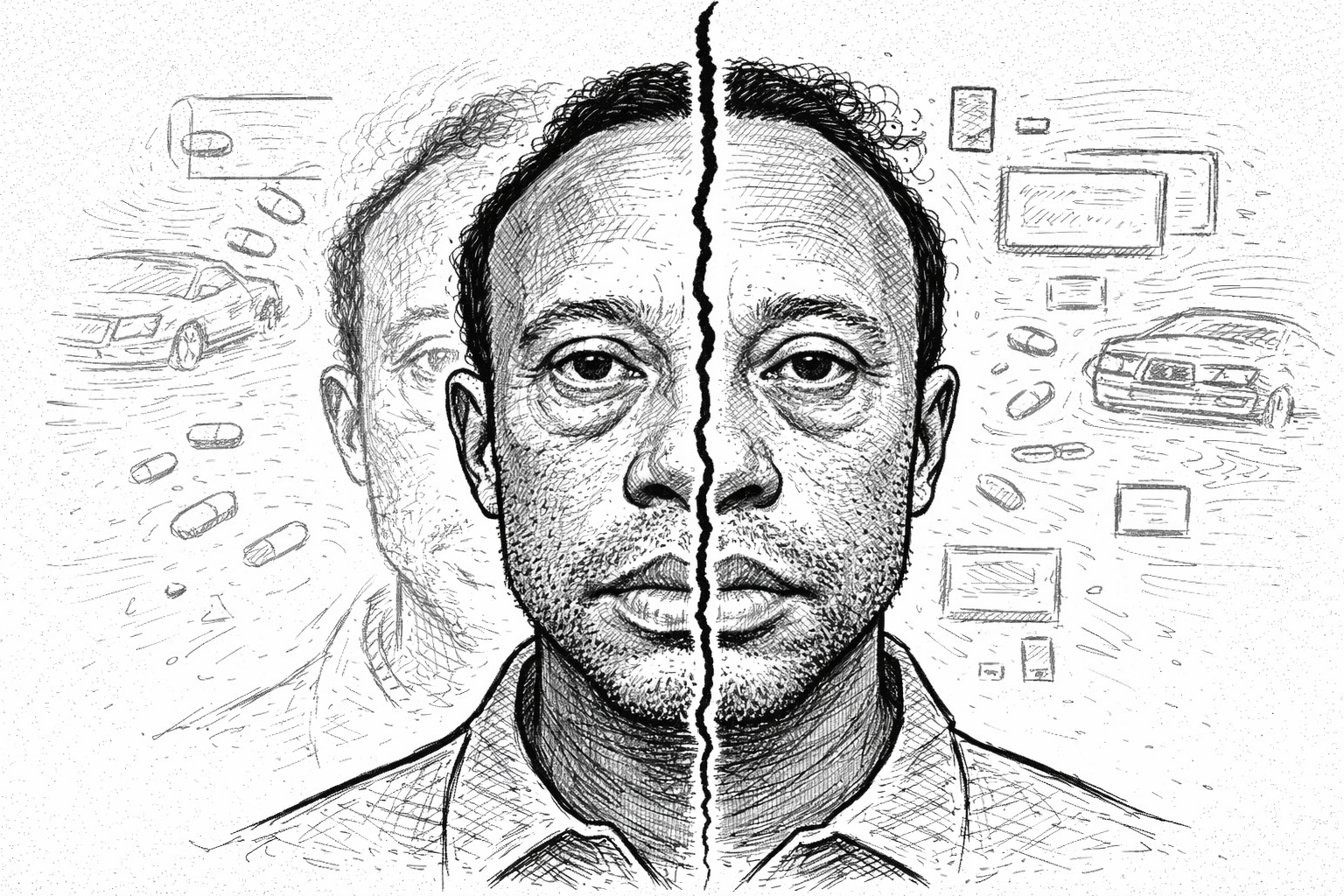
The image is familiar. The expression is flat. The lighting is clinical. It’s the kind of photo that doesn’t just document a moment — it defines one.
This time, the mugshot was real and current. On Friday, March 27, Tiger Woods was arrested on suspicion of DUI after his Range Rover clipped a pressure-cleaner trailer on Jupiter Island and rolled onto its side. A new booking photo was released by the Martin County Sheriff’s Office. But in the churn that followed, the 2017 mugshot resurfaced alongside it — often without timestamps — and two separate events nearly a decade apart collapsed into a single visual narrative.
The mechanism is worth naming. In 2017, Woods was found asleep behind the wheel and later pleaded guilty to reckless driving after saying he had taken a bad mix of painkillers. Friday’s arrest carried near-identical details: investigators suspected medication rather than alcohol, and Woods blew triple zeroes on a breathalyzer before refusing a urine test. The symmetry made the old image feel like confirmation rather than history — which is exactly how misinformation earns its credibility.
Platforms don’t just distribute information — they compress it. A familiar image travels further than a new one, especially when it already carries emotional recognition. The result is visual shorthand: audiences process the old moment as if it explains the new one, letting the past quietly overwrite the present. The image doesn’t need to be current to feel true; it only needs to be believable enough to fill in the gaps that speed creates.
The timeline here matters more than most. Woods has now been involved in three separate vehicle incidents — 2017, 2021, and 2026 — two resulting in wrecks. That pattern is real and worth examining on its own terms. But when images circulate without clear anchoring, pattern and coincidence become indistinguishable, and the context around a person gets replaced by whatever image is most available — not most accurate. It’s what SSC examined in Why Stories Are Missing and The Trust Gap: when speed is the primary editorial filter, the sequence of events is rarely the thing that travels.
Why this matters
The distortion isn’t just in the facts — it’s in the timeline. When events are stripped of sequence, accountability blurs, and the difference between pattern and coincidence becomes harder to distinguish. Once that line fades, perception begins doing the work that context used to carry, reshaping how audiences interpret both the past and the present in real time.
In a media environment defined by speed, the question is no longer just what happened, but when it happened — and whether that distinction still holds its value.