
Food companies are not thriving because hunger is good. They are thriving because insecurity, inflation, imports, and capital access have tilted the food system toward firms large enough to operate through crisis.
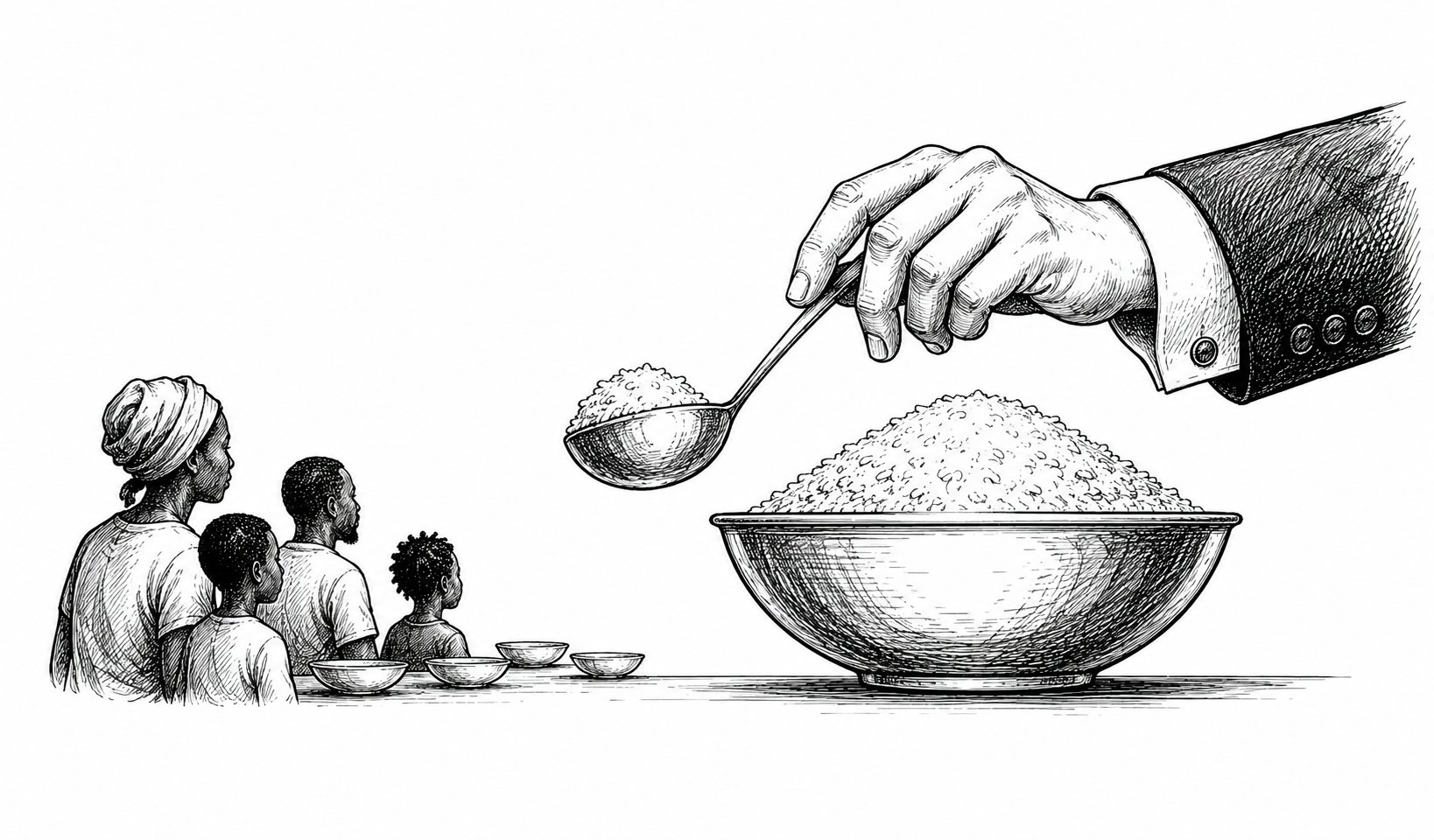
The Financial Times reported that Nigeria’s big food businesses are prospering through insecurity and economic shock, using BUA Foods as the clearest example. The company appeared at number 35 in the FT-Statista ranking of Africa’s fastest-growing companies after tripling revenue to ₦1.53tn in 2024 and posting ₦284bn in pre-tax profit. That growth happened in the same country where hunger protests filled the streets in 2024 and food inflation approached 40%.
That contrast is the story. It is not that a food company should fail because households are struggling. People still need food, and large producers can play a real role in keeping staples available when farming, transport, and currency conditions are unstable. But when some firms grow faster because the surrounding system is broken, the question changes. The issue is no longer only food supply. It is who has enough scale, capital, and political proximity to function when ordinary farmers and households cannot.
Nigeria’s food crisis has several layers. Insecurity in rural areas has kept farmers from fields, disrupted supply chains, and weakened local production. Currency devaluation has raised the cost of imported inputs and finished goods. Fuel subsidy removal increased transportation and production costs. Households have absorbed the result in the most intimate way possible: skipped meals. FT described Nigerians referring to days as ‘010,’ ‘101,’ or ‘001,’ shorthand for which meals they had to forgo.
Inside that same pressure, large food firms can become more important and more powerful. BUA Foods operates across sugar, flour, pasta, rice, and oils. It has refining capacity, import networks, distribution systems, and the balance sheet to move through shocks that would crush smaller players. When local farming becomes riskier, insecurity can push demand toward packaged, imported, or industrially processed staples. That is not simply a business win. It is a food-system shift.
The shift favors firms that can manage volatility. They can import when local supply fails. They can refine at scale. They can pass some costs along. They can negotiate within policy environments that smallholder farmers and informal food sellers experience mostly as constraint. In a fragile system, size becomes protection. For households, the same fragility shows up as higher prices, smaller portions, and fewer meals.
That is why the profit story cannot be separated from the farm story. Nigeria’s food system has long depended on smallholder farmers, but those farmers are exposed to violence, poor infrastructure, limited finance, climate pressure, and weak market access. When insecurity reduces local agricultural output, the response is often to rely more heavily on imports and large processors. That can stabilize supply in the short term. It can also deepen dependence on companies positioned to benefit from the very conditions that made small farming harder.
The policy response reflects the bind. Reuters reported in April that Nigeria plans to cut import duties on food items including rice, sugar, and palm oil in an effort to curb inflation and lower household costs. That may ease some pressure for consumers and businesses. It also shows how inflation relief can run through import channels rather than local production repair. When affordability policy depends on making imported food cheaper, the firms already built around import and processing capacity gain another advantage.
This is not only a Nigeria story. Across parts of West and Central Africa, conflict, climate strain, debt pressure, currency weakness, and reduced humanitarian funding are making food access more fragile. AP has reported UN warnings that tens of millions of Nigerians face acute food insecurity, with aid programs strained by funding cuts. In that environment, the companies able to keep shelves stocked can look like solutions while also accumulating more market power.
Large food companies are not villains for surviving a difficult economy. But survival is not neutral when the system rewards scale while punishing exposure. Farmers exposed to violence lose output. Families exposed to inflation lose meals. Firms insulated by capital and infrastructure gain share.
Power moves through the food chain. It moves away from dispersed farmers and price-sensitive households toward companies that can import, refine, distribute, and price across crisis. The question Nigeria’s food economy now raises is not whether big food can grow during hardship. It is whether the country is building a food system where resilience belongs only to the companies large enough to profit from instability.
— SSC News Desk | Social Storytellers Collective
Get SSC analysis delivered to your inbox every day. Subscribe free on Beehiiv: socialstorytellerscollective.beehiiv.com