I launched Social Storytellers Collective on Substack because I believed in what independent publishing could do — the ability to build an audience around ideas that mattered, without the gatekeeping of traditional media. What I didn’t fully anticipate was the gap between building that audience and converting it into sustainable revenue. That gap is not unique to SSC. It is the defining structural reality of the creator economy in 2026, and the numbers make it visible in ways that the industry’s growth headlines do not.
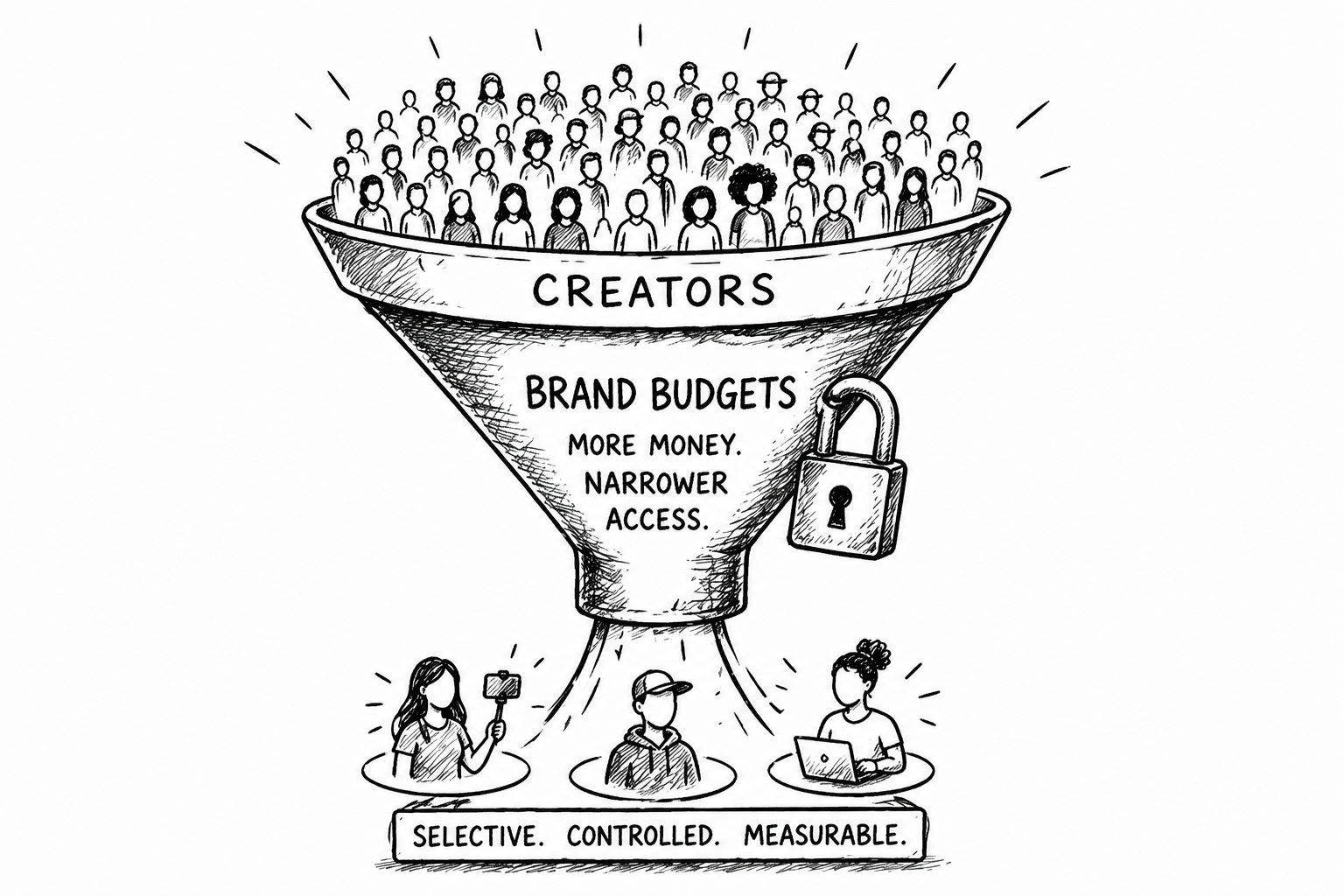
U.S. brand spending on creator partnerships is expected to reach nearly $44 billion. That figure is real. What it obscures is equally real: 57% of full-time creators earn below the U.S. living wage, the top 1% of creators capture an estimated 60 to 80% of total platform payouts, and brand deals account for approximately 70% of total creator income. More money is entering the system. It is not being distributed evenly. And in that gap between growth and access, the real shape of the creator economy is beginning to take form.
The imbalance begins with supply and demand moving in opposite directions. The number of creators entering the market has grown rapidly, fueled by platforms that make publishing and audience-building accessible to nearly anyone. But brand budgets, even as they increase, are not expanding at the same pace. That gap creates pressure. More supply is chasing a limited pool of demand, which forces brands to make tighter, more strategic decisions about where their dollars go — and the criteria they use to make those decisions are becoming more selective, not less.
That pressure is reshaping how deals are structured. Rather than broad, long-term partnerships across a wide range of creators, many brands are concentrating their spending in shorter, more controlled engagements — three to six posts, tightly scoped deliverables, clear timelines. The flexibility benefits brands operating under budget constraints, but it limits the ability of creators to build sustained, predictable income. The system favors precision over distribution, and that precision increasingly flows toward creators who are already established rather than those trying to become so.
A surprising pattern sits inside that dynamic: smaller and direct-to-consumer brands are often more active in creator partnerships than large, established companies. While major corporations are still increasing their spend, they remain cautious — held back by measurement challenges, internal processes, and the difficulty of translating creator engagement into traditional performance metrics. Smaller firms, by contrast, are more willing to experiment, moving faster and placing more frequent bets across a wider range of creators. The result is that the brands most accessible to mid-tier creators are often the ones with the least budget to offer.
Measurement sits at the center of this divide. Traditional advertising channels offer clear, standardized metrics — impressions, reach, conversions — that executives understand and trust. Creator partnerships operate differently. Their value is often distributed across awareness, cultural relevance, and community influence, which are harder to quantify in a single campaign. Without a clear measurement framework, larger brands limit exposure even as they acknowledge the importance of the space. The creator’s cultural impact is real. The budget that follows it is not guaranteed.
This creates a paradox that the growth numbers don’t capture. Creators are more culturally central than ever — filling the space left by declining physical connection, shaping how people think, what they trust, and what they believe is possible — and yet the systems used to allocate brand dollars have not adapted to that reality. Millions of followers do not guarantee brand deals, because brands are optimizing for alignment, reliability, and measurable outcomes rather than raw reach or cultural influence. Mid-tier creators can find themselves in a particularly difficult position — large enough to expect opportunities, but not always positioned within the narrow set of partnerships that brands prioritize.
The creator economy is not simply growing. It is maturing into a system with clearer gatekeeping mechanisms. Platforms opened access to audiences. Brands are now redefining access to revenue. The space feels open — and in terms of who can publish, it is. But the pathways to sustainable income inside that space are becoming more selective, more concentrated, and more dependent on criteria that have less to do with the quality of the work and more to do with the infrastructure surrounding it. More money is entering the system. The question is not whether the creator economy is expanding. It is who that expansion is actually built for.