
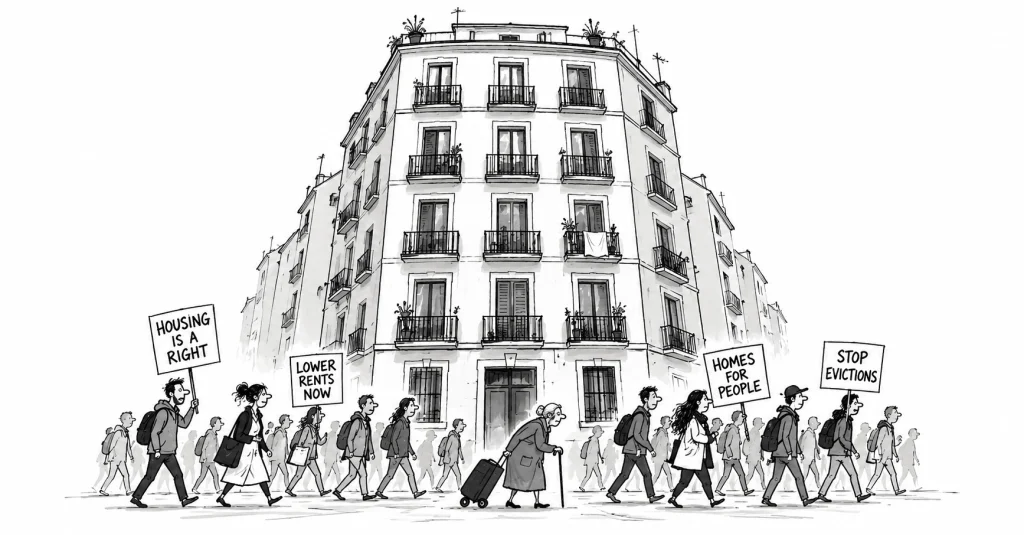
About 70,000 people marched in Madrid and demonstrations spread across dozens of cities after lawmakers rejected new housing measures. The protests show what happens when an affordability crisis becomes a question of whether ordinary households still have a secure place in the market.
Around 70,000 people marched in Madrid on October 3, while demonstrations took place in roughly 50 cities across Spain, demanding stronger government action on housing. The protests followed parliament’s rejection of measures intended to address rent, eviction and affordability pressures, and they were intensified by the recent eviction of an 87-year-old woman in Madrid. Reuters reported that most demonstrations were peaceful, though clashes broke out in Madrid and Valencia. Housing has been a political problem in Spain for years, but the scale of the turnout suggests the issue has moved beyond frustration over expensive apartments. It is becoming a test of whether the market still offers enough stability for people who rent, work and raise families in places where housing costs keep moving faster than incomes.
Prices Can Slow and Still Be Too High
Spain’s housing market illustrates why slower price growth does not automatically mean improved affordability. Second-hand home prices were still rising at double-digit rates in the third quarter, according to data cited by Reuters, even as growth moderated from earlier peaks. Meanwhile, the Bank of Spain has warned that the country could face a shortage of more than one million homes by 2028 if current trends continue. In some markets, rent now consumes close to an average monthly salary, leaving little room for households to absorb another increase. The problem is therefore not simply that prices rose quickly. It is that years of insufficient supply, population growth, tourism demand and limited rental availability have left households competing for too few homes.
The eviction cases have made that shortage tangible. Reuters profiled 65-year-old Pilar Lopez, who lived in the same Palma de Mallorca apartment for 12 years before the building was sold to an investment fund and she was eventually forced out. She spent two months sleeping in her car before finding temporary accommodation. In Madrid, the removal of 87-year-old Maricarmen Abascal became another symbol for tenant groups organizing the October protests. Neither case by itself explains Spain’s national housing market, but both show what happens when households without alternative housing reach the end of a lease, ownership change or legal protection. A market can continue recording transactions while still leaving long-term residents with nowhere affordable to go.
Policy Has Not Kept Pace With the Pressure
The political challenge is that Spain does not have one housing problem with one obvious solution. Tenant groups want stronger eviction protections, automatic lease renewals and tighter rent controls. Builders and economists have emphasized the chronic shortage of new housing. Tourism-heavy cities face additional pressure from short-term rentals, while some policymakers want tougher restrictions on investment buyers. Institutional landlords are frequently blamed in the public debate, but Reuters notes that large investment firms still own only a relatively small share of Spain’s total housing stock. That makes the policy problem more difficult: limiting one class of owner cannot by itself create the number of homes needed to close a structural supply gap.
The demonstrations also arrive at a politically sensitive moment. Reuters reported speculation that Prime Minister Pedro Sánchez could call a snap election following the defeat of housing measures in parliament, though his office declined to comment. Protest organizers are discussing further action with labor unions, including the possibility of a broader strike. What began as a dispute over rent and eviction rules is now intersecting with confidence in the government’s ability to respond. Housing has become one of the clearest places where national economic policy is being judged through household experience rather than aggregate growth figures.
Housing Determines More Than Where Someone Sleeps
The stakes extend beyond monthly rent. Housing determines how close people can live to work, whether children remain in the same school, whether older residents stay near support networks and how much income remains after shelter is paid for. A family forced farther from a city center may technically find cheaper housing while paying more in transportation and time. A worker who cannot afford to live near employment opportunities has fewer realistic choices even if jobs are available. Housing instability therefore moves quickly into labor, education and household-finance problems.
Spain’s protests are a warning about what happens when that instability becomes normal. Governments can point to construction targets, subsidies and regulatory reforms, while households experience the system through lease renewals, waiting lists and the possibility of displacement. The policy debate will continue over whether Spain needs more controls, more construction or some combination of both. The pressure in the streets is coming from a simpler problem: too many people no longer believe the housing system will reliably leave room for them inside it.