
Boston committed more than $52 million this week to support 892 income-restricted rental units across 13 developments, including 75 homes designated for individuals exiting homelessness. The funding spans nine neighborhoods and is part of the city’s ongoing attempt to stabilize access in one of the most expensive housing markets in the country. The investment is significant, but it arrives in a city where affordability is no longer an outcome of growth. It is an intervention designed to counteract it.
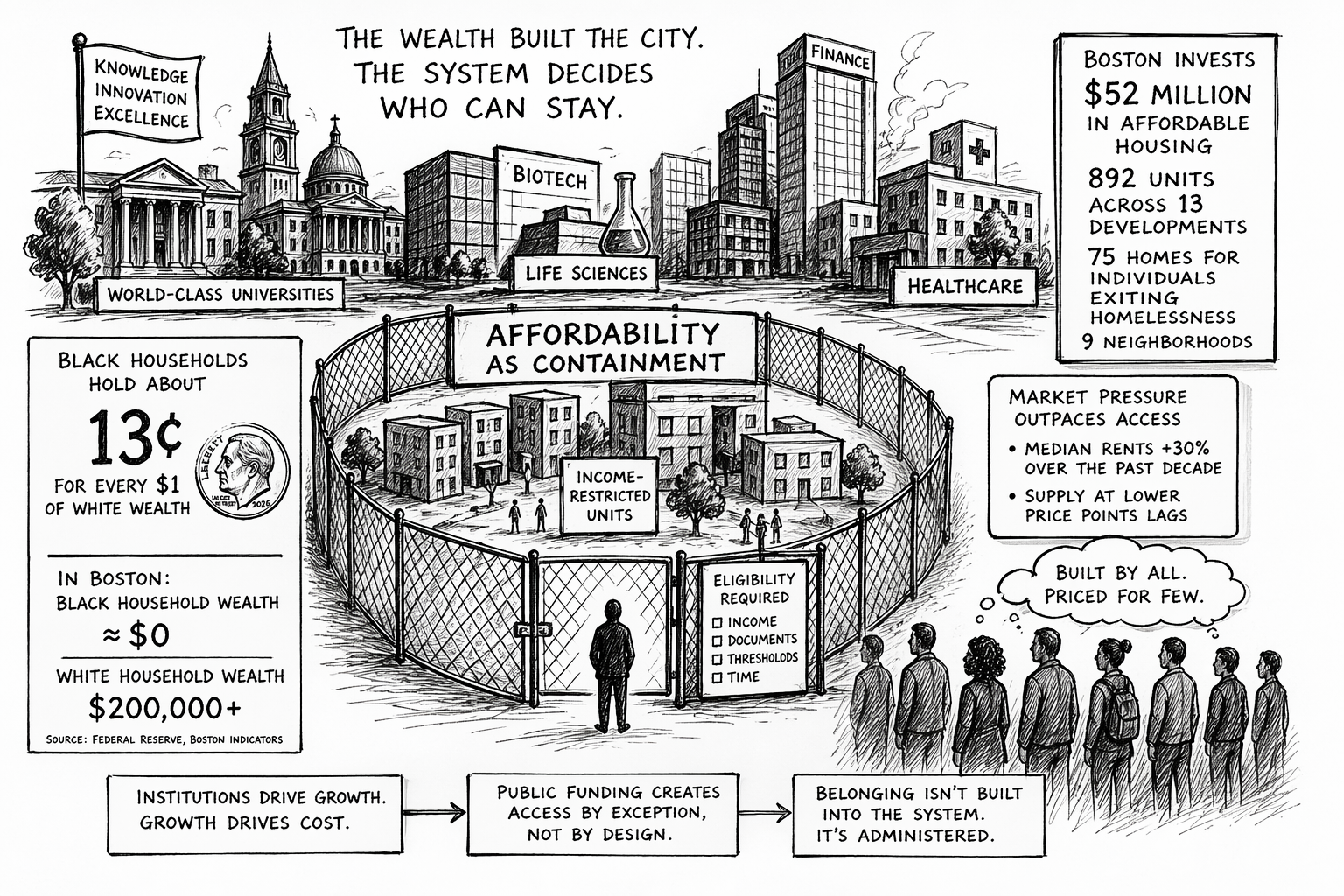
Boston has built its global identity around knowledge, innovation, and institutional excellence. It is home to some of the most well-endowed universities in the world, a life sciences sector that has positioned Massachusetts as a center of biomedical research, and a healthcare and financial ecosystem that generates wealth at a scale few American cities can match. Yet that wealth does not distribute evenly. As SSC recently reported, according to recent estimates, Black households nationally hold a fraction of white household wealth, with Black families typically possessing about 13 cents for every dollar of white wealth . In Boston specifically, earlier analyses have shown extreme disparities, with Black household wealth effectively near zero compared to six-figure averages for white households . The gap does not exist outside the system. It exists within it.
That contradiction is embedded in the housing market itself. Boston’s economic engine continues to attract high-income workers in education, biotech, and finance, creating sustained upward pressure on housing demand. Median rents have increased more than 30% over the past decade, while supply — particularly at lower price points — has lagged behind. The result is a system where new wealth entering the city raises the baseline cost of living faster than public interventions can offset it. Housing policy, in this context, becomes less about expanding opportunity and more about managing displacement.
The $52 million allocation reflects a broader shift in how cities respond to that pressure. Public funding is being used to create affordability that the market will not produce on its own. But this introduces a structural limitation: affordability is no longer embedded in the system. It is selectively granted. Each subsidized unit becomes a controlled point of access, while the broader market continues to price out residents who fall just outside eligibility thresholds. The question is not whether housing is being built. It is who qualifies to remain.
This dynamic mirrors patterns across other high-growth cities, but Boston’s institutional density intensifies it. Universities, hospitals, and research institutions do not just generate jobs; they anchor demand at a scale that reshapes entire neighborhoods. Their presence stabilizes the economy while simultaneously driving up land values and rents. The same institutions that define Boston’s global reputation are also key actors in the local affordability crisis, not through intent, but through the scale of economic gravity they exert.
The inclusion of 75 units for individuals exiting homelessness adds another layer to the story. Housing policy is increasingly being used as a stabilizing mechanism for those already pushed out of the system. But this raises a structural tension: are cities investing enough to prevent displacement, or are they primarily funding pathways back in after it occurs? The distinction matters because it determines whether policy is addressing root causes or managing outcomes. In Boston’s case, the scale of intervention suggests a system responding to pressure rather than reshaping it.
What this moment ultimately reveals is not a failure of growth, but a redefinition of access within it. Boston’s economy continues to expand, its institutions continue to generate wealth, and its global standing remains intact. But participation in that system is becoming increasingly conditional. The same structures that produce innovation and capital are also setting the terms for who can live near them, benefit from them, and remain within the city at all. Affordability, in this context, is not just a housing issue. It is the mechanism through which belonging is being decided.