
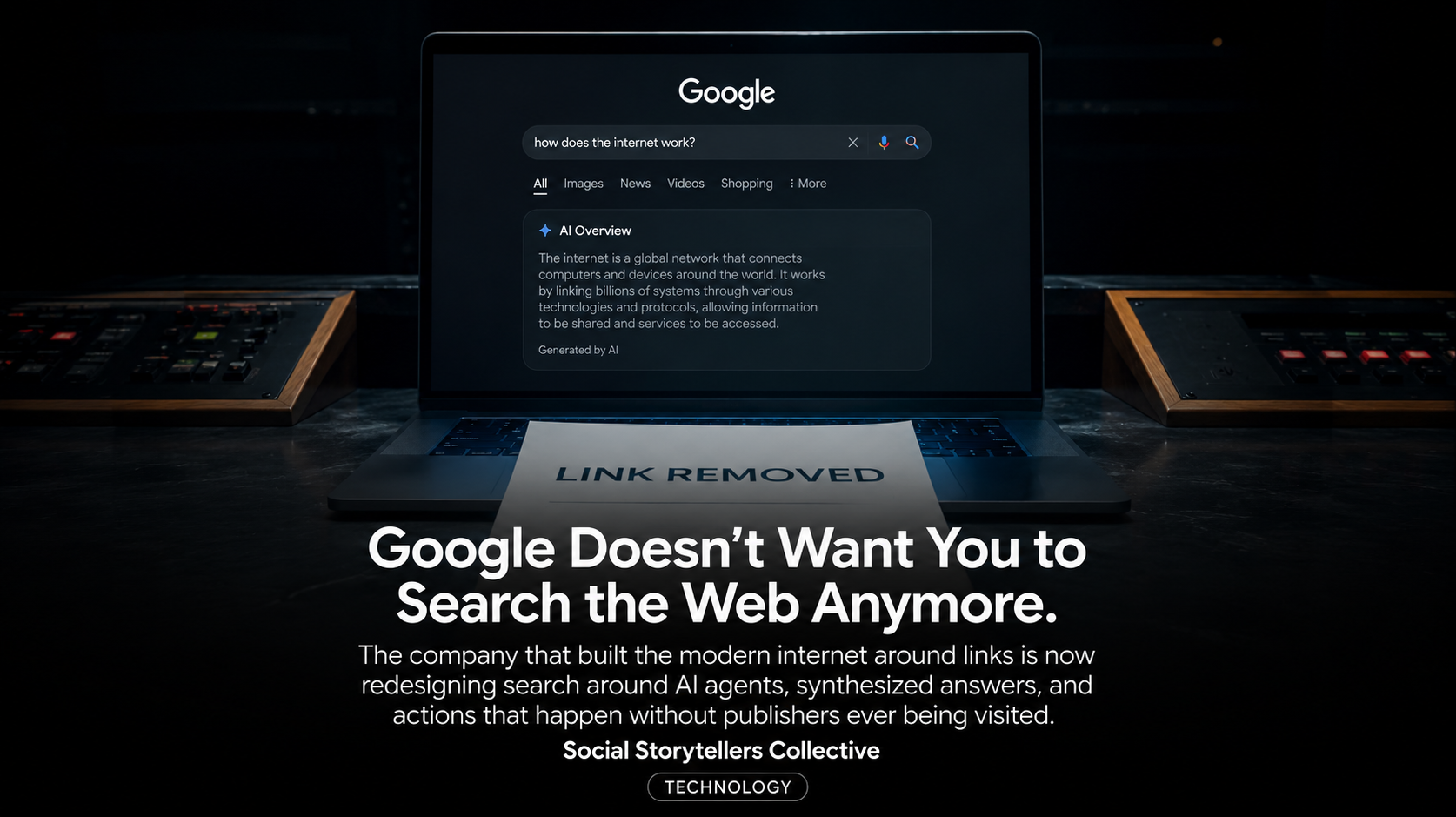
The ten blue links era is ending — quietly, but decisively.
At its 2026 Google I/O conference, Google unveiled what may become the single biggest transformation to internet behavior since the search engine itself went mainstream. The company is no longer positioning Search primarily as a tool for finding websites. It is rebuilding Search into an AI operating layer designed to answer questions directly, perform tasks autonomously, monitor information continuously, and eventually act on behalf of users without requiring them to meaningfully navigate the open web at all.
The implications extend far beyond product design. For more than two decades, the internet economy depended on a relatively stable exchange: publishers created information, Google indexed it, users searched for it, and traffic flowed outward through links. Entire industries emerged around this behavior — journalism, blogging, SEO consulting, independent media, digital advertising, forums, and niche expertise ecosystems. Google’s new AI-first architecture fundamentally weakens that relationship, because the destination is no longer the website. Increasingly, the destination is Google itself.
The company’s new AI-powered search experience replaces traditional link-based discovery with conversational interactions and synthesized responses. Instead of choosing between websites, users will increasingly interact with AI-generated summaries, dynamic widgets, and persistent project spaces that evolve over time. Search queries are becoming workflows. Google’s information agents will reportedly track topics continuously in the background, monitor changes across the web, synthesize updates, and notify users when conditions are met. The shift sounds subtle, but structurally it changes the purpose of searching entirely. Search is moving from retrieval toward delegation.
That distinction matters because delegation dramatically reduces the importance of publishers themselves. If an AI agent monitors sneaker drops, tracks housing prices, compares products, summarizes news developments, plans vacations, builds meal schedules, or manages research synthesis without users ever visiting original sources, then traffic — the economic oxygen of much of the web — begins to collapse. Google already destabilized publishers through AI Overviews, which summarize information directly inside search results and reduce click-through rates. The new system accelerates that logic further by making links increasingly optional rather than central.
The irony is structural. Google spent decades training businesses, journalists, creators, and institutions to optimize themselves for discoverability inside Search. Entire media strategies, editorial calendars, and business models were built around ranking highly on results pages. Now the same company is redesigning the interface so users may no longer need those destinations in the first place. The web is being reorganized from an ecosystem of distributed sites into an ecosystem of centralized AI mediation. Information still exists across the internet, but increasingly users will experience it through synthesis rather than direct exploration.
The intermediary becomes the authority.
There is also a psychological shift embedded inside this transition. Traditional search required active decision-making. Users scanned headlines, evaluated sources, opened tabs, compared perspectives, and manually pieced together understanding. AI-native search reduces that friction by collapsing those steps into a single conversational response. That convenience is precisely why the model will likely succeed at scale. But it also changes how authority is perceived online. Instead of trusting a publication, reporter, institution, or expert directly, users increasingly trust the interface that summarizes all of them together.
Google’s push toward generative UI and customizable mini-apps inside Search pushes this transformation further still. The company is no longer simply trying to organize the world’s information. It is trying to operationalize it.
Search results become interactive systems capable of booking reservations, tracking markets, generating personalized dashboards, and managing ongoing informational tasks autonomously. In that model, websites are less destinations than raw material feeding Google’s AI infrastructure.
The economic consequences could be severe for digital publishing. Independent publishers and ad-supported media organizations were already struggling under declining referral traffic, algorithm volatility, subscription fatigue, and audience fragmentation. AI-native search threatens to remove one of the last remaining stable traffic pipelines. Smaller publishers may be hit hardest, lacking the brand recognition to survive without discovery ecosystems. Large institutional outlets may adapt through licensing agreements, direct audience models, or platform partnerships. Much of the mid-tier and independent web may face a structural collapse if audiences stop clicking outward altogether.
What remains largely unaddressed in Google’s rollout — and in most of the tech industry’s coverage of it — is who decides what the AI surfaces. Algorithmic systems have never been neutral arbiters of information. They reflect the priorities, training data, and commercial incentives of the companies that build them. For Black and Brown communities, that history is not abstract. It is a track record of search results that criminalized, flattened, or erased. It is content moderation that disproportionately silenced. It is recommendation systems that buried independent Black media while amplifying mainstream institutions that parachuted into the same beats. AI synthesis does not resolve those distortions. It automates them. When the interface becomes the authority, the question of whose knowledge gets synthesized — and whose gets skipped — becomes more consequential, not less.
The open web was built around movement. AI-native search is built around settlement. What’s ending is not the internet — it’s the assumption that users navigate it themselves. And when those navigational choices are delegated to a single AI intermediary, the stakes of how that intermediary was designed, and for whom, become the defining question of the information age.