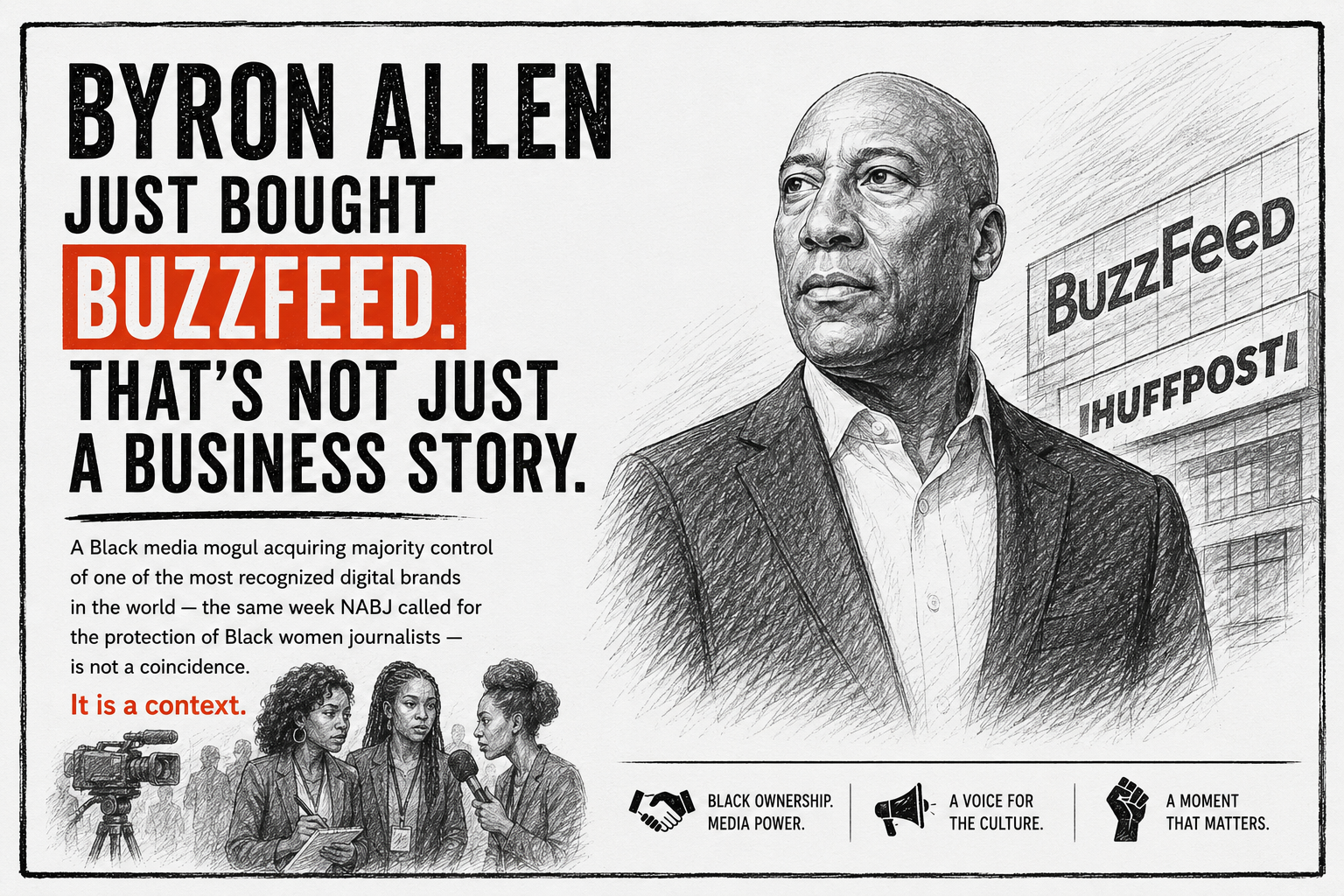
On Monday, Byron Allen’s family office agreed to acquire a 52% majority stake in BuzzFeed for $120 million — $20 million in cash at closing and a $100 million promissory note due five years from closing. Allen will become Chairman and CEO. Founder Jonah Peretti will transition to a new role as President of BuzzFeed AI. The deal is expected to close by the end of May.
The headline is a business transaction. The story underneath it is about who controls the infrastructure that shapes what gets covered, whose stories get told, and whose voices get amplified inside American media at a moment when all three of those questions are more consequential than they have been in decades.
What Allen is acquiring
BuzzFeed is not the company it was at its peak. Q1 2026 revenue came in at $31.6 million, down 12.4% year over year. The company has struggled as a publicly traded entity since its 2021 IPO — the same year it acquired HuffPost from Verizon in an attempt to scale. The digital media model that BuzzFeed pioneered — viral content, listicles, social distribution, quiz culture — has been disrupted by the same algorithmic forces that disrupted everything else. Hot Ones, the interview format that became one of BuzzFeed’s most valuable assets, spun out independently. The stock has languished on the Nasdaq.
What Allen is acquiring is not a peak-era digital media empire. It is a distressed asset with significant remaining infrastructure — HuffPost, one of the most recognized progressive news brands in the country. A global audience. A content production apparatus. And now, per Peretti’s new role, an AI content platform being built to chase YouTube as a free streaming destination.
Allen said in a statement: “Our vision is to build on the iconic foundation of BuzzFeed and HuffPost by expanding into free-streaming video, audio and user-generated content.”
That vision is consistent with what Allen has been building for three decades. Allen Media Group owns syndicated television shows, channels, and 13 broadcast affiliate TV stations across the country. The Weather Channel assets. A content distribution infrastructure that most people in media underestimate because it operates largely outside the prestige media conversation. BuzzFeed adds digital reach, brand recognition, and an AI development arm to an already operational media empire built by a Black entrepreneur who has been doing this since 1993.
Why the timing matters
This deal closes in the same week that the National Association of Black Journalists released a public statement condemning the treatment of ABC News Senior Congressional Correspondent Rachel Scott — calling the hostility directed at Black women journalists a documented pattern, not an isolated incident.
SSC reported on that statement this week in When the Question Is Legitimate and the Answer Is Personal. NABJ President Errin Haines said plainly: “When Black women journalists are targeted, insulted or demeaned for asking legitimate questions, it is not only an attack on them personally — it is an attack on the role of a free press in our democracy.”
The connection between these two stories is not metaphorical. It is structural.
The climate in which Black journalists — and specifically Black women journalists — operate is shaped significantly by who owns the institutions they work for, who controls the editorial environments they work in, and who has the institutional power to protect them when they are publicly attacked for doing their jobs. Representation in the newsroom matters. Representation in the ownership suite matters more — because ownership determines editorial priorities, resource allocation, hiring pipelines, and the institutional culture that either protects or abandons journalists when the pressure arrives.
Byron Allen acquiring majority control of BuzzFeed and HuffPost does not automatically resolve any of those questions. But it changes the composition of who is making the decisions that shape the answers. That is not a small thing in a media landscape where Black ownership at the executive level remains structurally rare.
The Black Enterprise contrast
SSC reported this week in Black Enterprise Was Already Telling The Story that the Black press has lost roughly 80% of its revenue since the DEI backlash intensified — and that less than 2% of US advertising spending goes to Black-owned media even during the peak years of corporate DEI commitments.
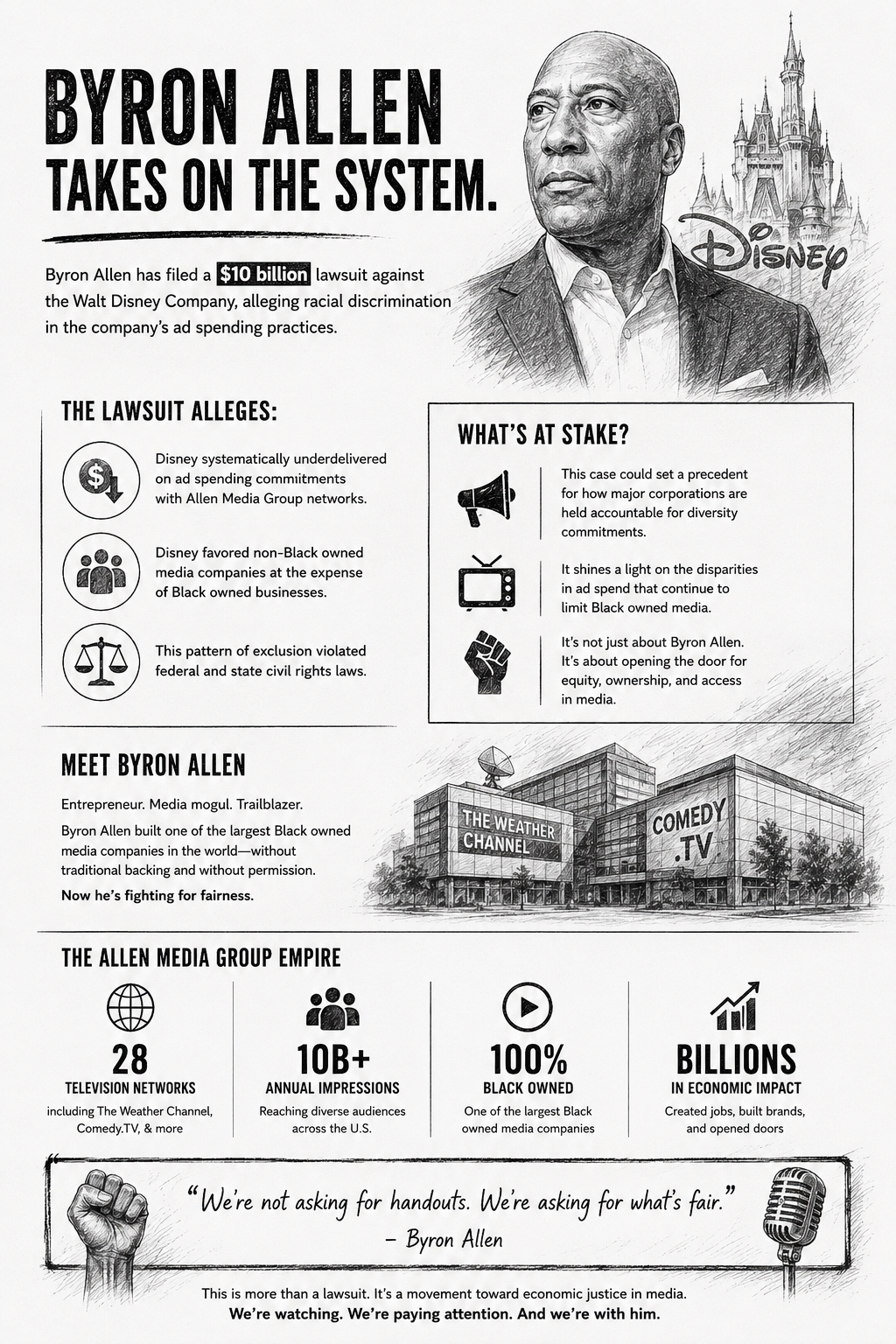
Byron Allen has spent years making this argument publicly and litigating it aggressively. He filed a $10 billion lawsuit against Charter Communications alleging racial discrimination in carriage deals for his networks. He has been vocal about the structural barriers Black media owners face in accessing advertising revenue, distribution deals, and the capital markets that fund media expansion.
The BuzzFeed acquisition is Allen doing what he has always argued the industry should allow Black media owners to do: compete for major assets at scale, with the operational infrastructure to run them, rather than being confined to the margins of the media economy while building something from scratch.
Black Enterprise is navigating survival inside a hostile ecosystem. Byron Allen just acquired a majority stake in a publicly traded media company. Both stories are about Black media ownership in 2026. The distance between them is the distance between what the ecosystem permits and what it prevents — and what happens when someone has built enough outside that ecosystem to operate inside it on different terms.
The Kevin Hart parallel
SSC also reported this week on the struggles at HartBeat Productions — a celebrity-driven media company valued at $650 million now navigating layoffs, stalled productions, and internal tension. The argument at the center of that piece: attention and operational durability are not the same thing. The celebrities who built lasting media enterprises did so by attaching their visibility to institutional infrastructure rather than betting that personality alone could sustain scale.
Byron Allen is the counter-example to that argument made manifest. He did not build his media empire on celebrity. He built it on syndication deals, broadcast infrastructure, carriage agreements, and the kind of operational depth that runs whether or not the founder is in the room. When he acquires BuzzFeed, he is not buying a platform for his personal brand. He is adding an asset to an institution that already knows how to run one.
That distinction — between the celebrity entrepreneur model and the operational media owner model — is the most clarifying frame for understanding what the Byron Allen/BuzzFeed deal actually represents. It is not a rescue. It is an acquisition by someone who has been building the infrastructure to make acquisitions like this for thirty years.
What comes next
The deal closes by the end of May. Peretti moves to AI development. Allen takes the chairman and CEO roles. HuffPost and BuzzFeed become part of an Allen Media Group portfolio that now spans broadcast television, digital media, streaming content, and AI-driven publishing.
Whether Allen can reverse BuzzFeed’s revenue decline — down 12.4% year over year in Q1 — is a legitimate open question. Digital media is a difficult business regardless of who owns it. The advertising ecosystem that is starving Black-owned media does not automatically become more generous because the owner is Byron Allen rather than a struggling startup.
But the question of who owns the infrastructure that shapes American media coverage — who decides what gets covered, whose stories get resources, whose journalists get protected — is one that the industry has answered in a remarkably narrow way for most of its history.
Byron Allen just changed the composition of that answer. In the same week NABJ had to issue a public statement reminding the country that Black women journalists deserve to do their jobs without being publicly humiliated for asking legitimate questions, a Black media owner acquired majority control of two of the most recognized digital news brands in America.
The context is not incidental. It is the story.