The Candidate Access Gap — Who Can Afford to Run
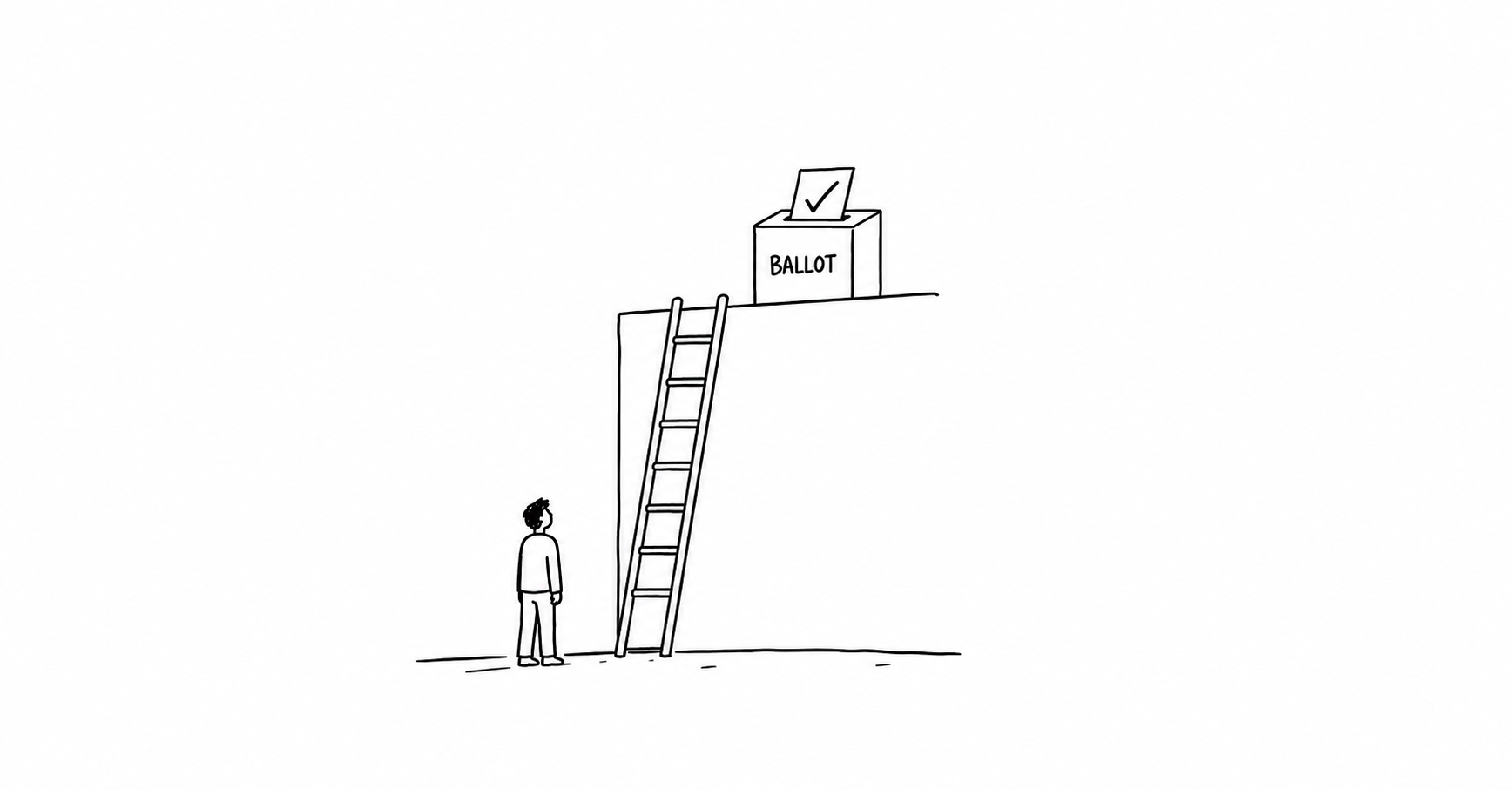
Democracy starts narrowing before voters choose when the cost of candidacy filters who appears on the ballot.
Reuters reported in September 2025 that real median U.S. household income was $83,730 in 2024. Former Nebraska Senate candidate Dan Osborn wrote in The Guardian that research by Nicholas Carnes found only 2.3% of Democratic candidates had worked exclusively in blue-collar jobs before entering politics. Those numbers belong in the same analysis. Running for office is a formal right. The cost of becoming a viable candidate is a private barrier that the formal right does not remove.
Candidacy is an economic system before it is an electoral one. A person considering a run must pay filing fees, absorb time away from paid work, build a campaign operation, travel the district, raise money at scale, and survive months of financial uncertainty before a single voter makes a decision. The ballot may be public. The path to the ballot is privately financed in time, money, professional networks, and risk tolerance.
That structure produces representation before representation. Voters encounter a field of candidates and treat it as the available democratic choice. The field has already been shaped by who could afford to enter it, who could persuade early donors, who had party access, and who could carry the financial risk of a losing race. The public chooses from a pool that private costs narrowed first.
Wealth provides specific advantages at each stage. Self-funding removes early donor dependency. Professional networks provide validators, introductions, and large-dollar contributors. Flexible or autonomous work makes daytime meetings, fundraising calls, and travel manageable without income loss. An hourly worker, a shift worker, a parent with child care costs, or someone carrying medical debt faces a different calculation at every one of those stages. The decision to run is not just about ambition. It is a financial risk assessment.
The narrowing affects policy downstream. Candidates who have navigated hourly scheduling, eviction risk, medical debt, or wage volatility bring different instincts to policy than those who have not. When those candidates cannot absorb the cost of running, those instincts lose a seat in the decision-making pipeline. The body can become more demographically diverse in visible ways while remaining narrow in class experience and economic exposure.
Campaign finance shapes the barrier at a different layer. Small-dollar fundraising has lowered some entry costs, but it has also created new infrastructure requirements: digital lists, content production, donor conversion systems, and compliance operations that require either money or volunteer capacity that candidates need connections to find. Public financing systems like New York’s matching program have tried to reduce the entry fee, but uneven adoption means access still depends heavily on geography, party support, and local rules.
Treating candidacy as infrastructure — through public financing, paid campaign leave protections, lower filing barriers, and shared compliance support — would not guarantee better candidates. It would widen the field before voters choose. Without that investment, the country will keep asking why government feels distant from ordinary life while preserving an entry system that filters out most ordinary people before the election begins.