
Part of The Access Shift — an ongoing series examining how access is being quietly reshaped across American life.
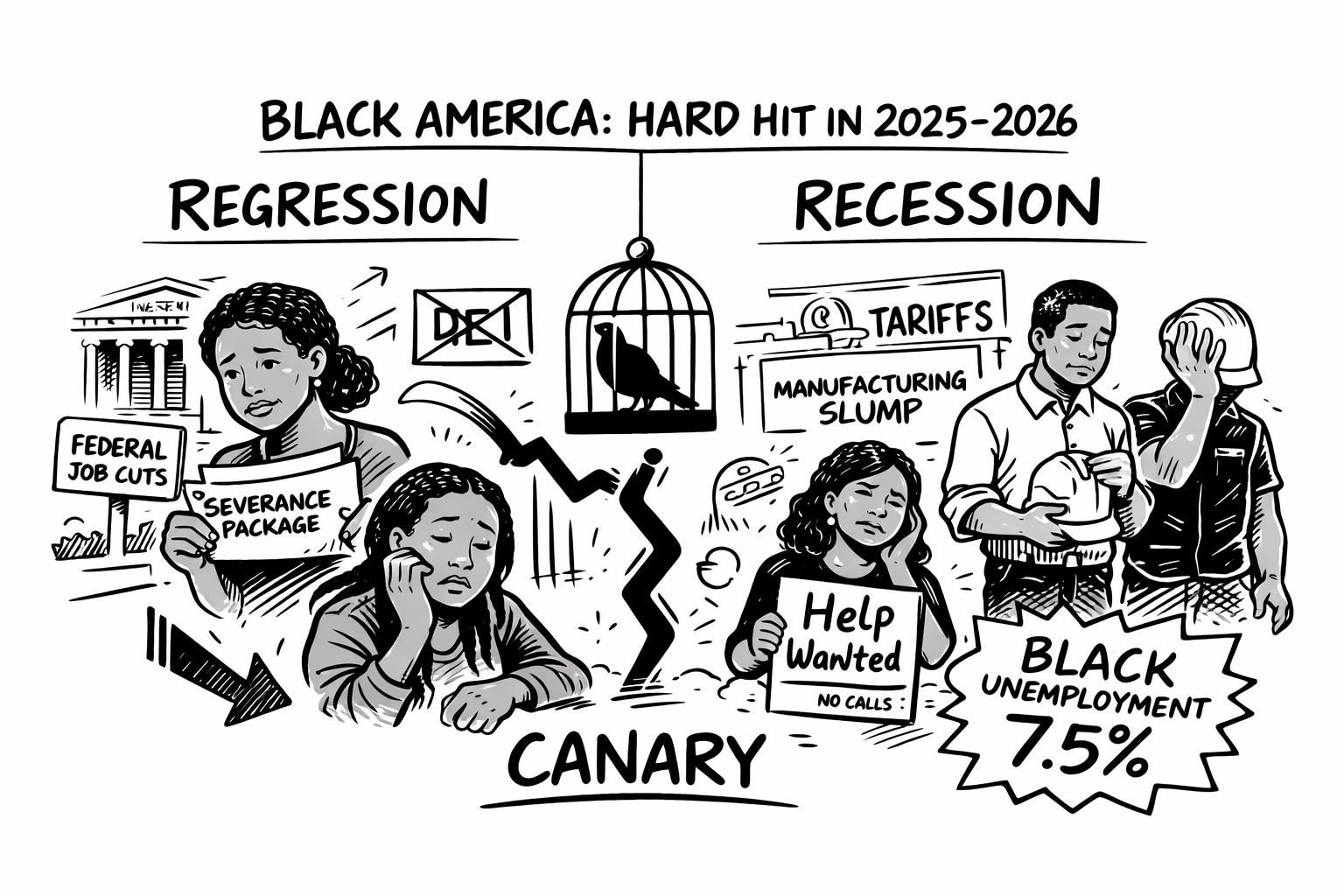
The numbers tell a story that national headlines keep missing. The Black unemployment rate reached 7.5% in 2026 — the highest level since October 2021 — and more than 300,000 Black women left the workforce in the first half of 2025. Pew Research Center The Joint Center for Political and Economic Studies has already declared it: 2025 was a “regression and recession” for Black America. The broader national recession hasn’t officially arrived. For Black workers, it’s already underway.
Black women started 2025 with an unemployment rate of 5.4%. They ended it at 7.3% — a level equivalent to what White women experienced during the bleakest moments of the Great Recession. The causes are layered: federal job cuts that fell disproportionately on Black workers, the dismantling of DEI initiatives across both public and private sectors, a manufacturing slump accelerated by tariffs, and a broader hiring slowdown that hits hardest when the candidate pool expands and discrimination has more room to operate.
The federal government has historically been one of the most reliable pathways into the Black middle class — offering stable salaries, benefits, and protections that the private sector rarely extended regardless of qualifications. Interrupting that pipeline doesn’t just affect the people who lost their jobs. It affects the families, communities, and generational trajectories built around them. Policy experts have long called Black Americans the “canary in the coal mine” of economic stress. Right now, the canary is not singing.
For more on how access to stable systems is quietly being restructured, read The Access Shift.
The Access Shift
The gradual redefinition of who systems are designed to serve.
Across sectors—from public infrastructure to healthcare to everyday spaces—access is no longer assumed. As costs rise and systems face increasing pressure, services once built for broad reach are becoming more selective, more conditional, and less universal. The Access Shift explores how these changes are unfolding in real time—and what they reveal about who is included, who is left out, and how the structure of everyday life is quietly being reshaped.