
Kwanza Jones is on the verge of becoming the first Black woman majority owner in Major League Baseball history. The $3.9 billion Padres deal is bigger than baseball — it’s about who gets to control what Black labor built.
Major League Baseball has existed in its modern form since 1903. That is 123 years of history — through two world wars, integration battles, strikes, steroids scandals, and cultural shifts that reshaped the country around it. And in all of that time, not once has a Black woman held a majority ownership stake in one of its franchises.
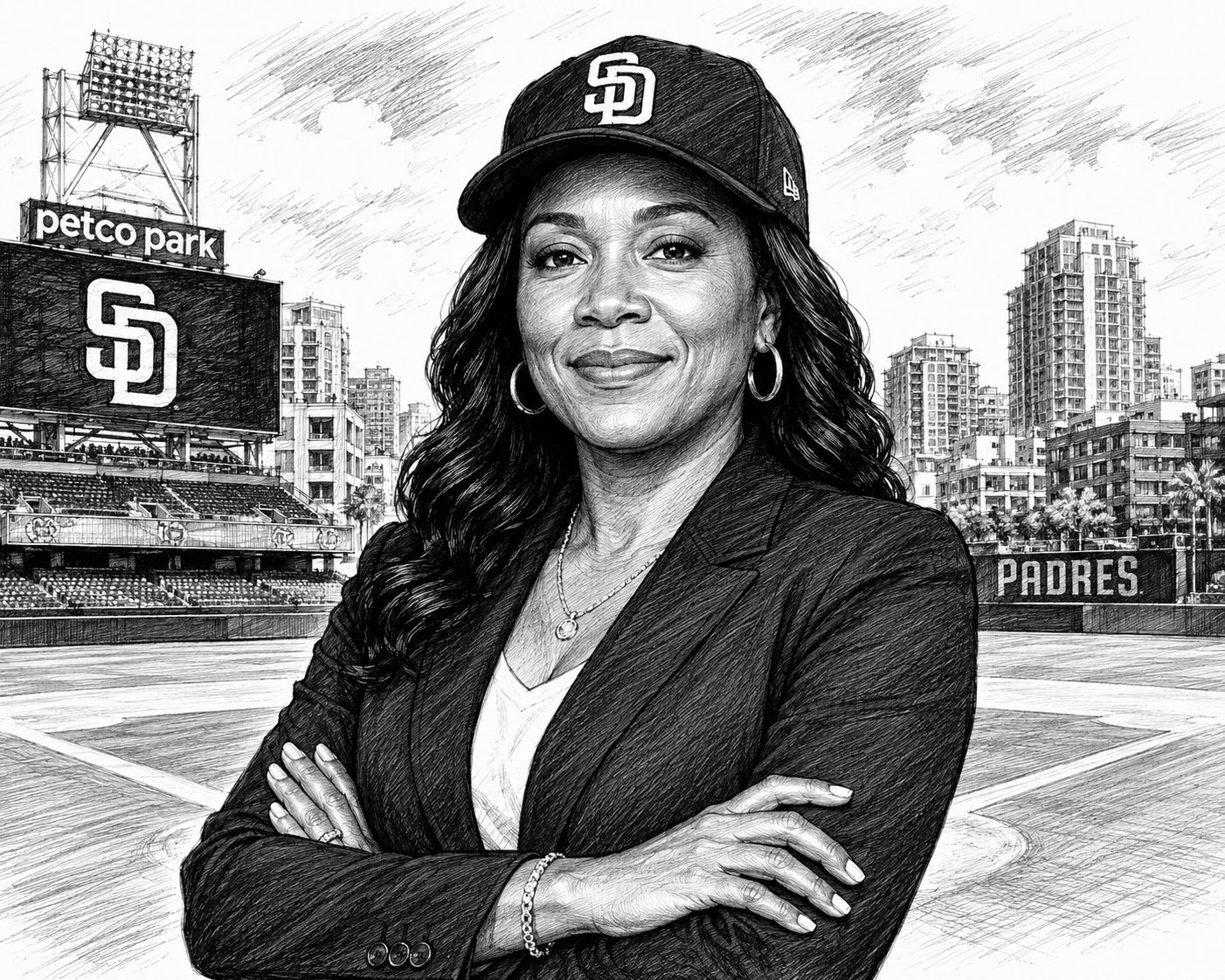
That may be about to change.
On May 2, 2026, the family of late San Diego Padres owner Peter Seidler announced an agreement to sell the franchise to an investor group led by entrepreneur, philanthropist, and Princeton graduate Kwanza Jones and her husband, private equity billionaire José E. Feliciano. The price: $3.9 billion — a new MLB record, surpassing the $2.4 billion Steve Cohen paid for the New York Mets in 2020.
If approved by at least 22 of MLB’s 30 club owners at the league’s quarterly meeting in June, Jones becomes the first Black woman majority owner in the sport’s history. Feliciano would become the first majority owner of Puerto Rican descent. The ownership group also includes the Sycuan Band of the Kumeyaay Nation — a rare instance of tribal participation in an MLB ownership structure.
This is not a minor milestone. This is a structural rupture in one of America’s most tradition-bound institutions.
The mountain that hasn’t moved
For as long as professional sports have existed in this country, Black athletes have been the engine. Black labor, Black talent, Black cultural influence have built enormous wealth for teams, leagues, sponsors, and media companies for more than a century. Ownership — the seat where that wealth actually accumulates — has remained almost entirely out of reach.
Magic Johnson holds minority stakes across multiple sports. LeBron James has his eye on NBA ownership in Las Vegas. Black athletes earn unprecedented salaries and sit at the center of brand creation in ways unimaginable a generation ago. And yet majority team ownership — the position that determines who profits from player labor, who hires coaches and executives, who controls media narratives, who sets institutional values — has remained just beyond their grasp.
The Jones-Feliciano deal is the closest Black ownership has come to the top of an MLB franchise since a chapter of history most people don’t know well enough.
The full-circle moment baseball doesn’t talk about
Here is what makes this deal culturally significant beyond the headline: the last time Black Americans controlled MLB-level baseball ownership, Jackie Robinson ended it.
That is not Robinson’s fault. It is the fault of a system that extracted Black talent and discarded Black infrastructure in the same motion.
Before integration, Black entrepreneurs built their own leagues. Arthur “Rube” Foster founded the Negro National League in 1920. At its peak, the Negro Leagues were a thriving economic ecosystem — Black-owned teams, Black-run front offices, Black fans filling stadiums, Black wealth circulating within Black communities. The leagues produced some of the greatest players in the sport’s history and created a deep, multigenerational love for baseball in Black America.
When Robinson signed with the Brooklyn Dodgers’ minor league affiliate in 1946 and debuted in MLB in 1947, it was a historic breakthrough. It was also, as Effa Manley — the legendary owner of the Newark Eagles — understood almost immediately, the beginning of the end. MLB absorbed the talent. It did not absorb the ownership. By the early 1960s, Black baseball and Black-owned baseball were effectively dead. The wealth stayed white. The labor stayed Black.
That pattern has defined professional sports ownership in America ever since.
The potential Jones-Feliciano purchase, as Andscape’s William C. Rhoden wrote this week, is a full-circle moment — the return of Black ownership to the institution that dismantled it the last time.
Who Kwanza Jones is
Jones is not a celebrity buyer or a passive investor. She is the founder and CEO of SUPERCHARGED, a motivational media company and lifestyle brand. She and Feliciano co-founded the Jones-Feliciano Initiative, a philanthropic organization that has directed more than $250 million toward education, entrepreneurship, equity, and empowerment. In 2020, they made a $20 million donation to Princeton — the largest gift to the institution from Black and Latino donors at the time, which led to the naming of Kwanza Jones Hall.
She recently launched The Apollo x Kwanza Jones Presents: Culture In Motion — a national roadshow uniting communities through arts and empowerment.
She is not arriving at sports ownership as an outsider. She is arriving as someone who has spent decades building institutions, investing in communities, and moving capital in ways that center people who are typically left out of both.
In their joint statement, Jones and Feliciano said: “This is about more than baseball — it’s about boosting the pride, energy, and connection that define the Padres, investing in community, deepening belonging, and ensuring this team remains accessible and endures for generations.”
What still has to happen
The deal is not done. A formal vote among all 30 MLB club owners is expected at the league’s June quarterly meeting, where the sale needs at least 22 votes to pass. From there it requires SEC review and sign-off from the City of San Diego, which holds a stake in Petco Park. If everything clears, the Jones-Feliciano era begins around this summer’s All-Star break.
The Padres are currently the only major professional sports franchise in San Diego. Attendance has climbed to record levels three consecutive seasons. The team was 19-12 when the announcement came down.
History is pending a vote. It usually is.