
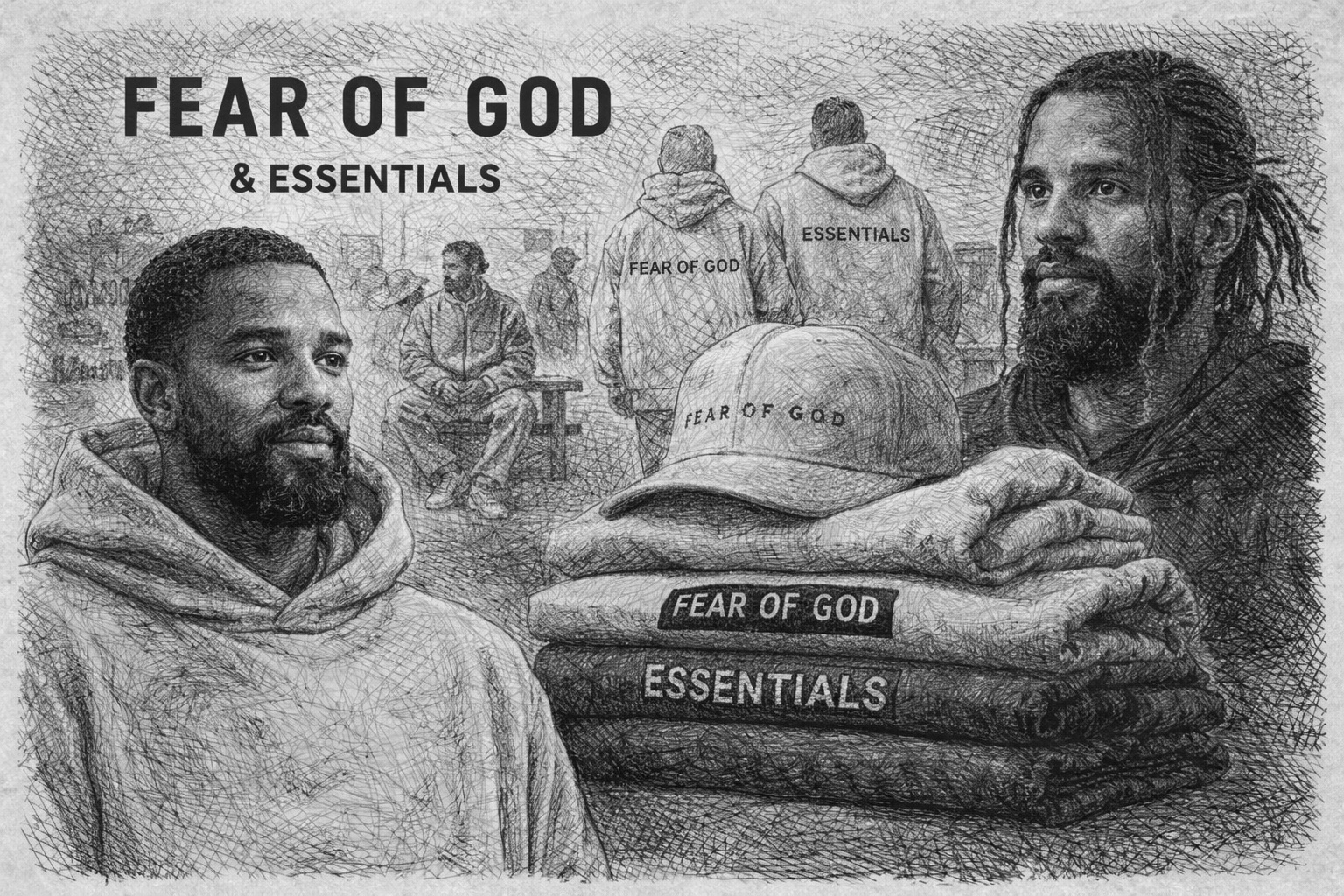
I’ll be honest with you. Fear of God and Essentials are two of my favorite brands, and I don’t always make a clean distinction between them. That’s intentional — but not in the way the fashion conversation usually means.
There’s a season of life I’ve settled into where dressing intentionally and dressing comfortably are the same thing. When I’m not in professional settings, I ease into garments like these because of how they’re structured on the body. The proportion. The weight. The way something sits without demanding attention. I’m not reaching for a logo. I’m reaching for a feeling — and Fear of God, at both price points, consistently delivers it.
That personal relationship is what made me pay closer attention to what Jerry Lorenzo has actually built. Because what looked, from the outside, like a brand extension is something more considered than that. And I’ll add this — I recently learned that Jerry Lorenzo and I share the same fraternity. That has nothing to do with my love of the brand. It was just the icing on the cake. The work earned my respect long before I knew that.
For years, Fear of God operated in the space between luxury and streetwear, building its identity on restraint rather than noise. It never chased volume the way many of its peers did. It built slowly, deliberately, with price points and release patterns that made ownership feel intentional. Scarcity wasn’t just a tactic. It was part of the meaning.
The rise of Essentials reorganized that structure. What once existed as a single lane — premium, limited, elevated — now operates as a layered system. Essentials sits at the base: accessible, repeatable, widely available. Fear of God sits above it: more controlled, more expensive, more selective. Together, they don’t compete. They reinforce each other. And for someone like me, who moves between both without thinking twice, that’s exactly the point. The language is consistent. The entry point is different.
Most brands move from exclusivity to accessibility and lose something in the process. Fear of God managed to do both simultaneously. Essentials lowers the barrier to entry without collapsing the perception of the core line. In fact, it strengthens it. The more people who wear Essentials, the more visible the aesthetic becomes. The more visible the aesthetic becomes, the more defined the upper tier feels. The person wearing the $80 hoodie and the person wearing the $800 jacket are speaking the same language at different volumes.
There’s a cultural layer underneath the product that makes this possible. Fear of God doesn’t rely on logos the way traditional streetwear does. The signal is in the silhouette. The muted palette. The proportion. It’s recognizable without needing to announce itself. That subtlety has allowed the brand to move across spaces — from athletes and artists to people like me, who simply want to feel well-dressed without performing it — without losing coherence. It doesn’t feel like a drop. It feels like a dialect.
What’s happening now is less about clothing and more about infrastructure. As Essentials pricing becomes more approachable and distribution widens, the brand is shifting from a moment to a system. It’s not asking who can get it anymore. It’s building something durable enough that more people can adopt it without the adoption changing what it means.
That’s the problem most brands can’t solve. Fear of God is solving it quietly, the same way it does everything else — by letting the structure do the work, and trusting that the people paying attention will feel it before they can fully explain it.
I felt it before I could explain it too.