
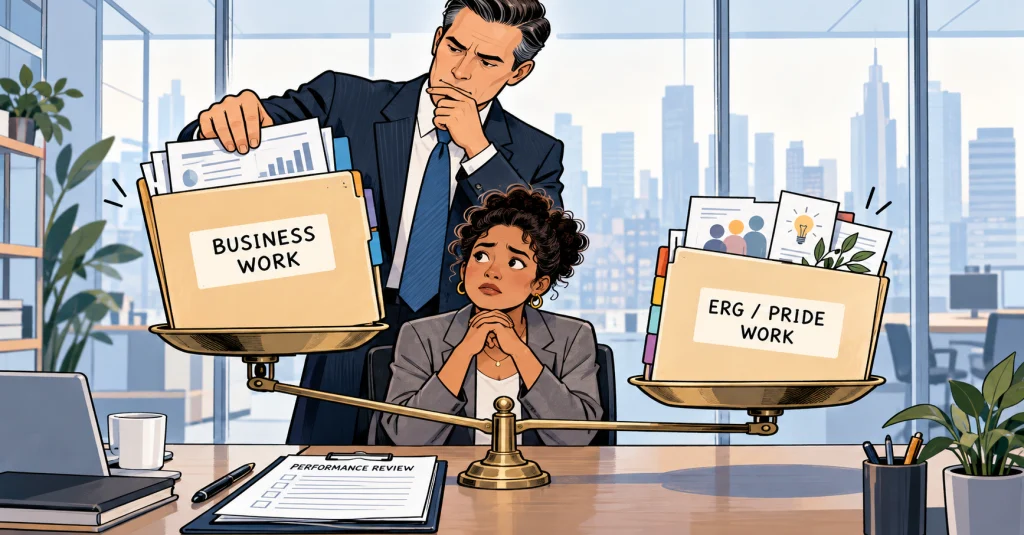
Brian Larson says JPMorgan encouraged his leadership in its LGBTQ+ employee group, then a supervisor refused to count that work in his performance review. The lawsuit raises a broader workplace question: when companies ask employees to build culture, who decides whether that labor actually counts?
Brian Larson says JPMorgan Chase gave him two different messages about the same work. The bank’s diversity leadership treated his involvement with its LGBTQ+ employee group as part of his contribution to the company. Larson alleges one of his supervisors saw it differently, telling him to separate his “gay job” from his “day job” and later warning that “DEI is not going to save you.” Larson filed a federal discrimination lawsuit against JPMorgan Chase on September 23, alleging discrimination and retaliation connected to his sexual orientation and his leadership in the bank’s PRIDE employee group. JPMorgan denies the allegations and says an internal investigation found no evidence substantiating his claims.
When Culture Work Counts
Larson joined JPMorgan through the Chase Associate Program, a rotational program designed to move participants through different teams before they pursue permanent roles. While there, he became co-chair of PRIDE Tri-State, an employee affinity group supporting LGBTQ+ workers. According to his complaint, JPMorgan’s then-global head of diversity, equity and inclusion, Brian Lamb, emailed Larson recognizing his DEI work and indicating that his manager would be instructed to incorporate it into three categories of his performance review. Larson alleges his supervisor, Peter Bergman, responded that he would not include Larson’s Pride activities in the evaluation. Bloomberg Law reported the same conflict from the federal complaint.
That disagreement gets at a problem that exists far beyond one bank. Employee resource groups are frequently presented as part of how companies recruit talent, retain employees, mentor workers and build internal culture. Employees are asked to organize events, serve as representatives, mentor colleagues and help companies demonstrate their commitments externally. But those assignments can occupy an unusual space inside organizations: important enough for the company to promote, yet dependent on individual managers to determine whether the time and labor involved have professional value. Larson’s allegations describe what can happen when those two systems collide.
Two Versions of the Same Performance
Larson alleges the tension escalated after he complained about Bergman’s remarks. His lawsuit says he was removed from projects, subjected to greater scrutiny and warned that obtaining a permanent position after the associate program was not guaranteed. The complaint says Bergman eventually rated Larson “on track” in three performance categories while writing that he wished Larson showed the same passion for his assigned business segment that he demonstrated for the LGBTQ+ community. Larson says those assessments contrasted with stronger feedback during other rotations and later affected his attempts to move into another position at JPMorgan. He applied for dozens of internal jobs without securing one, according to the complaint.
JPMorgan offers a different account. A spokesperson told The Independent that the bank takes the allegations seriously but found no evidence supporting Larson’s discrimination claims after an internal investigation. The bank also says multiple managers identified performance gaps and provided coaching, and that participation in the Chase Associate Program did not guarantee a permanent position. JPMorgan says Larson was given additional time to secure another role and ultimately resigned after failing to obtain one. Those competing accounts have not been resolved by a court.
The dispute eventually extended to about $40 in transportation expenses. Larson’s complaint says HR questioned two Uber rides associated with Pride Month events and told him the expenses raised concerns about trustworthiness and honesty. Larson said he had been authorized to attend the events and instructed to expense the rides; according to the complaint, his manager corroborated that account and HR found no policy violation. Four days later, Larson alleges, HR told him his time in the associate program had expired and gave him the choice of resigning or being terminated. JPMorgan disputes the broader allegation that discrimination drove his departure.
The Manager Still Controls the Translation
Larson’s case is still an allegation, not a finding of discrimination. But the organizational structure described in the lawsuit presents a recognizable tension for companies that rely on employee-led groups. An institution can describe affinity work as strategically valuable, encourage employees to participate and showcase those programs publicly, while leaving performance evaluation, project assignments and advancement largely in the hands of individual managers. The employee then has to navigate two definitions of valuable work at once: the one articulated by the institution and the one applied by the person evaluating the employee.
That makes the Larson case about more than whether a particular comment was made. The lawsuit asks what corporate commitments mean when they reach the performance-review process, where recognition becomes compensation, assignments, promotion and continued employment. Companies can create employee groups and describe inclusion as part of their business strategy. Whether that work carries professional weight is ultimately tested somewhere much less visible: in the meeting where a manager decides what counts.