
Part of The Access Shift — an ongoing series examining how systems expand, restrict, and redirect opportunity
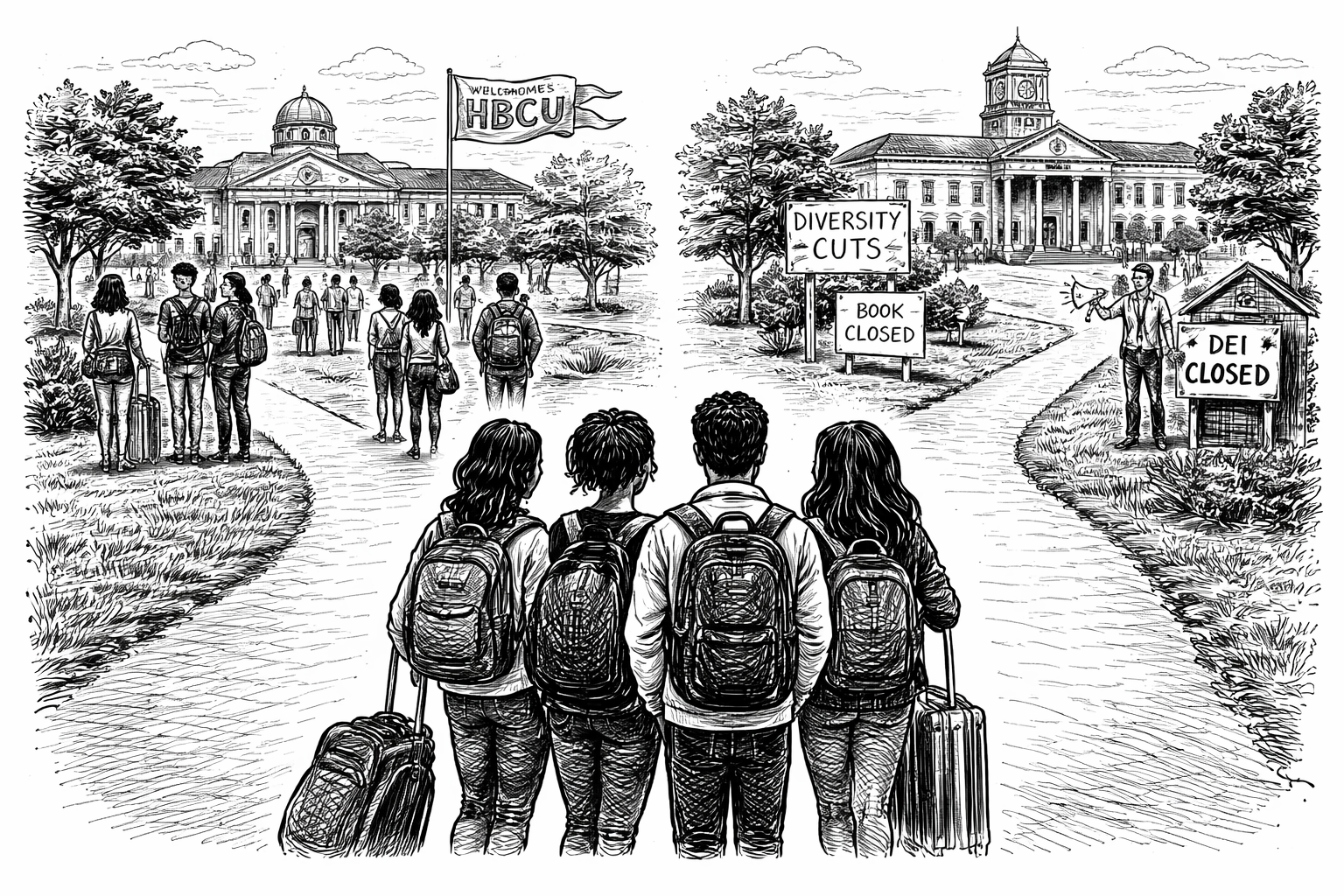
Black students are not just choosing colleges differently—they are responding to a changing political and cultural signal about where they belong. According to the National Center for Education Statistics, Historically Black Colleges and Universities have experienced renewed attention in recent years, with multiple institutions reporting increases in applications and enrollment interest. That growth has unfolded alongside a broader shift in how students evaluate not just where they can attend, but where they are likely to be supported once they arrive.
The current moment cannot be separated from the policy climate shaped during the administration of Donald Trump. Efforts to scale back diversity, equity, and inclusion initiatives—along with broader rhetoric around race, history, and national identity—sent a clear signal to many Black students about how they might be positioned within predominantly white institutions. For some, that signal did not feel abstract. It felt personal.
This is where the access shift becomes visible. It is not only about long-term patterns. It is also about moments when policy, rhetoric, and institutional behavior converge in ways that make students reassess their options in real time. When the environment feels uncertain or contested, students do not wait for conditions to stabilize. They move toward spaces where the terms of belonging feel more clearly defined.
Beverly Daniel Tatum has long argued that educational environments shape identity development in ways that extend beyond academics. When students feel that their history or lived experience is being minimized or debated, the question shifts from “Can I succeed here?” to “Am I meant to be here at all?” HBCUs answer that question differently. They are not spaces where Black identity must be negotiated. They are spaces where it is assumed.
What distinguishes this moment is not that HBCUs suddenly became relevant. It is that external pressures made their value more visible. The rise in interest is not just a return—it is a recalibration. Students are weighing not only opportunity, but alignment, safety, and affirmation in a climate where those factors feel less guaranteed in other spaces.
At the same time, increased demand exposes a persistent constraint. Many HBCUs operate with limited resources and longstanding funding disparities, making it difficult to absorb the full scale of renewed interest. The result is a familiar imbalance: the institutions best positioned to meet student needs are often the least resourced to expand access.
The deeper question, then, is not simply why students are choosing HBCUs. It is why the broader system continues to create conditions that make that choice feel necessary—especially in moments when policy signals suggest that inclusion itself is negotiable.
The access shift is not just about movement. It is about interpretation. Students are reading the environment around them—policy, rhetoric, institutional response—and making decisions accordingly. And when the message changes, so does the direction they choose to go.
The gradual redefinition of who systems are designed to serve.
Across sectors—from public infrastructure to healthcare to everyday spaces—access is no longer assumed. As costs rise and systems face increasing pressure, services once built for broad reach are becoming more selective, more conditional, and less universal. The Access Shift explores how these changes are unfolding in real time—and what they reveal about who is included, who is left out, and how the structure of everyday life is quietly being reshaped.