
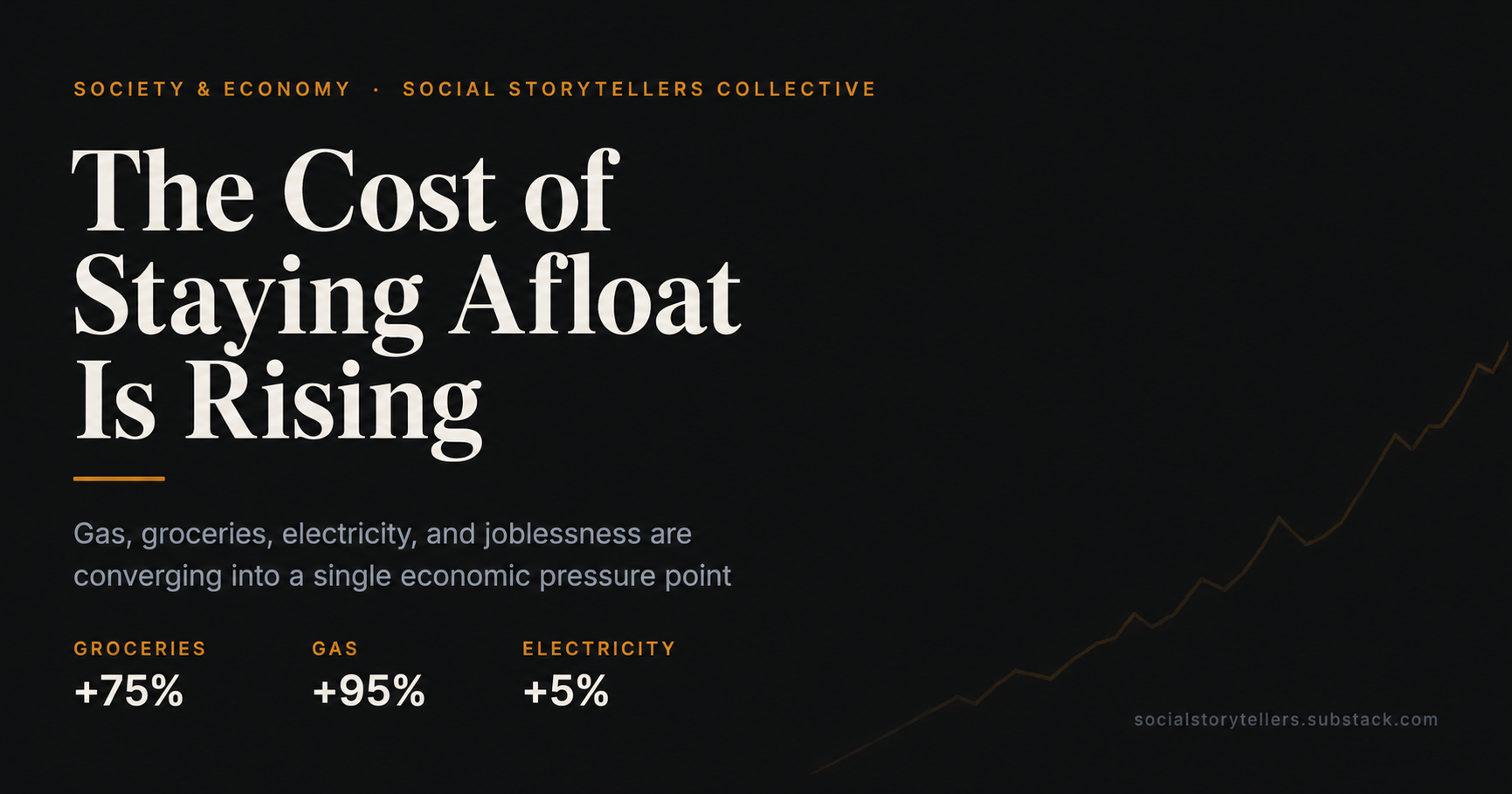
My grocery budget used to run about $200 every two weeks. Same stores, same items, same list. It’s now $350. My gas tank used to cost $40 to fill. It’s now $78 — almost double. I didn’t change my habits. The baseline changed around me. And when I started looking at the data behind what I was feeling at the register and the pump, I realized this wasn’t personal misfortune. It was a pattern — showing up across every essential category at the same time, hitting the same households hardest, in the costs that cannot be cut, deferred, or substituted away.
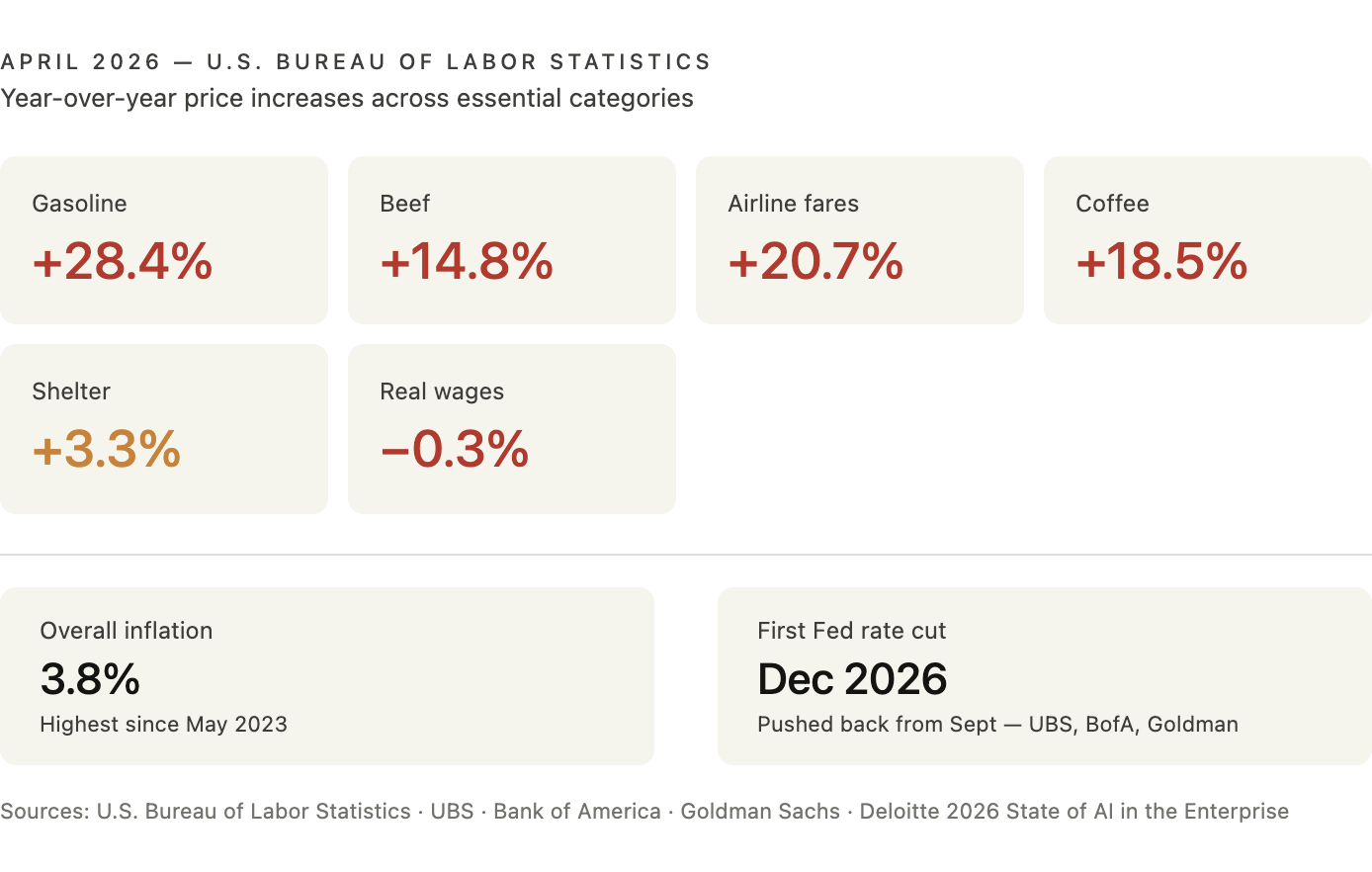
The U.S. Bureau of Labor Statistics confirmed it this month. April 2026 inflation came in at 3.8% year-over-year — the highest reading since May 2023. Real wages fell 0.3% annually over the same period. Americans are earning more on paper and buying less in reality. That gap is not an abstraction. It is what a budget that used to work feels like when it no longer does.
The Iran war accelerated what was already in motion, but it did not start it. Economist Ken Foster noted that most of what we are seeing in the food price chain predates the conflict — and the data supports that. Extreme weather has been compressing food costs for over a year. Beef prices surged 15% in April compared to the same period last year, driven largely by drought in the Western U.S. Global coffee production took a similar hit, pushing prices up 18.5% year-over-year. When the conflict disrupted energy supply chains, it landed on top of a system that was already strained. Gasoline is now up 28.4% annually. Beef up 14.8%. Airline fares up 20.7%. Shelter costs up 3.3%. This is not a single-sector problem. It is compression across every category households cannot opt out of — hitting simultaneously, at a moment when there was no margin left to absorb it.
The political context matters here, and SSC is not going to sidestep it. When asked directly about the financial situation of American families, Donald Trump said: “I’m not thinking about the financial situation of Americans. I’m not thinking about anyone.” His stated priority is preventing Tehran from acquiring a nuclear weapon. That is a national security argument that can be made on its own terms. But the economic consequences of that posture do not distribute themselves evenly. Lower-income households spend a higher share of income on fuel and food, which means every percentage point of energy-driven inflation lands on them with disproportionate weight. The people absorbing the most of this cost are the ones with the least capacity to absorb any of it.
Federal Reserve relief is not arriving anytime soon. Wall Street has already adjusted its expectations — UBS pushed its first projected rate cut back to December 2026, with a second not expected until March 2027. Bank of America and Goldman Sachs made similar revisions this week, all pointing to the same driver: inflation that is persistent because energy prices are persistent. The Fed will not cut while inflation runs hot, which means elevated borrowing costs sit on top of rising essential prices with no near-term release. That is the double squeeze — costs climbing, relief delayed, and no structural intervention visible before year-end.
Geopolitics has always carried an economic price. What this moment makes clear is that the price is never distributed by the same logic as the decision that creates it. The people making the call on Iran are not the ones paying more for beef, coffee, and gas every week. That asymmetry — between who decides and who absorbs — is the throughline in every inflation report, every Fed revision, and every receipt that rings up higher than it should. The numbers have been telling this story for months. The question is whether the people responsible for the policy are listening.